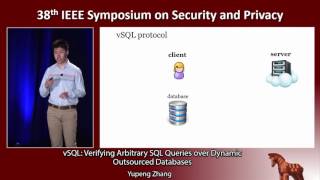
vSQL: Verifying Arbitrary SQL Queries over Dynamic Outsourced Databases
Explore verifiable SQL queries on outsourced databases with vSQL, a cryptographic protocol offering efficient verification and improved server performance compared to existing solutions.
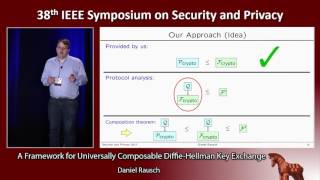
A Framework for Universally Composable Diffie-Hellman Key Exchange
Explore a framework for universally composable Diffie-Hellman key exchange, simplifying analysis of real-world protocols and reducing the need for complex reduction proofs in cryptographic security.
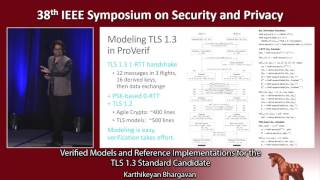
Verified Models and Reference Implementations for the TLS 1.3 Standard Candidate
Comprehensive analysis of TLS 1.3 Draft-18, addressing security concerns, verifying computational security, and extending guarantees to implementations through symbolic and computational models.
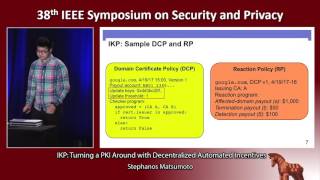
Turning a PKI Around with Decentralized Automated Incentives
Explore automated responses to unauthorized certificates and incentives for improved PKI security through blockchain-based consensus and smart contracts.
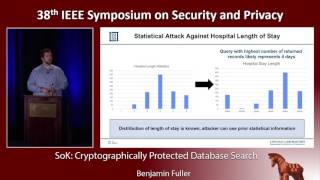
Cryptographically Protected Database Search
Exploration of cryptographically protected database search systems, analyzing primitive operations, current implementations, potential attacks, and future directions for enhancing data security and functionality.
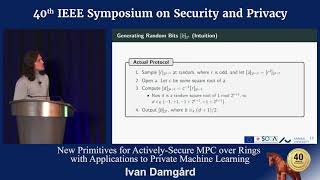
New Primitives for Actively-Secure MPC over Rings with Applications to Private Machine Learning
Explore new primitives for secure multi-party computation over rings, with applications to private machine learning. Efficient protocols for equality test, comparison, and truncation are presented and benchmarked.
Spectre Attacks Exploiting Speculative Execution
Explore speculative execution vulnerabilities in modern processors, their impact on system security, and potential countermeasures to protect against Spectre attacks.
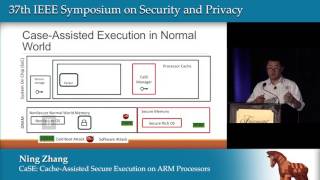
CaSE- Cache-Assisted Secure Execution on ARM Processors
Secure execution framework for ARM processors using TrustZone and Cache-as-RAM to protect sensitive applications against software attacks and cold boot attacks, with minimal performance impact.
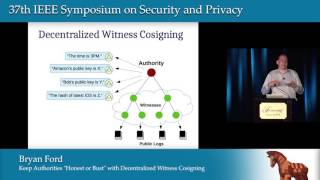
Keeping Authorities "Honest or Bust" with Decentralized Witness Cosigning
Explore decentralized witness cosigning to enhance authority security, prevent undetected exploits, and ensure public scrutiny of authoritative statements through scalable collective signatures.
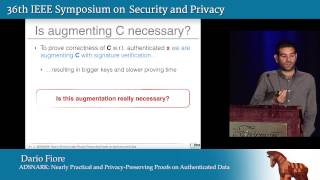
ADSNARK: Nearly Practical and Privacy-Preserving Proofs on Authenticated Data
Explore privacy-preserving proofs on authenticated data, focusing on ADSNARK's improved efficiency in proof computation and storage for third-party verification without data access.
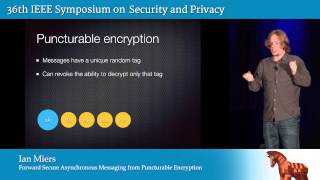
Forward Secure Asynchronous Messaging from Puncturable Encryption
Explore forward secure encryption in messaging systems using puncturable encryption, allowing recipients to update decryption keys without sender communication. Practical implementation and performance analysis included.
ZeeStar - Private Smart Contracts by Homomorphic Encryption and Zero-Knowledge Proofs
Explore innovative privacy techniques for smart contracts using homomorphic encryption and zero-knowledge proofs, enhancing security and confidentiality in blockchain applications.
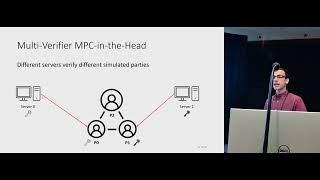
Sabre- Sender-Anonymous Messaging with Fast Audits
Explore sender-anonymous messaging with Sabre, featuring fast audits, secure multiparty computation, and distributed point functions. Learn about denial of service resistance and Sabre-M for express messaging.
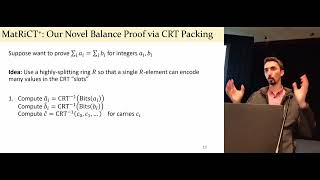
MatRiCT+: More Efficient Post-Quantum Private Blockchain Payments
Explore post-quantum blockchain privacy with MatRiCT+, featuring lattice-based cryptography, balance proofs, and innovative approaches for enhanced efficiency and security in digital payments.
Private Nearest Neighbor Search with Sublinear Communication and Malicious Security
Explore secure and efficient private nearest neighbor search techniques, focusing on sublinear communication and protection against malicious adversaries in two-party computation scenarios.
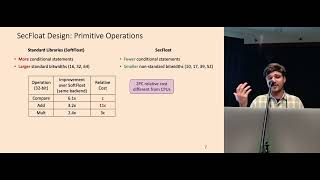
SecFloat- Accurate Floating-Point Meets Secure 2-Party Computation
Explore SecFloat, a novel approach combining accurate floating-point arithmetic with secure two-party computation, enhancing privacy-preserving data analysis and machine learning.
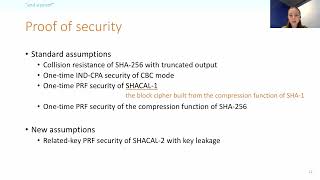
Four Attacks and a Proof for Telegram
Explore cryptographic vulnerabilities in Telegram's MTProto 2.0 protocol, including symmetric channel attacks, related key issues, and implementation flaws. Learn about security models and proofs for messaging apps.
Post-Quantum WireGuard
Explore post-quantum cryptography in WireGuard, covering core handshake security, computational models, and key confidentiality for enhanced network protection.
Did You Mix Me? Formally Verifying Verifiable Mix Nets in Electronic Voting
Explore formal verification of mix nets in electronic voting, focusing on cryptographic properties, software independence, and machine-checked proofs for enhanced security and transparency.
Keep the Dirt- Tainted TreeKEM, Adaptively and Actively Secure Continuous Group Key Agreement
Explore Tainted TreeKEM, an innovative approach to secure continuous group key agreement, offering adaptive and active security while maintaining efficiency.
Epochal Signatures for Deniable Group Chats
Explore secure group chat protocols with epochal signatures, focusing on deniability, ephemeral keys, and hidden interactions for enhanced privacy and security.