Concentration Bounds for Quantum States and QAOA Limitations
Delve into quantum state concentration bounds, exploring limitations of QAOA through polynomial approximations and their implications for shallow circuits and dense Hamiltonian evolution.
Quantum Algorithms and the Power of Forgetting - The Welded Tree Problem
Explore quantum algorithms and the welded tree problem through groundbreaking research that reveals why quantum computations must sometimes "forget" their paths to achieve exponential speedup.
Quantum Mass Production Theorems - Implementing Multiple Copies of Quantum Circuits
Delve into quantum circuit optimization through mass production theorems, exploring efficient implementations of multiple copies of quantum transformations and their theoretical implications.
Guaranteed Efficient Energy Estimation of Quantum Many-Body Hamiltonians Using ShadowGrouping
Discover a novel approach to quantum energy estimation through ShadowGrouping, offering improved accuracy for molecular ground-state calculations and variational quantum algorithms.
Improved Product-state Approximation Algorithms for Quantum Local Hamiltonians
Delve into advanced algorithms for approximating ground state energy and free energy in quantum local Hamiltonians, exploring new techniques for dense systems and sparse graphs with fixed minor exclusions.
Improved Algorithm and Lower Bound for Variable Time Quantum Search
Discover advances in variable time quantum search algorithms, featuring improved complexity bounds and simplified implementation methods for quantum information processing systems.
Influences of Fourier Completely Bounded Polynomials and Classical Simulation of Quantum Algorithms
Delve into quantum query algorithms through new polynomial characterizations, exploring influential variables in Fourier completely bounded polynomials and their implications for classical simulations.
Classical Simulation of Short-Time Quantum Dynamics
Explore classical algorithms for simulating quantum dynamics, focusing on local observables and Loschmidt echo calculations in polynomial time for short-time quantum systems.
A Graphical #SAT Algorithm for Formulae with Small Clause Density
Explore a novel graphical approach to solving #SAT problems using ZH-calculus, focusing on Boolean satisfiability with small clause density and its applications in quantum circuit analysis.
Approximate Degree Lower Bounds for Oracle Identification Problems
Delve into quantum computing theory through an exploration of approximate degree lower bounds in oracle identification problems, focusing on ordered search and hidden string challenges.

Wisening Assertions: A Live Bayesian Reasoning System for Probabilistic Correctness
Explore a novel approach to run-time assertions that balances robustness and scalability, gradually transitioning from "on" to "off" as confidence in code correctness increases over time.

Efficient Matching of Regular Expressions with Lookaround Assertions
Explore efficient matching of regular expressions with lookaround assertions, including formal semantics, simplification properties, and a new O(m·n) algorithm using oracle-NFAs for improved performance.
On the Instance Optimality of Detecting Collisions and Subgraphs
Explore instance optimality in detecting collisions and subgraphs, examining how structural knowledge impacts algorithm efficiency for various detection tasks in functions and graphs.
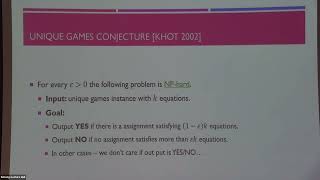
How Efficiently Can We Solve Unique Games? - Lecture
Explore the computational complexity of Unique Games and their efficient solutions in this insightful talk by Yotam Dikstein.
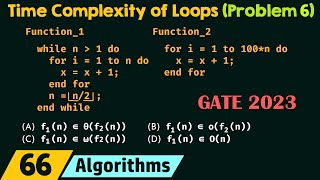
Time Complexity of Loops - Solved Problem 6
Analyze time complexity of loops through a GATE 2023 problem, enhancing algorithm understanding and problem-solving skills for computer science students.
Why Study Quantum Computing? - Lesson 100 of Quantum Computer Programming in 100 Easy Lessons
Explore the significance and potential of quantum computing in this thought-provoking conclusion to a comprehensive series on quantum programming.

Why Retrieval Augmented Generation (RAG) is Overrated
Explore the limitations of Retrieval Augmented Generation (RAG), including hallucinations, complexity, and cost. Learn practical approaches to make RAG more effective in AI applications.

The Art and Craft of Large-scale Quantum Error-correction Simulations
Explore large-scale quantum error-correction simulations with insights from Nord Quantique researcher Maxime Tremblay at QHack 2023.
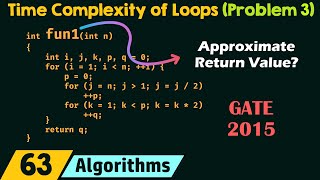
Time Complexity of Loops - Solved Problem 3
Solve a GATE 2015 problem on time complexity of loops, enhancing your algorithm analysis skills for competitive programming and software engineering interviews.
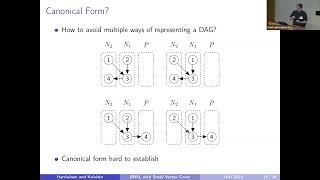
Revisiting Bayesian Network Learning with Small Vertex Cover
Explore Bayesian network structure learning with bounded vertex cover, analyzing complexity bounds and hardness results for optimization and counting problems.

On Inference and Learning With Probabilistic Generating Circuits
Explore efficient inference algorithms for Probabilistic Generating Circuits, addressing computational challenges and discussing implications for learning from data in probabilistic modeling.