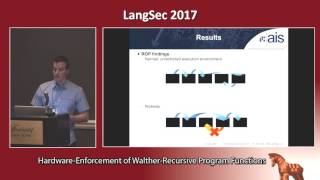
Hardware-Enforcement of Walther-Recursive Program Functions
Explore hardware-enforced restrictions on computational complexity using JIT compilation and Intel's Processor Tracing to improve security through limited return-oriented programming.
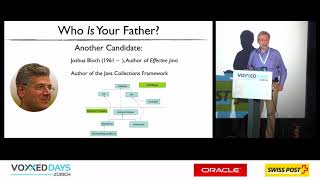
Not Your Father's Complexity - Performance in a New Machine Age
Explore memory layout's impact on Java program performance, challenging traditional complexity analysis and showcasing alternative collection implementations for optimized code execution.
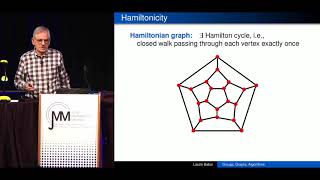
Groups, Graphs and Algorithms
Explore the intersection of group theory, graph theory, and algorithms with László Babai, delving into topics like graph irregularity, canonical coloring, and string isomorphism.
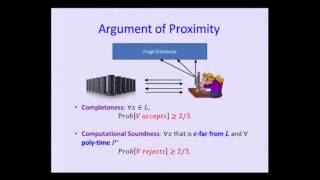
Arguments of Proximity
Explore sublinear-time verification, interactive proofs of proximity, and arguments of proximity in cryptography, focusing on bounded depth computation and recent advancements.
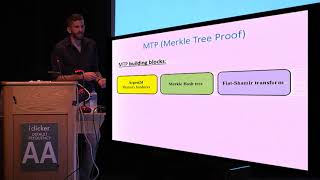
Time Memory Tradeoff Attacks on the MTP Proof of Work Scheme
Explore time-memory tradeoff attacks on MTP proof of work, covering memory-hard functions, Merkle hash trees, and computational complexity in blockchain security.
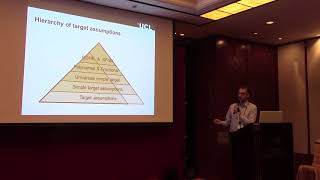
Towards a Classification of Non-Interactive Computational Assumptions in Cyclic Groups
Explore non-interactive computational assumptions in cyclic groups, covering families, variants, and hierarchies. Gain insights into cryptographic foundations and their classifications.
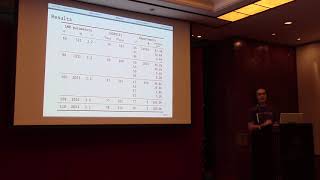
Revisiting the Expected Cost of Solving uSVP and Applications to LWE
Explores the expected cost of solving unique Shortest Vector Problem (uSVP) and its applications to Learning with Errors (LWE), providing insights for cryptographic security assessments.
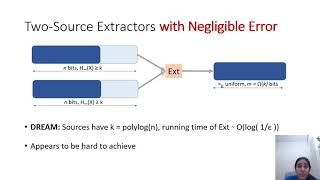
Low Error Efficient Computational Extractors in the CRS Model
Explore efficient computational extractors with low error in the CRS model, covering weak sources, two-source extractors, and non-malleable extractors. Gain insights into cutting-edge cryptographic research.
How to Sort Your Socks Using JavaScript
Explore sorting algorithms in JavaScript engines, understanding their implementation, performance, and practical applications for creating efficient and consistent applications.
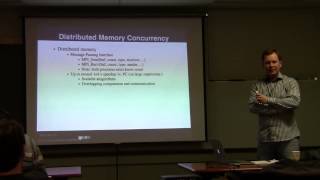
C++ in Space Plasma Model Development
Explore space plasma modeling using C++11, covering numerical methods, advanced algorithms, and concurrency for efficient simulations in astrophysics and space weather.
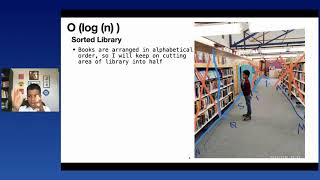
Computational Complexity Theoretical Foundation on How Long Will Program Run
Explore computational complexity with 7-year-old programmer Kautilya Katariya. Learn time complexity, Big-O notation, and algorithm analysis through searching and sorting examples. Gain insights from the youngest Guinness World Record holder.
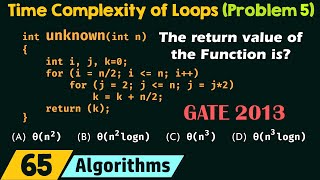
Time Complexity of Loops - Solved Problem 5
Analyze time complexity of loops through a GATE 2013 problem. Master algorithm efficiency evaluation techniques for improved problem-solving skills.
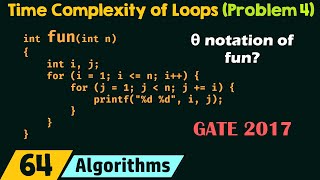
Time Complexity of Loops - Solved Problem 4
Solve a GATE 2017 problem on time complexity of loops, enhancing your algorithm analysis skills for competitive programming and software engineering interviews.
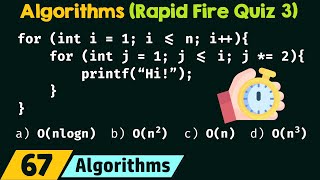
Algorithms - Rapid Fire Quiz 3 on Time Complexity of Loops
Test your algorithm knowledge with 12 rapid-fire questions on time complexity of loops. Sharpen your problem-solving skills and deepen your understanding of algorithmic efficiency.
Synthesis and Verification of Finite Horizon Tasks
Explore finite horizon task synthesis and verification techniques, focusing on model and system creation for time-bounded objectives in computational systems.
Physical Limits to Cognition - How I Learned to Stop Worrying and Love Black Hole Thermodynamics
Explore the intersection of information theory, cognitive science, and black hole thermodynamics to understand fundamental limits of physically-embodied computational systems and cognitive processes.
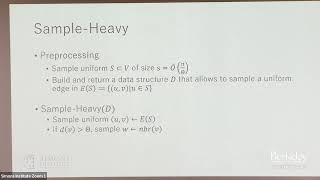
Sampling Multiple Edges Efficiently
Dive into efficient algorithms for sampling multiple edges in graphs, exploring innovative techniques and mathematical frameworks presented by MIT researcher Talya Eden.
Sublinear Algorithms and Complexity Theory Vignettes
Explore key concepts and applications of sublinear algorithms through practical vignettes, focusing on efficient computational methods and algorithmic complexity.
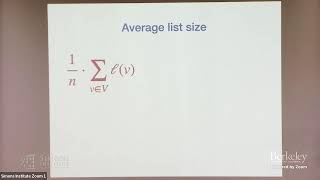
Simple Sublinear Algorithms for Vertex Coloring
Dive into advanced graph theory concepts and efficient vertex coloring algorithms, exploring sublinear approaches for optimizing computational complexity.
Performance and Limitations of QAOA at Constant Levels on Large Sparse Hypergraphs and Spin Glass Models
Delve into quantum algorithm analysis, exploring QAOA's performance limitations on large hypergraphs and spin glass models through theoretical frameworks and mathematical proofs.

Fundamental Limitation on the Detectability of Entanglement in Quantum Systems
Delve into quantum entanglement detection limitations, exploring theoretical trade-offs between efficiency and effectiveness in quantum systems, with focus on single-copy and multi-copy measurements.