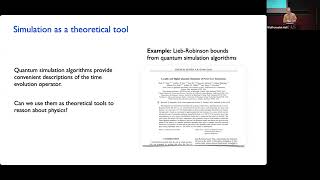
Digital Quantum Simulation Algorithms
Explore cutting-edge digital quantum simulation algorithms with expert Andrew Childs, delving into advanced techniques for modeling complex quantum systems.

Mathematical Problems in Machine Learning - Lecture 4/4
Explore advanced mathematical concepts in machine learning, focusing on complex problem-solving techniques and theoretical foundations.

Mathematical Problems in Machine Learning - Lecture 3/4
Explore mathematical challenges in machine learning with Andrea Montanari, delving into advanced concepts and problem-solving techniques.

Mathematical Problems in Machine Learning - Lecture 2/4
Explore mathematical challenges in machine learning, focusing on advanced concepts and problem-solving techniques in this comprehensive lecture series.
High-Dimensional Convexity: Testing, Learning, and Complexity
Explore the fascinating parallels between high-dimensional convex sets and monotone Boolean functions, examining algorithmic structures and mathematical complexities in Gaussian space.

Checking the Fraction of Satisfying Assignments for 3CNF
Explore computational complexity theory through an analysis of satisfying assignments in 3CNF formulas, based on recent research developments and mathematical proofs.
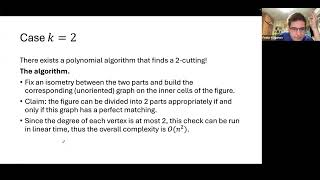
Cutting Figures into Equal Parts Using Grid Lines and SAT Solvers - May 27, 2024
Explore computational techniques for solving geometric cutting problems using SAT solvers, with practical applications in grid-based figure partitioning and combinatorial optimization.

Divide and Conquer Algorithm Design - Design and Analysis of Algorithms
Master divide and conquer algorithms through practical examples. Enhance problem-solving skills and optimize algorithmic design for efficient solutions in computer science and programming.
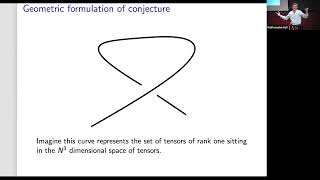
Lower Bound Barriers in Complexity Theory and Overcoming Them With Geometry
Explore the evolution of complexity theory's lower bound barriers through geometric perspectives, from linear algebra to advanced mathematical concepts in algebraic geometry and representation theory.
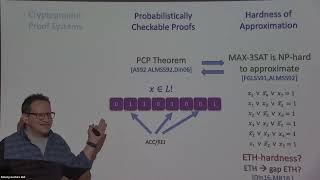
Dot-Product Proofs for Circuit Satisfiability and Cryptographic Systems
Delve into probabilistic proof systems and dot-product proofs, exploring their applications in circuit satisfiability, MAX-LIN approximation, and cryptographic verification complexity.
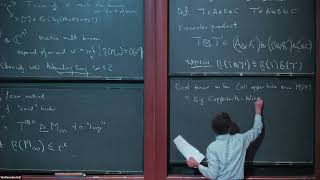
Tensors of Minimal Border Rank and Their Role in Matrix Multiplication Complexity
Delve into advanced algebraic geometry concepts exploring minimal border rank tensors and their crucial role in matrix multiplication complexity theory and computational mathematics.
A Reverse Minkowski Theorem in Lattice Theory and Geometry
Explore the groundbreaking reverse Minkowski theorem and its applications in complexity theory, cryptography, and algorithms, building on fundamental concepts in geometry of numbers.
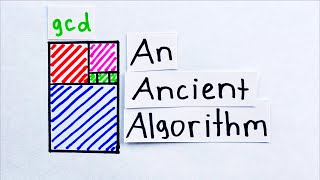
Finding the Greatest Common Factor Using Euclid's Algorithm
Master Euclid's algorithm for finding greatest common divisors, from its historical origins to modern applications in solving diophantine equations, with proven computational efficiency methods.
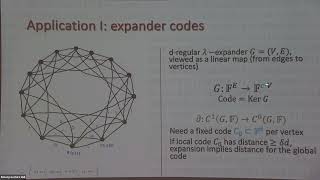
Local-to-Global Theorems on High Dimensional Expanders
Explore high dimensional expansion theory, from graph fundamentals to complex applications in error-correcting codes and PCPs, focusing on how local properties influence global behaviors in mathematical structures.

Sequential Decision Making Under Uncertainty - Information Asymmetry in AI Systems
Delve into sequential decision-making under uncertainty, exploring persuasion and mechanism design in information asymmetry scenarios, with applications to AI and dynamic modeling frameworks.