Quantum Advantages in Energy Minimization - IPAM at UCLA
Explore quantum advantages in energy minimization, including QAOA for spin glasses and finding local minima in quantum systems. Gain insights into potential quantum computing benefits over classical methods.
Have We Seen a Demonstration of Experimental Quantum Advantage? - IPAM at UCLA
Explore the latest claims of quantum advantage, examining evidence for classical hardness and discussing gaps between theory and experiment in near-term quantum circuit experiments.
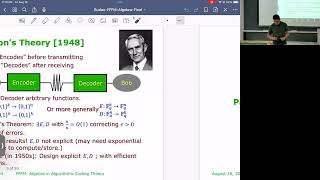
Algebra in Algorithmic Coding Theory
Explore algebraic techniques in algorithmic coding theory, focusing on error-correcting codes and their applications in computer science and information theory.
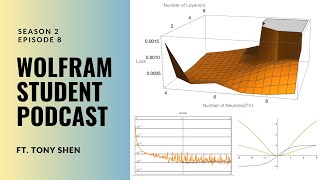
Evaluating Complexity for Neural Nets in Learning Math Functions
Explore neural net complexity's impact on learning math functions through criteria analysis and optimization techniques.

Efficient CHAD - Optimizing Combinatory Homomorphic Automatic Differentiation
Optimizar el algoritmo CHAD para diferenciación automática en modo reverso, logrando la complejidad computacional esperada mediante técnicas funcionales y paralelismo.
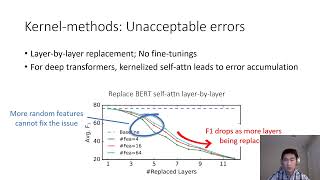
The NLP Task Effectiveness of Long-Range Transformers
Explore the effectiveness of long-range Transformer variants on NLP tasks, comparing their performance and analyzing attention behaviors to uncover strengths and limitations.
Subgroup Tests and Tailored Non-local Games - Lecture on Interactive Proof Systems
Explore advanced concepts in interactive proof systems, refuting the Aldous-Lyons conjecture through subgroup tests and tailored non-local games.
Extroverted Sublinear Algorithms
Explore extroverted sublinear algorithms with Google Brain researcher Ilya Mironov, delving into innovative computational techniques for efficient data processing and analysis.
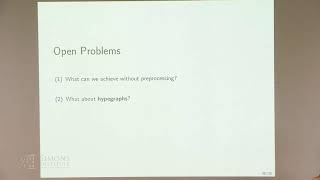
Linear and Sublinear Algorithms for Graphlet Sampling
Explore efficient algorithms for graphlet sampling, including linear and sublinear preprocessing techniques, with applications to semi-streaming and MPC settings.
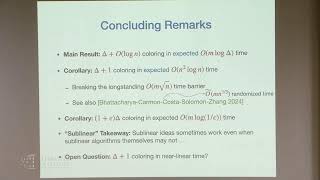
Sublinear Insights: A Faster Classical Algorithm for Edge Coloring
Explores a novel randomized algorithm for near-linear time graph edge coloring, improving on decades-old methods. Discusses implications for Vizing's theorem and dense graph coloring efficiency.
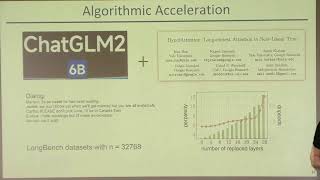
Long-context Attention in Near-Linear Time
Explores HyperAttention, an innovative approach to tackle computational challenges in long-context LLMs, offering significant speed improvements while maintaining performance across various datasets.
Sublinear-Time Algorithms in Learning
Explore cutting-edge sublinear algorithms for efficient machine learning, focusing on extroverted approaches and their applications in large-scale data analysis.
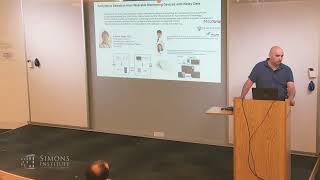
Applications of Sub-linear Algorithms in Other Fields
Explore how sub-linear algorithms impact diverse fields, enhancing efficiency and scalability in data analysis and problem-solving across disciplines.
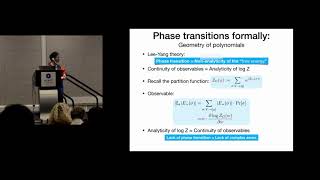
A Deterministic Algorithm for Counting Colorings with 2Δ Colors
Explore a deterministic algorithm for counting colorings, delving into phase transitions, partition functions, and entropy conditions in graph theory.
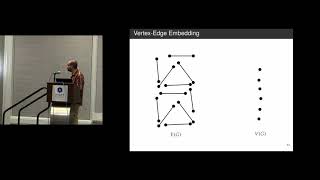
Inapproximability of Clustering in Lp Metrics
Explores computational complexity of clustering in Lp metrics, discussing approximation algorithms, hardness of approximation, and key concepts like Johnson Coverage Hypothesis.
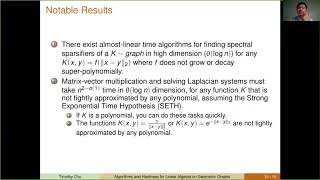
Algorithms and Hardness for Linear Algebra on Geometric Graphs
Explore algorithms and hardness for linear algebra on geometric graphs, focusing on K and K-graphs, sparsifiers, matrix-vector multiplication, and Hamming nearest neighbor problems.
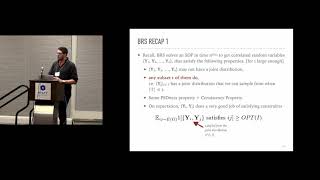
Approximating Constraint Satisfaction Problems on High Dimensional Expanders
Explore high-dimensional expanders and their role in approximating constraint satisfaction problems, with insights on natural collections and general expanders.
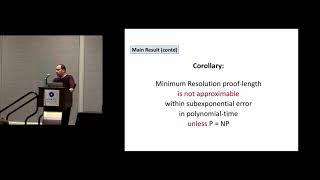
Automating Resolution is NP-Hard
Explore the complexity of automating resolution in proof systems, including key developments, positive and negative results, and implications for computational theory.
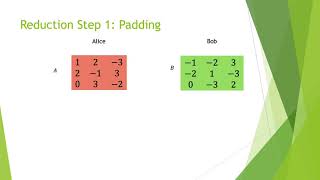
Smoothed Complexity of 2-player Nash Equilibria
Explore smoothed complexity in 2-player Nash equilibria, covering algorithmic hardness, approximation challenges, and novel approaches to finding equilibria in perturbed games.
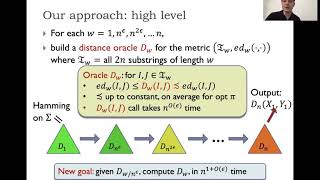
Edit Distance in Near-Linear Time - It’s a Constant Factor
Explore efficient algorithms for computing edit distance, focusing on near-linear time solutions and constant factor improvements in computational complexity.
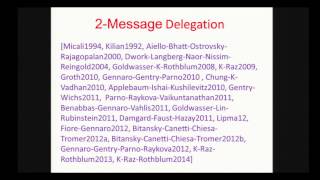
How to Delegate Computations - The Power of No-Signaling Proofs
Explore the concept of delegating computations and the significance of no-signaling proofs in cryptography, presented by expert Yael Tauman Kalai at Crypto 2014.