Known Boundary Emulation of Complex Computer Models - Ian Vernon, Cambridge
Explore efficient methods for emulating complex computer models using Known Boundary Emulation, focusing on uncertainty quantification and applications in climate, tsunami, and earthquake problems.

Pragmatically Ambitious Multiscale Global Temperature Reconstruction - Finn Lindgren, Edinburgh
Explore pragmatic approaches to global temperature reconstruction using multiscale models, data sources, and statistical techniques for uncertainty quantification and bias correction.
Chance and Chaos - How to Predict the Unpredictable by Jens Marklof
Explore chaos theory, unpredictability, and mathematical tools for analyzing chaotic systems. Discover applications in weather forecasting, statistical physics, and everyday phenomena like coin tosses and bread kneading.
Causal Inference for Earth System Sciences - Jakob Runge
Exploring causal inference techniques for Earth system sciences, focusing on advanced methods to uncover complex relationships in climate data and improve understanding of multi-scale processes.
Statistics for Complex Climate Problems
Explore statistical approaches for addressing complex climate issues, focusing on advanced techniques and their applications in environmental research and policy-making.
The Role of Mathematics in Solving the World's Main Challenges
Explore how mathematics and computation contribute to understanding climate, energy, the cosmos, and life itself through TED-style talks by renowned computational scientists.

Efficient and Effective Calibration of Spatio-Temporal Models - Dan Williamson & James Salter, Exeter
Explore efficient calibration techniques for spatio-temporal models, focusing on uncertainty quantification and Gaussian Process emulation in complex physical systems like climate and natural disasters.
High-Dimensional Hierarchical Models for Large-Scale Geophysical Applications
Explore high-dimensional hierarchical models for geophysical applications, focusing on uncertainty quantification and Gaussian Process emulation in complex physical systems.
Bayesian Inference - Lecture 2
Explore Bayesian inference principles, methods, and applications in data assimilation for weather and climate modeling. Gain insights into uncertainty estimation and practical implementation.
Linear Algebra - Part I
Explore fundamental concepts of linear algebra, including vector spaces, matrices, and linear transformations, laying the groundwork for advanced mathematical applications.
Linear Algebra II
Explore advanced linear algebra concepts and their applications in data analysis, machine learning, and scientific computing. Enhance problem-solving skills and mathematical reasoning.

Collaborating with Mathematicians on Major Societal Challenges - Session B02
Explore interdisciplinary collaborations between mathematicians and physicists addressing societal challenges, from quantum computing to climate science, through talks by leading researchers.
Randomness in Dynamical Systems - Lecture 2
Explores randomness in dynamical systems, focusing on geophysical fluid dynamics. Covers theoretical concepts and practical applications in climate modeling and atmospheric-oceanic interactions.
Randomness in Dynamical Systems - Lecture 1
Explore randomness in dynamical systems, focusing on its role and implications in geophysical fluid dynamics and climate modeling. Learn about stochastic aspects and their impact on system behavior.
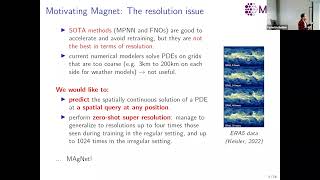
MAgNet: Mesh Agnostic Neural PDE Solver
Explore innovative neural PDE solver for accurate, scalable climate predictions. Learn about mesh-agnostic architecture combining Implicit Neural Representations and Graph Neural Networks.

Mathematics: A Tool Kit to Tackle Climate Change
Explore how mathematics can combat climate change with Dr. Emily Shuckburgh. Learn about modelling localized effects like floods, droughts, and extreme weather to tackle this pressing global issue.
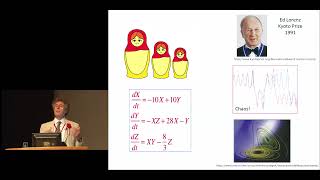
From Determinism to Probability: Development of the Ensemble Prediction Technique for Weather and Climate Forecasting
Discover how ensemble prediction revolutionized weather forecasting by transforming deterministic methods into probabilistic approaches, enhancing forecast reliability and decision-making in meteorology.
Oceans in a Warming Climate - Understanding Sea Level Rise and Climate Projections
Explore ocean physics in climate change, focusing on sea level patterns and improving climate simulations through machine learning and physics integration for more accurate projections.
Debiasing Coarse-Scale Climate Models Using Statistically Consistent Neural Networks
Explores using neural networks to improve coarse-scale climate models, addressing unresolved scales and enhancing predictions. Discusses framework, wavelet analysis, and multi-model architecture for more accurate climate simulations.
A Deep Learning Parameterization of Gravity Wave Drag Coupled to an Atmospheric Global Climate Model - Aditi Sheshadri
Explores deep learning parameterization of gravity wave drag in climate models, demonstrating improved predictions of atmospheric phenomena like the QBO and potential for generalizing to future climate scenarios.
Contained Chaos - Ensemble Consistency Testing for the Community Earth System Model
Explore ensemble consistency testing for climate models, focusing on the Community Earth System Model. Learn about statistical methods to evaluate model changes and ensure software quality in climate simulations.