Scaling Batch, Big Data, and AI Workloads Beyond the Kubernetes Scheduler
Explore solutions for scaling AI, big data, and batch workloads on Kubernetes. Compare projects like Koordinator, Kueue, MCAD, Volcano, and YuniKorn to optimize cluster utilization and overcome scheduling challenges.
Coresets and Their Applications to Design Sublinear Algorithms
Explore coresets and their role in designing efficient sublinear algorithms, enhancing computational performance for large-scale data analysis and machine learning tasks.
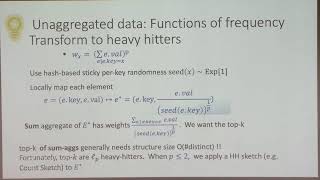
Sampling Big Ideas in Sublinear Algorithms
Explore random sampling techniques for enhancing data analysis scalability, focusing on weighted and coordinated sampling schemes for streamed or distributed data.
Strengthening Apache Pinot's Query Processing Engine - Adaptive Server Selection and Runtime Query Killing
Enhancing Apache Pinot's query processing with intelligent routing and runtime query killing for improved resiliency and performance in large-scale distributed OLAP database deployments.

Dwell Time Analysis with Computer Vision - Real-Time Stream Processing
Optimize processes using computer vision for wait time analysis. Learn object detection, tracking, and time calculation in zones to enhance customer experience and improve efficiency.
Fink on Kubernetes - Efficient Management of Massive Alert Streams for Astronomical Object Identification
Explore how Kubernetes enables real-time processing of massive astronomical data streams, facilitating scientific discoveries through cloud-based infrastructure and distributed computing frameworks.
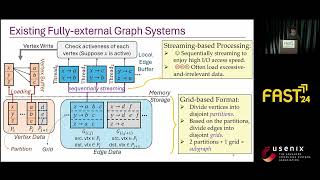
Seraph: Scalable and Efficient Fully-External Graph Computation via On-Demand Processing
Explores Seraph, a novel fully-external graph computation system that balances scalability and efficiency through on-demand processing, hybrid data formats, and selective pre-computation.

Generative AI for Data Platforms - Cutting to the Chase
Explore AI-infused lakehouses: integrating generative AI with data platforms for enhanced code generation, natural language queries, and semantic search. Includes live demo of IoT event processing.
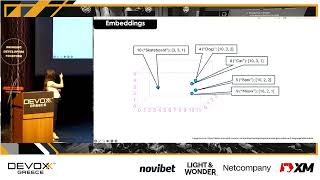
Unleashing the GenAI Magic - Building a Chatbot for Traders with Generative AI
Explore the creation of a trader-focused chatbot using Generative AI, covering prompt engineering, Retrieval Augmented Generation, and unconventional tech choices for robust, scalable solutions.
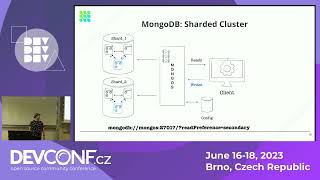
Change Data Capture for Non-Relational Databases
Explore Debezium for real-time data streaming with MongoDB. Learn deployment topologies, outbox pattern implementation, and building scalable architectures for efficient data synchronization.
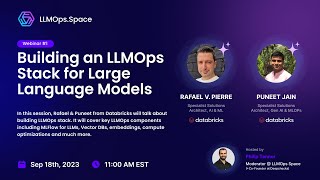
Building an LLMOps Stack for Large Language Models
Explore LLMOps architecture: MLFlow for LLMs, Vector Databases, RAG strategies, and prompt evaluation. Gain insights into optimizing and deploying large language models effectively.
ML and MLOps with Databricks: LLMOps, MLFlow, Transformers, and Databricks
Explore LLMOps, MLFlow, and Databricks for advanced machine learning operations. Master transformers and enhance your data science skills.
MLOps MLFlow: MLflow Projects with PySpark Docker Environments
Explore MLflow Projects with PySpark in Docker, utilizing Databricks for artifact storage and tracking in MLOps workflows.
MLFlow Projects: Dockerized Environments in MLflow
Explore MLflow projects using Docker environments and Databricks for artifact repository and tracking in MLOps workflows.
MLOps: Databricks MLFlow and Optuna Hyper-parameter Tuning
Optimize XGBoost models using Databricks, MLflow, and Optuna for efficient hyperparameter tuning and improved machine learning workflows.
MLOps: Databricks and MLFlow Hyper-parameter Tuning for XGBoost Models
Optimize machine learning models using Databricks and MLflow for hyperparameter tuning with XGBoost and HyperOpt.
LLMOps with Langchain, OpenAI, and Faiss on Databricks - Creating a Retrieval QA Tool
Develop a Retrieval QA tool using Langchain, OpenAI, and Faiss. Learn to save components in Databricks' MLFLOW, work with Model Governance, and perform inference after chain retrieval.
ML and MLOps with Databricks: LLMOps, MLFlow, OpenAI, and Databricks
Build a code reviewer using GPT-4, encapsulate it in MLflow, and deploy for inference in Databricks pipelines. Enhance your ML workflow with LLMOps techniques.
Data Extraction with LangChain and OpenAI for Machine Learning and Data Science
Extraer información de fuentes no estructuradas utilizando LangChain y OpenAI para aprendizaje automático y ciencia de datos.
Multimodal Q&A RAG Tool with Gemini for Data Science and Machine Learning
Develop a multimodal Q&A RAG tool using Gemini for unstructured data analysis, enhancing data science and machine learning capabilities.
A Short Summary of the Last Decades of Data Management - GOTO 2024
Explore the evolution of data management over decades, from monolithic systems to open-source engines and cloud computing, examining key trends, successes, and failures in this trillion-dollar industry.