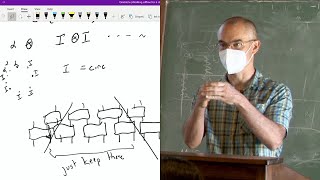
Introduction to Quantum Cellular Automata
Explore quantum cellular automata: fundamental concepts, applications, and connections to topological phases of matter in this comprehensive lecture by Microsoft Research expert.
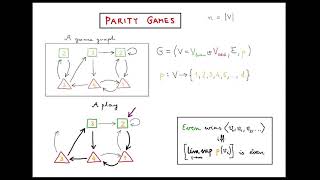
Games: From Logic and Automata to Algorithms
Explore the intersection of logic, automata, and algorithms through game theory, focusing on theoretical foundations and computational applications.
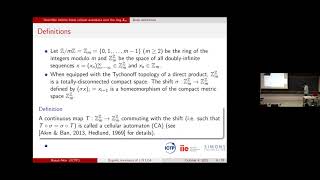
Reversible D-Dimensional CA Over the Ring ZM and Some Applications in Ergodic Theory
Explore cellular automata on $\mathbf{Z}_p$ and $\mathbf{Z}_m$, covering invertibility, ergodic properties, and entropy concepts. Delve into measure-theoretic and topological entropy for 1D linear CA and $\mathbb{Z}^2$-actions.

Arduino-Controlled Rotary Telephone - DIY Escape Room Prop Tutorial
Transform a vintage rotary phone into a versatile escape room prop using Arduino. Learn to wire components, program custom behaviors, and integrate audio for an immersive gaming experience.
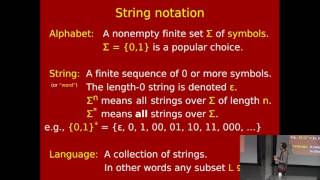
Deterministic Finite Automata
Explore deterministic finite automata, their structure, and applications in computer science. Learn to construct DFAs, understand regular languages, and solve computational problems.
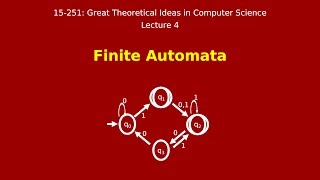
Great Ideas in Theoretical Computer Science: Finite Automata
Explore finite automata and regular languages in theoretical computer science, covering DFAs, computation concepts, and language analysis techniques.
Formal Verification of Embedded Linux Systems Using Trace-Based Models
Explore trace-based models for formal verification of embedded Linux systems, focusing on safety-critical aspects, real-time properties, and system instrumentation techniques.
Text Search Protocols with Simulation Based Security
Explore text search protocols with simulation-based security, covering applications, automata encryption, and evaluation techniques for secure and efficient data retrieval.
PLSE Seminar Series - The Power of Symbolic Automata
Explores symbolic automata, their applications in program verification, and novel decision procedures for equivalence checking and minimization of these powerful automata operating over infinite alphabets.
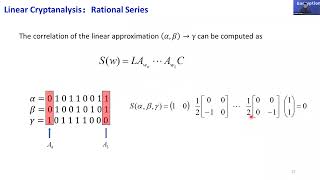
Cryptanalysis of ARX Ciphers - Recent Developments and Open Questions
Explore recent advancements in cryptanalysis of ARX ciphers, covering representation, differential group analysis, automatic methods, and open questions in this comprehensive talk by Siwei Sun.
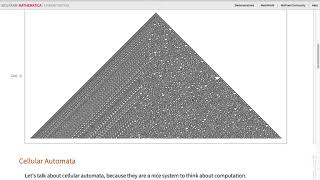
Cellular Automata: Algorithmic Information Dynamics in Living Systems
Explore cellular automata, a computational model for complex systems, and their applications in studying causality and living systems from networks to cells.
Chomsky Normal Form and Conversion of CFG to CNF in Automata Theory
Learn to convert Context-Free Grammars to Chomsky Normal Form, a standardized format for simplifying and analyzing grammars in automata theory. Understand the steps and rules for this important transformation.
Conversion of Regular Expression to Finite Automata Using Subset Method in Automata Theory
Learn to convert regular expressions to finite automata using the subset method, covering NFA construction, epsilon transition removal, and DFA conversion in automata theory.
Conversion of Finite Automata to Regular Expression Using State Eliminating Method in Automata Theory
Learn to convert finite automata to regular expressions using the state elimination method, a crucial technique in automata theory for simplifying complex systems.
Conversion of Finite Automata to Regular Expression Using Arden's Method in Automata Theory
Learn to convert finite automata to regular expressions using Arden's method in automata theory. Explore step-by-step process with examples to master this important concept in theoretical computer science.
Conversion of NFA with Epsilon to NFA Without Epsilon in Automata Theory
Learn to convert NFA with epsilon transitions to NFA without epsilon, a crucial skill in automata theory. Understand the step-by-step process and its importance in simplifying finite automata representations.
Formal Verification Made Easy and Fast
Learn practical approaches to formal verification in Linux kernel development using Finite-State Machines and tracing events, with insights on low-overhead runtime verification techniques.
Mathematical Games - Turing Machines and Turmites - Episode 19
Explore mathematical games and puzzles involving Turing machines and turmites with Ed Pegg Jr. Discover fascinating concepts in computational theory and cellular automata.
An Automata-Based Framework for Verification and Bug Hunting in Quantum Circuits
Explore a novel automata-based approach for analyzing quantum circuits, enabling efficient verification and bug detection in large-scale quantum systems using tree automata and algebraic representations.
Parikh's Theorem Made Symbolic - POPL'24
Explore Parikh's Theorem for symbolic automata, learning efficient algorithms for handling large or infinite alphabets in language processing and constraint solving.
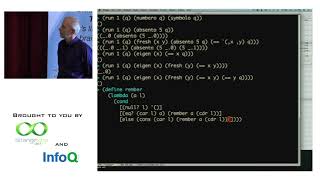
A Relational Exploration of the Chomsky Hierarchy
Explore encoding automata and Turing Machines in miniKanren for relational programming. Learn to generate strings and associated data structures, gaining insights into the Chomsky Hierarchy and automata workings.