Arrays and Matrices II - Data Structures in Mathematics Math Foundations
Explore matrices from traditional linear algebra to a novel data structure approach. Learn matrix multiplication, algebra, and a new perspective using pixels and maxels.
Arrays and Matrices - Data Structures in Mathematics Math Foundations | NJ Wildberger
Introduction to arrays and matrices as 2D data structures, exploring definitions, examples, and extending to 3D arrays. Distinguishes between arrays and matrices, offering a novel approach to linear algebra.
Higher Data Structures - Data Structures in Mathematics Math Foundations
Explore advanced mathematical data structures, including nested combinations of lists, ordered sets, multisets, and sets. Learn their applications in combinatorics, graph theory, and other mathematical fields.
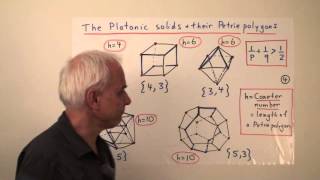
Petrie Polygons of a Polyhedron - Universal Hyperbolic Geometry
Explore Petrie polygons on polyhedra, focusing on Platonic solids. Learn about tesselations, Schlafli symbols, and orthogonal projections in this geometric journey.
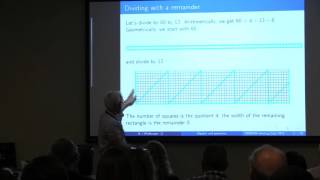
Teaching Connections Between Algebra and Geometry I - A MANSW Presentation
Exploring connections between algebra and geometry, covering topics like Euclidean algorithm, continued fractions, and projective geometry. Aims to revitalize interest in geometry as a core subject for students.
The Rotation Problem and Hamilton's Discovery of Quaternions - Famous Math Problems
Explore complex numbers and their connection to plane rotations, laying the groundwork for understanding quaternions and 3D rotations. Emphasizes a logical, algebraic approach without relying on transcendental functions.

Rational Trigonometry, Generalized Triangle Geometry and Four-Fold Incenter Symmetry
Explores rational trigonometry and generalized triangle geometry, introducing quadrances, spreads, and chromogeometry. Discusses Euler lines, incenters, and various triangle centers, culminating in a novel result on colored incenters.
The Integral of X^n - Famous Math Problems
Explores the integral of x^n, its historical development, and challenges in modern analysis. Proposes a new 'Algebraic Calculus' approach, addressing issues with continuum, infinite processes, and area theory.
Tangent Conics and Tangent Quadrics - Differential Geometry
Exploring advanced calculus concepts through algebraic methods, focusing on tangent conics and quadrics. Offers a fresh perspective on polynomial approximations and their geometric applications.
The Rotation Problem and Hamilton's Discovery of Quaternions - Famous Math Problems
Explore quaternions and their connection to 3D rotations using 2x2 complex matrices. Learn key formulas and visual models for this algebraic structure without relying on transcendental concepts.
Spectral Graph Theory - Eigenvalues at CMU - Lecture 15a of CS Theory Toolkit
Explore eigenvalues of the Laplacian and Markov operator in spectral graph theory, including associated formulas and their applications in theoretical computer science research.
Spectral Graph Theory - Minimizing/Maximizing the Quadratic Form
Explore spectral graph theory, focusing on minimizing and maximizing quadratic forms, with connections to graph components and bipartiteness in this graduate-level lecture.
Spectral Graph Theory - The Quadratic Form
Explores spectral graph theory, focusing on the quadratic form associated with undirected graphs. Covers basic setup and provides examples for graduate-level computer science research.

Algebraic Circuit Complexity
Explore algebraic circuit complexity, including models, formulas, and NP connections in computational complexity theory.
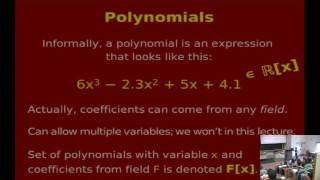
Polynomials
Explore polynomials, from formal definitions to applications in finite fields, interpolation, and error-correcting codes for noisy communication channels.
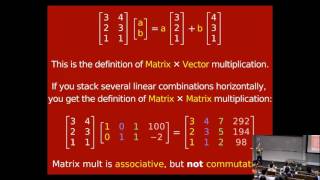
Linear Algebra
Explore vector spaces, linear combinations, and applications in computer science, including Fibonacci sequences and message transmission on noisy channels.
Equations of Lines and Planes in 3D - Wild Linear Algebra A - NJ Wildberger
Explore parametric and Cartesian equations of lines and planes in 3D space, including novel concepts like describing all 2D lines as a Möbius band and using determinants for 3D analysis.
Solving a System of Linear Equations - Wild Linear Algebra A
Explore systems of linear equations, matrix forms, row reduction, and echelon forms. Learn key concepts and techniques for solving complex linear algebra problems efficiently.
Generalized Dilations and Eigenvalues - Wild Linear Algebra A - NJ Wildberger
Explore coordinate systems, basis changes, and similar matrices in linear algebra. Learn about generalized dilations and the fundamental concept of eigenvalues and eigenvectors.
Applications of 3x3 Matrices - Wild Linear Algebra A
Explore 3x3 matrices and their applications in 3D space, covering dilations, reflections, rotations, and projections. Learn key concepts and formulas for linear transformations in three dimensions.
Inverting 3x3 Matrices - Wild Linear Algebra A | NJ Wildberger
Comprehensive exploration of 3x3 matrix inversion, covering determinants, adjoints, and inverse properties. Includes theorem derivations, examples, and exercises for practical application.