Three Dimensional Affine Geometry - Wild Linear Algebra A - NJ Wildberger
Explore 3D affine geometry through parallel projections, coordinate systems, and the distinctions between points, vectors, lines, and planes. Gain insights into space representation and its mathematical foundations.
More Applications of 2x2 Matrices - Wild Linear Algebra A
Explores advanced applications of 2x2 matrices in linear algebra, covering rotations, reflections, composition of transformations, and connections to calculus, with a focus on linear approximations and derivatives.
Change of Coordinates and Determinants - Wild Linear Algebra A
Explore change of coordinates, linear equations, vectors, matrices, and determinants in linear algebra. Gain insights into fundamental concepts and their applications through examples and exercises.
Area and Volume - Wild Linear Algebra A | NJ Wildberger
Explore area and volume in linear algebra using bi-vectors and tri-vectors. Learn algebraic formulations, geometric proofs, and applications in physics and electromagnetism.
Center of Mass and Barycentric Coordinates - Wild Linear Algebra A
Explore vectors, forces, and motion through engaging games. Learn about center of mass, Archimedes' principle, and barycentric coordinates in this comprehensive linear algebra lecture.
Geometry with Vectors - Wild Linear Algebra A 2 - NJ Wildberger
Explore vector geometry, arithmetic, and affine combinations. Learn key theorems about parallelograms and triangles. Practice with exercises on vector properties and geometric relationships.
Introduction to Linear Algebra - Wild Linear Algebra A 1 - NJ Wildberger
Explore geometric approach to linear algebra, focusing on vectors, coordinate systems, and transformations. Learn essential concepts and problem-solving techniques in this foundational mathematics course.
Applications of Row Reduction - Gaussian Elimination I - Wild Linear Algebra A - NJ Wildberger
Explores row reduction applications in linear algebra: inverting matrices, finding eigenvalues/eigenvectors, and calculating determinants. Includes examples and exercises for practical understanding.
Linear Algebra With Polynomials - Wild Linear Algebra A
Explore polynomials in linear algebra, covering interpolation, regression, and isomorphism. Learn to apply geometric approaches to transformations and connect polynomial spaces with vector spaces.
The Geometry of a System of Linear Equations - Wild Linear Algebra A
Explore the geometry of linear equations through a novel approach using properties instead of infinite sets. Gain insights into subspaces, kernel, and linear transformations with practical examples.
Rank and Nullity of a Linear Transformation - Wild Linear Algebra A - NJ Wildberger
Explore linear transformations in higher dimensions, focusing on kernel, image, nullity, and rank. Learn to visualize 4D space and apply row reduction techniques to solve problems.
Lines and Parabolas I - Arithmetic and Geometry Math Foundations
Explore lines and parabolas using algebraic calculus, covering y-intercepts, slopes, x-intercepts, quadratic polynomials, Taylor expansions, derivatives, and tangent lines in elementary mathematics.

Translating Polynumbers and the Derivative - Arithmetic and Geometry Math Foundations
Explore polynomials and derivatives algebraically, introducing Taylor polynomials and sub-derivatives. Challenges traditional calculus views, shifting towards Euler and Lagrange's approach to mathematical foundations.
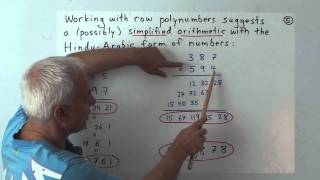
Row and Column Polynumbers - Arithmetic and Geometry Math Foundations
Explore two-dimensional arithmetic with polynumbers, introducing bipolynumbers and their associated polynomials in alpha and beta variables. Learn simplified arithmetic and multiplication techniques.
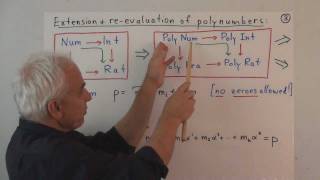
The Division Algorithm for Polynumbers - Arithmetic + Geometry Math Foundations | N J Wildberger
Explore the division algorithm for polynumbers, covering integral and rational polynumbers, and different approaches to division. Learn foundational concepts in mathematics with a focus on logical rigor.
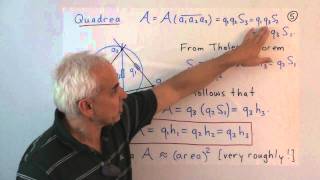
Thales' Theorem, Right Triangles + Napier's Rules - Universal Hyperbolic Geometry
Explores Thales' theorem and Napier's rules in universal hyperbolic geometry, focusing on right triangles. Covers key concepts like quadrea, spreads, and proofs, with practical exercises for deeper understanding.
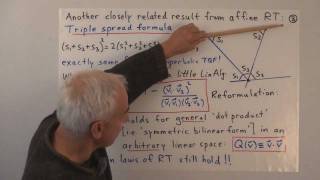
The Triple Quad Formula in Universal Hyperbolic Geometry
Explores the Triple quad formula in hyperbolic geometry, its proof, and related concepts. Compares with Euclidean geometry and discusses algebraic challenges, providing exercises for deeper understanding.
Change of Basis and Taylor Coefficient Vectors - Wild Linear Algebra A - NJ Wildberger
Explore change of basis, vatrices, and Taylor coefficients in linear algebra. Novel framework connects coordinate vectors to calculus applications, featuring generalized Pascal matrices.
Cubic Splines - De Casteljau Bezier Curves Using Linear Algebra
Explore de Casteljau Bezier curves and cubic splines using linear algebra, focusing on their elegant formulas and applications in design work from automobiles to modern graphics.
Limits and Rational Poly On-Sequences - Real Numbers + Limits Math Foundations | N J Wildberger
Explore rational polynumbers, infinite sequences, and the concept of infinity in mathematics. Learn about factorizations, limiting behaviors, and the delicate nature of associating sequences with rational functions.
An Informal Introduction to Abstract Algebra
Informal introduction to abstract algebra, covering fields, rings, and vector spaces. Explores key concepts and examples, from basic number systems to advanced constructions, providing essential background for algebraic topology.