Vulkan Lecture Series
Comprehensive exploration of Vulkan graphics API, covering essentials, swap chains, resources, commands, pipelines, ray tracing, and synchronization for advanced graphics programming.
Vulkan
Comprehensive introduction to Vulkan API, covering core concepts, advanced techniques, and practical implementation for real-time rendering and graphics programming.

Vulkan - C++ Game Engine Tutorials
Learn to build a game engine using Vulkan and C++, covering graphics pipelines, device setup, shaders, 3D transformations, lighting, and more. Gain practical skills for advanced game development.
Mesa 3D in an Embedded Context - Performance Tools and Recent Advances
Explore Mesa 3D's advancements for embedded products, including API support, quality assurance, flexibility, openness, and hardware compatibility. Learn about performance tuning tools for OpenGL workloads on embedded devices.

Rays and Spheres- The Math! - Ray Tracing Series
Explore the mathematics behind ray tracing, focusing on rays, spheres, and their intersections. Learn key concepts and equations essential for implementing realistic 3D graphics rendering.

Welcome to Ray Tracing
Introduction to ray tracing techniques for generating photo-realistic digital imagery, covering setup, rendering, performance optimization, and GPU acceleration using C++ and Vulkan.

Rendering a Sphere Using Ray Tracing - Ray Tracing Series
Learn to render a sphere using ray tracing techniques in C++. Covers creating a Renderer class, structuring code like a pixel shader, and implementing sphere rendering with optimized performance.

Vulkan - Powering AAA Experiences on Android - Unreal Fest Europe 2019 - Unreal Engine
Explore cutting-edge Vulkan features, optimization techniques, and the future of Android graphics development for AAA gaming experiences using Unreal Engine.

Creating GUI Applications in C++ with ImGui and Vulkan
Learn to create GUI applications using C++, ImGui, and Vulkan with the lightweight Walnut framework. Explore setup, usage, and inner workings of this tool for building graphics-related apps efficiently.

All It Takes: A Vulkan Story - Diagnosing Slow Renderer Performance
Diagnose and optimize a slow Vulkan renderer, exploring performance bottlenecks and implementing solutions for improved graphics rendering efficiency.
Overview of the Open Source Vulkan Driver for Raspberry Pi 4
Explore the development, challenges, and future plans of the open-source Vulkan driver for Raspberry Pi 4, including its implementation, testing process, and performance considerations.
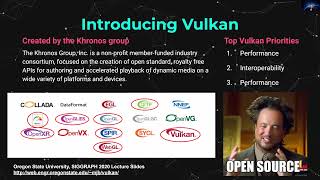
Beyond CUDA: GPU Accelerated Machine Learning on Cross-Vendor Graphics Cards with Vulkan Kompute
Explore GPU-accelerated machine learning across multiple vendors using Vulkan Kompute. Learn parallel processing options, Vulkan basics, and implement a linear regression example on diverse graphics cards.

What Can Vulkan Do for You? - Introduction to Modern 3D Graphics API
Explore Vulkan's advantages for embedded graphics, including efficiency, multithreading, and modern hardware compatibility. Learn about open-source efforts and Intel's Vulkan driver development.
Portable Graphics Abstraction in Rust with gfx-rs
Explore gfx-rs, a Rust-based graphics abstraction library bringing Vulkan everywhere. Learn about its history, features, and future roadmap for portable graphics development.
The Many APIs of Gaming on Proton
Explore the complex API landscape for gaming on Proton, comparing Windows and Linux implementations and examining cross-boundary solutions for seamless gameplay experiences.
Make Shinier, Faster Mobile Games with Vulkan
Explore Vulkan's high-efficiency graphics API for mobile games. Learn porting techniques, performance optimization, and how to leverage Vulkan's unique features for enhanced mobile gaming experiences.
GAPID: Graphics API Debugger for Android Games - Android Game Developer Summit 2018
Explore GAPID, Google's graphics debugger for Android games. Learn to capture, analyze, and optimize API calls for OpenGL and Vulkan, enhancing game performance and visual quality.
Vulkan Optimizations for Android Game Development
Explore Vulkan Graphics API optimizations and best practices for game development, based on two years of experience in enhancing Vulkan games.

Unity on Android: Performance Improvements and Development Impact
Explore Unity's latest improvements on Android, including Vulkan and multithreading, to enhance game development performance and productivity.
Making High Fidelity Android Games Possible with Vulkan
Explore Vulkan's potential for high-performance graphics in Android games. Learn adoption strategies for games and engines to leverage this powerful ecosystem.

Reach and Devices for Game Development: Targeting, Optimization, and Analytics
Explore game development strategies using Reach and devices for targeting decisions, and Android vitals for performance tracking. Learn about new features for monetization and stability troubleshooting.