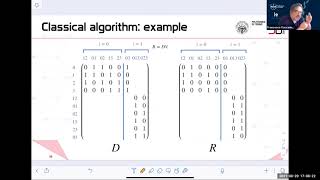
Parallel Decomposition of Persistence Modules Through Interval Bases
Exploring parallel decomposition of persistence modules using interval bases, with applications in Topological Data Analysis and connections to the Hodge Laplacian.
Geometric Deep Learning
Dive into geometric deep learning principles and advanced mathematical concepts with Prof. Michael Bronstein's comprehensive exploration of this cutting-edge field in artificial intelligence.

Gapped Clique Homology is QMA1-Hard and Contained in QMA
Explore the complexity of homology problems in computational topology, focusing on clique complexes and their quantum complexity classification through innovative eigenvalue analysis techniques.
Topological Message Passing: From Graph Neural Networks to Simplicial Complexes on CW Networks
Delve into advanced Graph Neural Network concepts, exploring topological message passing, simplicial complexes, and high-dimensional interactions for computational graph networks and molecular design applications.
Distributed Computing through Combinatorial Topology
Explore distributed computing through combinatorial topology, learning key concepts and their applications to solve distributed problems using algebraic topology techniques.
Topology of Complexes Arising in Models for Distributed Computing
Explore simplicial models in distributed computing, focusing on chromatic subdivisions and their applications to problems like Weak Symmetry Breaking, leading to new mathematical questions.
High-Dimensional Expanders - Lecture 2
Explore high-dimensional expanders with Irit Dinur, delving into advanced concepts and applications in analysis and theoretical computer science.
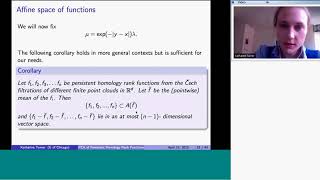
Katharine Turner - PCA of Persistent Homology Rank Functions with Case Studies
Explore persistent homology rank functions through PCA, featuring case studies and insights into topological data analysis techniques.
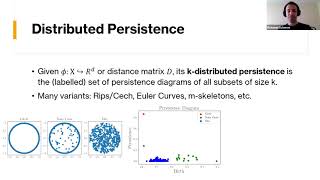
Dimensionality Reduction via Distributed Persistence - DIPOLE
Explore dimensionality reduction with DIPOLE, a novel approach combining local metric and global topological preservation for improved data visualization and analysis.
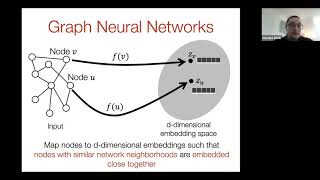
Graph Representation Learning and Its Applications to Biomedicine
Graph representation learning techniques for biomedical applications, focusing on SubGNN for disentangled subgraph embeddings and their use in predicting disease treatments and safe drug combinations.
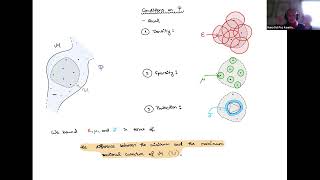
Curvature Variation Based Sampling for Delaunay Triangulations of Manifolds
Explore adaptive sampling for Delaunay triangulations of Riemannian manifolds, focusing on curvature variation and quality bounds for successful triangulation. Learn about geometric realizations and manifold triangulation techniques.
Topology of Complexes and Distributed Computing
Exploring simplicial models in distributed computing, focusing on chromatic subdivisions and Weak Symmetry Breaking, with insights into combinatorial-simplicial questions and related mathematical challenges.
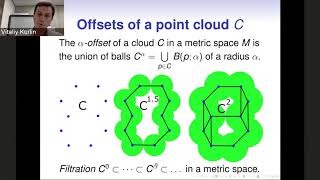
Skeletonization Algorithms With Theoretical Guarantees for Point Clouds
Explore skeletonization algorithms for point clouds, including Mapper, alpha-Reeb graphs, and Homologically Persistent Skeleton. Compare their performance on synthetic and real data sets.
Topology of Surprisal - Information Theory and Vietoris-Rips Filtrations
Explore the fusion of information theory and Vietoris-Rips filtrations, focusing on Kullback-Leibler divergence and its applications in deep learning, with insights on overcoming non-symmetry challenges.
A Fibrational Framework for Modal Simple Type Theories
Explore modal extensions of homotopy type theory, focusing on fibrational frameworks for modal simple type theories and their applications in topology, geometry, and spectra.
Discrete and Codiscrete Modalities in Cohesive HoTT
Explore discrete and codiscrete modalities in Cohesive Homotopy Type Theory, examining their applications in topology, differential geometry, and synthetic formalizations of mathematical concepts.
Exotic Spheres and Singularities - Math Associates Seminar
Explore the fascinating journey from exotic spheres to Milnor's Fibration Theorem, a cornerstone in singularity theory, and its impact on complex hypersurface geometry and topology.
Storm: Realtime Distributed Computing with Nathan Marz - ETE 2012
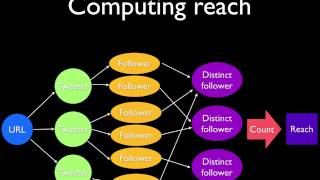
Explore Storm for real-time data processing, covering concepts, development, deployment, fault-tolerance, and practical applications in distributed computing environments.
The Asynchronous Computability Theorem - Distributed Systems and Algebraic Topology
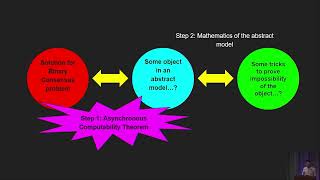
Explore the connection between distributed systems protocols and algebraic topology, proving consensus impossibility in asynchronous wait-free models through combinatorial structures.

Entanglement of Sections - IPAM at UCLA
Explore quantum information in parameter families through examples, presented by Microsoft Research's Michael Freedman at IPAM's workshop on topology and quantum error correction.
Lipschitz Geometry and Combinatorics of Abnormal Surface Germs
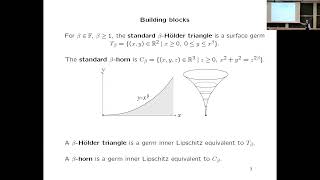
Explore Lipschitz geometry and combinatorics of abnormal surface germs in this advanced mathematics talk by Andrei Gabrielov from Purdue University.