Tangent Groupoid in Noncommutative Geometry - Lecture 8
Explore advanced concepts in noncommutative geometry, focusing on the tangent groupoid and its applications in graduate-level mathematics.
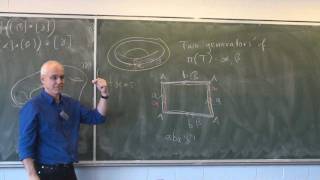
Fundamental Group of Surfaces - Multiplication and Properties
Explores fundamental group of surfaces, proving loop multiplication forms a group. Covers torus and projective plane, with examples and a problem on describing fundamental groups.
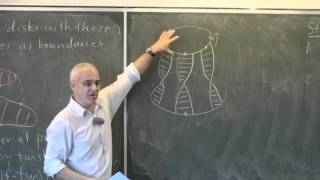
Knots and Surfaces - Seifert Surfaces in Algebraic Topology - Lecture 2
Explore Seifert surfaces, their construction for knots like the trefoil, and learn about Euler numbers for surfaces with boundaries in this advanced algebraic topology lecture.
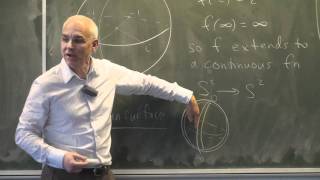
Sphere Geometry and Complex Analysis - Algebraic Topology Lecture 4
Explore advanced concepts in sphere geometry, including inversive geometry, Riemann sphere, complex analysis, and projective lines, enhancing understanding of algebraic topology.
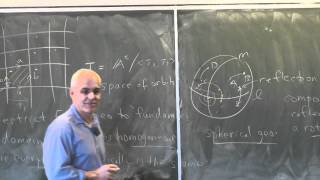
The Geometry of Surfaces - Algebraic Topology Lecture 20
Explore the connection between 2D surfaces and classical geometries, focusing on isometries and introducing hyperbolic geometry through circle inversions in the Beltrami Poincare disk model.
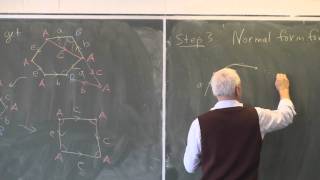
Classification of Combinatorial Surfaces - Lecture 2
Explores the classification of two-dimensional surfaces using polygon reduction techniques. Covers cutting, pasting, and creating crosscaps and handles to achieve standard forms in algebraic topology.
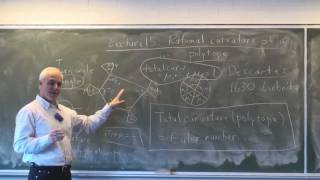
Rational Curvature of a Polytope - Algebraic Topology Lecture 15
Introduces a new rational definition of polytope curvature, using turn-angle to connect curvature with Euler number. Explores opposite cones and applies Harriot's theorem on spherical triangles.
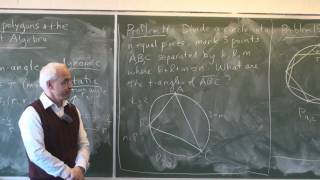
Duality for Polygons and the Fundamental Theorem of Algebra - Algebraic Topology Lecture 12
Explore duality in polygons and a rational proof of the Fundamental Theorem of Algebra using winding numbers. Gain insights into algebraic topology concepts and their applications.
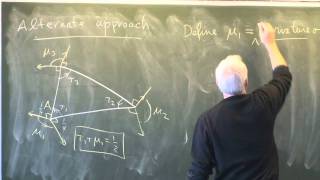
Rational Curvature, Winding, and Turning in Algebraic Topology - Lecture 11
Explores rational curvature, turn angles, and winding numbers in algebraic topology. Introduces new geometric concepts for describing polygons and planar curves, emphasizing practical applications in mathematics.
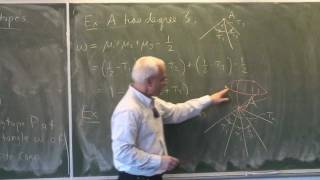
Rational Curvature of Polytopes and the Euler Number - Algebraic Topology Lecture 16
Explore the relationship between polyhedron curvature and Euler number using rational formulation. Learn about Harriot's theorem and analyze various polyhedra, including tetrahedron, cube, and dodecahedron.
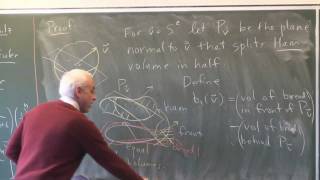
The Ham Sandwich Theorem and the Continuum - Algebraic Topology Lecture 14
Explore the Borsuk-Ulam theorem, Ham Sandwich theorem, and their applications in algebraic topology. Learn how these concepts relate to continuous maps and homeomorphisms in affine spaces.
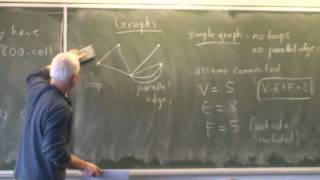
Applications of Euler's Formula and Graphs in Algebraic Topology
Explore Euler's formula applications to Platonic solids, polyhedra, and higher dimensions. Learn about planar graphs and delve into advanced geometric concepts in algebraic topology.
Complex Numbers and Curves in 19th Century Mathematics
Explore complex numbers, algebraic curves, and their intersection with projective geometry and topology. Discover how these concepts revolutionized 19th-century mathematics and laid the foundation for modern algebraic geometry.
Euler's Relation Between Vertices, Edges, and Faces of Platonic Solids - Famous Math Problems 15
Explore Euler's famous formula relating vertices, edges, and faces of Platonic solids. Discover its historical context, proof, and significance in modern topology.
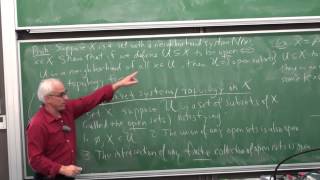
Topological Spaces and Manifolds - Differential Geometry Lecture 24
Explore topological spaces and manifolds through neighborhood systems and open sets. Learn key concepts, solve problems, and understand the foundations of continuous space theory in modern mathematics.
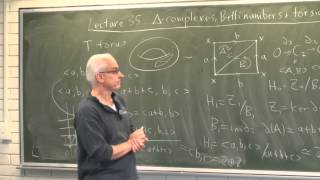
Delta Complexes, Betti Numbers, and Torsion in Algebraic Topology
Explore homology groups of torus and projective plane using delta-complexes. Learn about Betti numbers and torsion in algebraic topology, with practical computations and insights into fundamental concepts.
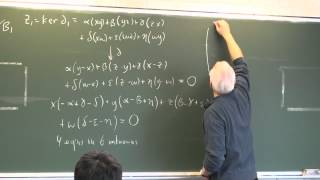
More Homology Computations in Algebraic Topology - Lecture 2
Explore homology computations for the 2-sphere using tetrahedron and delta-complex models. Learn how linear algebra applies to topological problems and simplify calculations with semi-simplicial complexes.
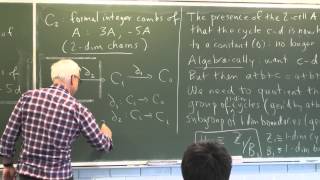
Introduction to Homology in Algebraic Topology - Part 2
Explores cycles, boundaries, and homology in algebraic topology, focusing on graph modifications and using commutative group theory to analyze formal combinations of geometric elements.
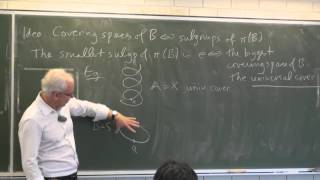
Universal Covering Spaces in Algebraic Topology
Explore fundamental groups, covering spaces, and universal covers. Learn about helical coverings, two-fold coverings, and connections between geometry and topology in this advanced algebraic topology lecture.
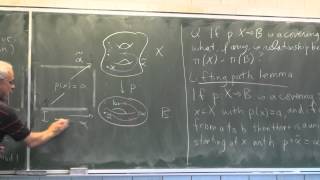
Covering Spaces and Fundamental Groups - Algebraic Topology Lecture 28
Exploring covering spaces and fundamental groups, focusing on torus examples and key lemmas to understand relationships between covering spaces and base spaces.
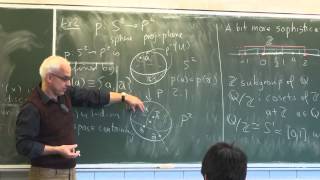
Covering Spaces in Algebraic Topology
Explore covering spaces in algebraic topology, including fundamental groups, line-circle coverings, sphere-projective plane relations, and torus knots. Visualize complex topological concepts through practical examples.