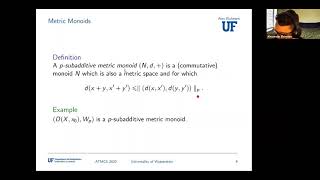
Universality of Persistence Diagrams and Bottleneck & Wasserstein Distances
Explore the mathematical foundations of persistence diagrams and their associated metrics, focusing on universality properties and distance calculations in topological data analysis.
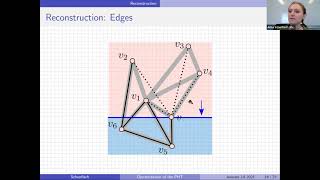
A Faithful Discretization of the Persistent Homology Transform
Explore a faithful discretization method for the Persistent Homology Transform, enhancing computational efficiency in topological data analysis and shape recognition.
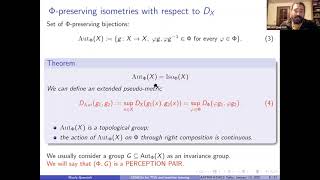
Group Equivariant Non-Expansive Operators and Their Use in Deep Learning
Explore group equivariant non-expansive operators and their applications in deep learning, focusing on topological and geometrical properties.
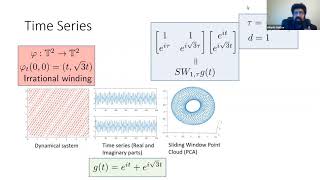
A Theoretical Analysis of Quasiperiodicity Using Persistent Künneth Formulae
Explore quasiperiodicity through advanced mathematical analysis, focusing on persistent Künneth formulae and their applications in theoretical algebraic topology.
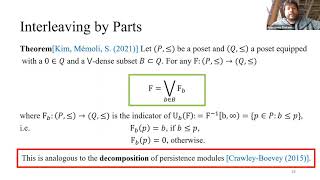
Interleaving by Parts for Persistence in a Poset
Explore interleaving techniques for persistence analysis in partially ordered sets, focusing on algebraic topology applications and methodologies.
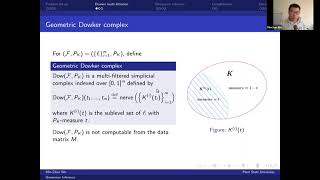
A Topological Approach to Inferring the Intrinsic Dim. of Convex Sensing Data
Explore a topological method for determining the intrinsic dimension of convex sensing data, offering insights into data analysis and dimensionality reduction techniques.
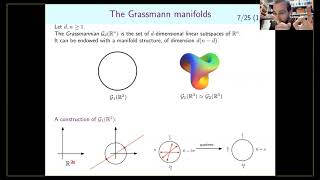
Persistent Stiefel-Whitney Classes
Explore persistent Stiefel-Whitney classes in topological data analysis, extending beyond homology groups to estimate vector bundle structures from finite samples using a persistent approach.

The Topology of the 3 Body Problem & Space
Explore the topological structure of invariant manifolds in the 3-body problem and its applications in space missions, dynamical astronomy, and celestial body impacts.
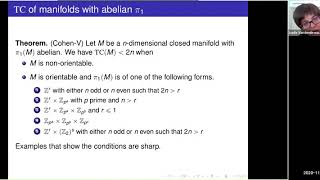
Topological Complexity for Manifolds with Abelian Fundamental Group
Explores conditions for nonmaximal topological complexity in manifolds with abelian fundamental groups, generalizing results on spaces with small fundamental groups and nonorientable surfaces.
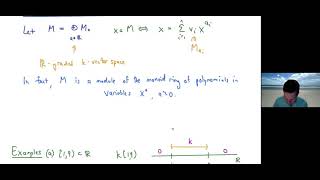
Homological Algebra for Persistence Modules
Introduction to persistence modules in algebraic topology, exploring tensor products, Hom operations, and their role in homological algebra. Insights into preserving exact sequences and advanced concepts.

Bredon Cohomology and LS-Categorical Invariants
Explore Bredon cohomology's role in estimating topological complexity of aspherical spaces and its application to equivariant LS-category of groups with operators.
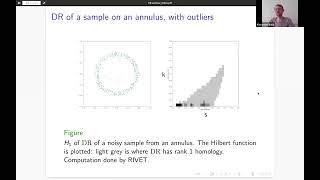
Homology Inference for the Degree-Rips Bifiltration
Explore density-sensitive degree-Rips bifiltration, its homology inference framework, and applications to annular point clouds with outliers. Analyze homotopy types and explanatory power in topological data analysis.
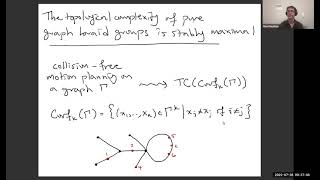
The Topological Complexity of Pure Graph Braid Groups Is Stably Maximal
Explore the topological complexity of configuration spaces in graphs, using group theoretic estimates for higher topological complexity instead of traditional cohomology approaches.
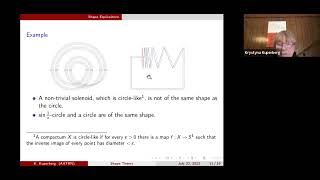
Krystyna Kuperberg - Shape Theory: Vietoris-Cech Approach to Homotopy
Explore shape theory's geometric approach to homotopy for compact metric spaces, extending Vietoris' work on first homotopy groups to higher dimensions with applications in mind.
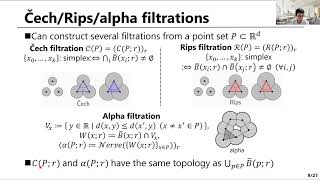
RipsNet- Fast and Robust Estimation of Persistent Homology for Point Clouds
Estimating persistence diagrams of point clouds using neural networks for faster, more robust topological analysis. Overcomes computational complexity and sensitivity to outliers in practical applications.

Isoperimetric Inequality for Hausdorff Contents and Its Applications
Explore isoperimetric inequality for Hausdorff contents, its applications in systolic geometry, and new systolic inequalities for non-simply connected Riemannian manifolds.
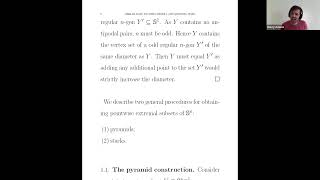
Extremal Spherical Polytopes and Borsuk's Conjecture
Explore extremal spherical polytopes and their connection to Borsuk's Conjecture, delving into geometric principles and mathematical theories in this insightful presentation.
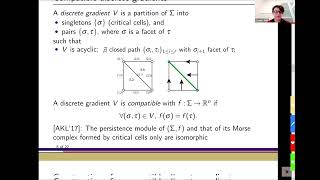
Claudia Landi - Multi-parameter Persistence from the Viewpoint of Discrete Morse Theory
Explore multi-parameter persistence through discrete Morse theory, connecting combinatorial properties of critical cells to algebraic properties of persistence modules in topological data analysis.
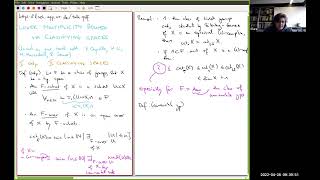
Lower Multiplicity Bounds via Classifying Spaces
Explore equivariant methods and classifying spaces to analyze Lusternik-Schnirelmann category variations, focusing on open covers with fundamental group constraints and applications to amenable subgroups.
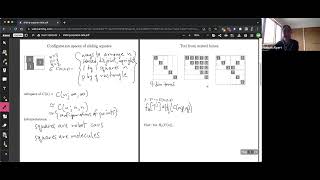
Homology of Sliding-Squares Configuration Spaces
Explore homology of sliding-squares configuration spaces, comparing point and square configurations in planes and rectangles. Discover surprising growth patterns in homology group ranks.
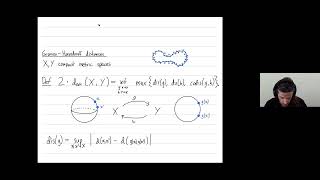
Gromov-Hausdorff Distances, Borsuk-Ulam Theorems, and Vietoris-Rips Complexes
Explore Gromov-Hausdorff distances, Borsuk-Ulam theorems, and Vietoris-Rips complexes in geometry. Learn about recent advancements in lower bounding distances between spheres using innovative mathematical techniques.