Manfred Einsiedler- Effective Homogenous Dynamics 1
Explore homogeneous dynamics, focusing on transformations, orbits, and effective statements in topology and number theory.
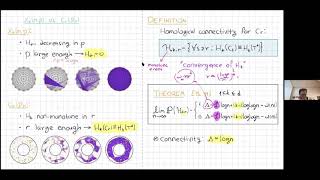
Omer Bobrowski - Random Simplicial Complexes
Explore higher-dimensional generalizations of random graphs, focusing on random d-complexes and Cech complexes. Learn about connectivity, cycle formation, and giant components in these structures.

Omer Bobrowski - Random Simplicial Complexes, Lecture I
Explore random simplicial complexes, their applications in data analysis, and key phenomena like connectivity and cycle formation. Includes introduction to algebraic topology and homology theory.
On the Cohomology of Quot Schemes Parametrizing Torsion Quotients on a Smooth Curve
Explore cohomology of Quot schemes on smooth curves, focusing on torsion quotients. Delve into additive basis, natural maps, and geometric interpretations with expert insights.
Introduction to Higgs Bundles - Lecture 1
Explore complex geometric concepts in Higgs bundles, including Riemann surfaces, theorems, and constructions. Gain insights into advanced mathematical topics through examples, exercises, and proofs.
Artin Reciprocity via Spheres
Explore Artin reciprocity through spheres, covering functionality, logical construction, global fields, spectra, and K theory in this advanced mathematics lecture.
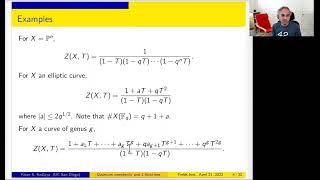
Quantum Complexity and L-functions
Explore quantum algorithms for L-functions and zeta functions, examining complexity results, cohomology's role, and applications to modular forms and Mordell-Weil theorem.
Applications of O-minimality to Hodge Theory - Lecture 4
Explore infinitesimal thickening, definable spaces, and cell decomposition in o-minimality, with applications to Hodge theory and Abelian shields.
Hilbert's 16th Problem and O-Minimality - Lecture 1
Explore the topology of cycles, limit cycles, and related mathematical concepts in this advanced graduate-level lecture on Hilbert's 16th problem and o-minimality.
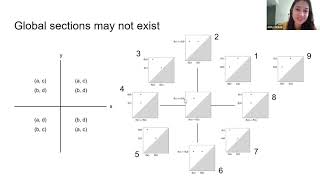
Persistence Diagram Bundles- A Multidimensional Generalization of Vineyards
Explore persistence diagram bundles, a multidimensional generalization of vineyards for analyzing topological changes in data sets with multiple parameters, including computation methods and potential applications.
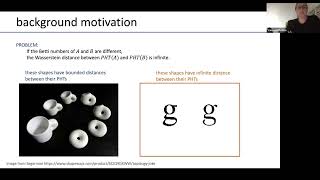
Vanessa Robins - The Extended Persistent Homology Transform for Manifolds with Boundary
Explore extended persistent homology transform for shape analysis, offering finite distances between shapes with different Betti numbers and applications in shape clustering.
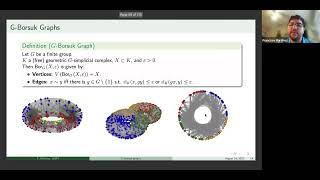
Chromatic Number of G-Borsuk Graphs
Explore G-Borsuk graphs, their chromatic numbers, and topological connections. Delve into G-actions, Hom-complexes, and random graph thresholds for a deeper understanding of this algebraic topology concept.

New Results in Computing Zigzag and Multiparameter Persistence
Explore new advancements in computing zigzag and multiparameter persistence, including efficient conversion methods and improved algorithms for 2-parameter persistence modules.
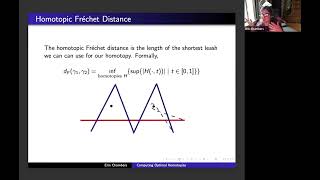
Computing Optimal Homotopies
Explore optimal curve similarity measures using homotopy-based approaches, examining structural properties, algorithms, and open questions in topology and computational geometry.
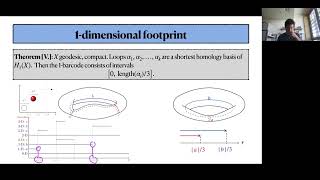
Žiga Virk - Information Encoded in Persistence Diagrams
Explore topological data analysis through persistence diagrams, uncovering spatial properties like homology, geodesics, and proximity in various mathematical contexts.
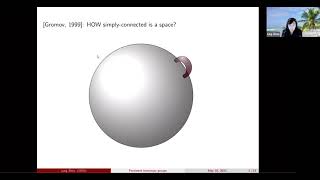
Persistent Homotopy Groups of Metric Spaces
Explore persistent homotopy groups of metric spaces, their stability, and advantages over persistent homology. Learn about tree-like structures and ultrametrics in fundamental groups.
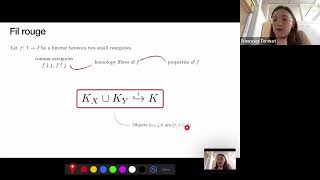
What's Behind the Homotopical Decomposition of a Simplicial Complex
Explore homotopical decomposition of simplicial complexes, focusing on conditions for homotopy type preservation and the mathematics behind decomposability results.

Chirality and Quantifying Embeddability
Explore chirality, embeddings, and non-embeddability in topology, with applications to chemical structures and generalizations of classical results.
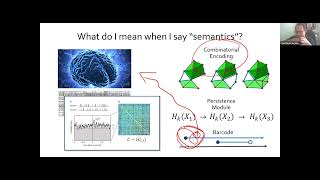
An Approach to Assigning Semantics to Persistent Homology Classes
Explore a novel approach to interpreting persistent homology classes in applied settings, overcoming traditional limitations by leveraging comparative measurements against known models.

Fedor Manin - Linear Nullhomotopies of Maps to Spheres
Explore controlled Lipschitz constant nullhomotopies of maps to spheres, focusing on mathematical techniques and recent research developments in algebraic topology.
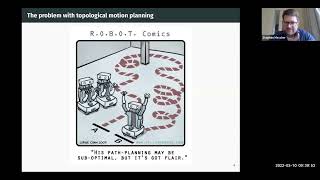
Geodesic Complexity of Riemannian Manifolds
Explore geodesic complexity in Riemannian manifolds, connecting robot motion planning to topology and geometry. Learn about cut loci, bounds, and applications in this advanced mathematical talk.