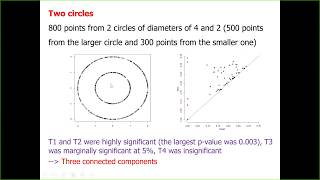
Modeling and Replicating Persistence Diagrams
Explore modeling and replicating persistence diagrams for statistical inference in topological data analysis. Learn about RST approach, parametric modeling, and improvements for clustered data.
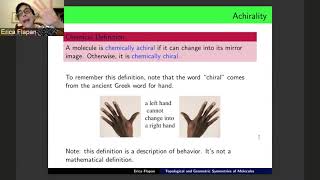
Erica Flapan - Topological and Geometric Symmetries of Molecular Structures
Explore topological and geometric approaches to studying symmetries of complex molecular structures, aiding chemists in verifying synthesized molecules' forms through experimental data interpretation.
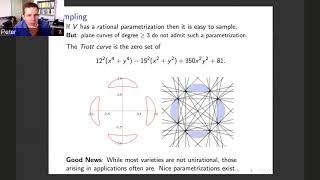
Bernd Sturmfels - Learning Algebraic Varieties from Samples
Explore algebraic varieties through sampling, focusing on topology and geometry. Learn algorithms for determining dimensions and polynomials, with practical applications in Julia.
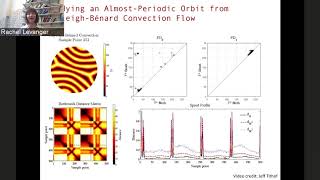
Rachel Levanger - A Comparison Framework for Interleaved Persistence Modules
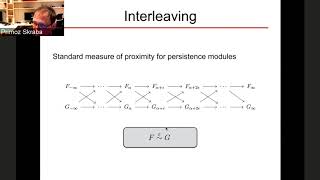
Explore rigorous tracking of noise in persistent homology, comparing approximation techniques and addressing non-uniform sub-level set filtrations in topological data analysis.
An Approximate Nerve Theorem
Explore the Nerve Theorem's application in topological data analysis, focusing on epsilon-acyclic covers and their impact on persistent homology approximations in space filtrations.
David Meyer - Some Algebraic Stability Theorems for Generalized Persistence Modules
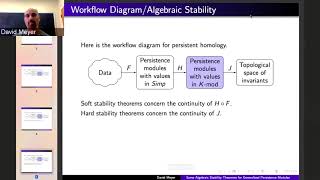
Algebraic stability theorems for generalized persistence modules, exploring interleaving metrics, bottleneck metrics, and isometry theorems in the context of poset algebras and quiver representations.
Constructions of K-Regular Maps Using Finite Local Schemes
Explore k-regular maps and interpolation theory in algebraic geometry. Learn construction methods, bounds, and applications to continuous function interpolation using advanced mathematical concepts.
Bedlewo- Topological Complexity and the Motion Planning Problem in Robotics
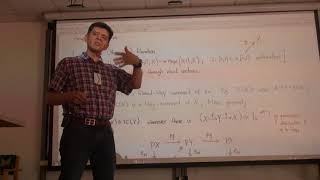
Explore topological complexity in robotics motion planning, its algebraic topology properties, recent developments, and research trends in this rich field.
Pavle Blagojević - Bedlewo: Shadows of Cohen's Vanishing Theorem
Explore Cohen's Vanishing theorem and its applications in algebraic topology, geometry, and combinatorics. Discover its impact on configuration spaces and measure partition problems.
Pawel Dlotko - A Few Simple Stories on Topology in Action
Explore practical applications of computational topology in material science, dynamical systems, and brain research. Learn how theory and algorithms work together to solve real-world problems.
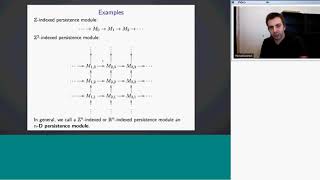
Michael Lesnick - Algebraic Stability of Zigzag Persistence Modules
Explore algebraic stability in zigzag persistence modules, covering key concepts, theorems, and applications in topological data analysis and computational topology.
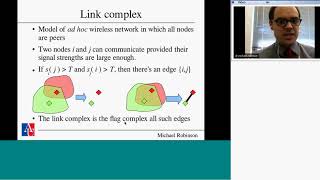
Sheaf Based Modeling of Wireless Communications
Explore sheaf-based modeling for wireless communications, covering topology, simplicial complexes, interference, and network activation. Learn about persistence, homological invariants, and simulation examples.

Larry Wasserman - Robust Topological Inference
Explore robust topological inference with Larry Wasserman, covering persistence, confidence bands, bootstrap methods, and optimal tuning for data analysis and statistical modeling.
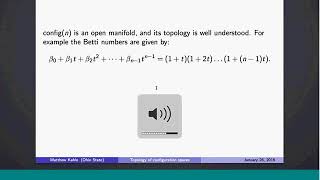
Matthew Kahle - Topology of Configuration Spaces of Hard Spheres
Explore configuration spaces, homology, and topology in hard sphere systems. Learn about critical points, computational approaches, and theoretical foundations in applied algebraic topology.

Tamal Dey - A Framework for Topological Summarization
Explore topological summarization frameworks, covering concepts like nerve complexes, multiscale mapper, persistence diagrams, and stability in hierarchical covers. Gain insights into advanced computational topology techniques.
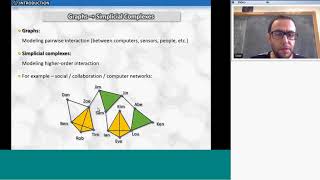
Omer Bobrowski - Maximally Persistent Cycles in Random Geometric Complexes
Explore persistent cycles in random geometric complexes, examining key tools, processes, and results. Gain insights into random graph theory and future research directions.
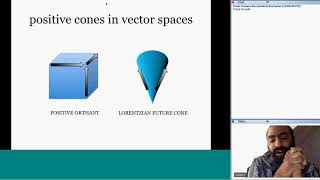
Sanjeevi Krishnan - Homological Programming
Explore algebraic topology applications in programming, covering pursuit-evasion problems, positive cones, Alexander duality, and directed topology, with insights into decomposability and computational aspects.
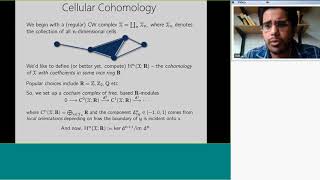
Vidit Nanda - Morse Theory for Local Coefficients
Explore Morse theory with local coefficients, covering cohomogeneous complexes, wave graphs, and isomorphisms. Delve into advanced topics and theorems in algebraic topology.
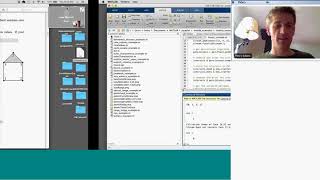
Applied Algebraic Topology Network - Student Seminar Introduction to JavaPlex
Learn to use JavaPlex for topological data analysis, covering key concepts like witness complexes, data representation, and visualization tools. Ideal for students exploring computational topology.
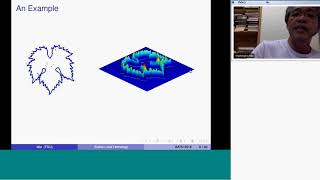
Washington Mio - Stable Homology of Metric Measure Spaces
Explore stable homology in metric measure spaces, covering Wasserstein distance, local homology stability, and applications in data analysis and taxonomic classification.
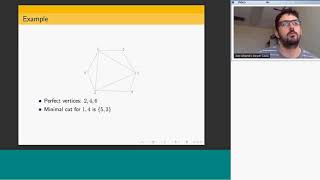
José Samper Seminar - Higher Chordality
Explore higher chordality in algebraic topology, covering community algebra, linear resolution, graphs, polytopes, and complex links. Gain insights into advanced mathematical concepts.