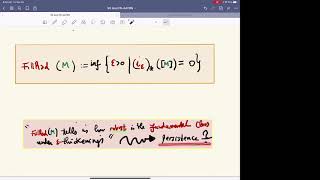
Vietoris-Rips Persistent Homology, Injective Metric Spaces, and The Filling Radius
Explore geometric persistent homology, its isomorphism with Vietoris-Rips filtration, and applications in characterizing persistence barcodes, bounding intervals, and connecting to filling radius.
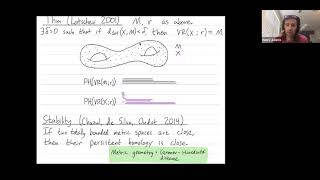
Vietoris-Rips Thickenings - Problems for Birds and Frogs
Explore open problems in Vietoris-Rips complexes, connecting diverse mathematical areas. Suitable for both broad theorists and problem-solving specialists in applied algebraic topology.
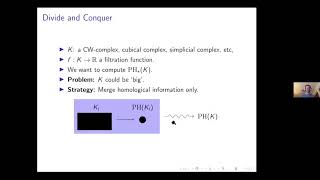
The Persistence Mayer-Vietoris Spectral Sequence
Explore the persistent Mayer-Vietoris spectral sequence, its applications in parallelizing persistent homology computations, and its ability to provide locality-enriched persistence barcodes.
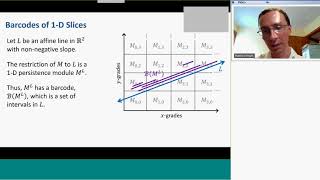
Visualizing 2 Dimensional Persistent Homology
Explore techniques for visualizing 2D persistent homology, a powerful tool in topological data analysis, to gain insights into complex datasets and their underlying structures.

Helmut Bölcskei - Lossy Compression on General Data Structures
Explore lossy compression for data on manifolds and fractals, with bounds on rate-distortion function and quantization error. Applications in data science and image processing.
Algebraic Perspectives of Persistence
Explore algebraic approaches to persistent homology, focusing on the stability of persistence diagrams and their relation to input data changes in topological data analysis.
Novel Computational Perspectives of Persistence
Explore innovative computational approaches to persistence in algebraic topology, focusing on advanced techniques and their applications in data analysis and topological research.
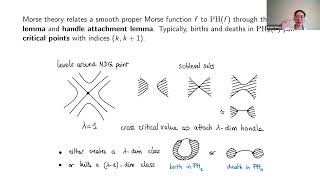
Generalized Morse Theory of Distance Functions to Surfaces for Persistent Homology
Unifying distance fields, persistent homology, and Morse theory to quantify complex shape textures, with applications in characterizing vascular structures in leukemia samples.
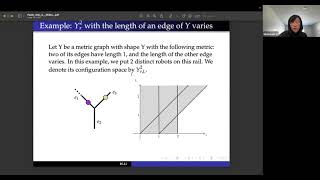
Two-Parameter Persistent Homology of Second Configuration Spaces in Star Graphs
Explore configuration spaces in robot motion planning, focusing on 2-parameter persistent homology of second configuration spaces of star graphs with restraint parameters.
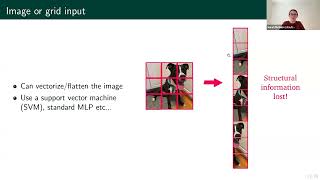
Classification of Euler Characteristic Transforms Using CNNs - 5/9/24
Explore how Euler Characteristic Transforms and CNNs can be used for shape classification, with a focus on leaf datasets. Learn about ECT-CNN pipeline, rotation equivariance, and practical applications.
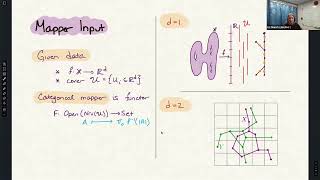
Bounding the Interleaving Distance for Mapper Graphs with a Loss Function
Exploring interleaving distance for Mapper graphs, introducing a loss function to measure assignment quality and enable polynomial-time computation for data comparison and clustering.

Informational and Topological Signatures of Individuality in Network Neuroscience
Exploring brain function through topological data analysis, demonstrating improved individual and age discrimination using algebraic-topological features extracted from resting fMRI data compared to traditional methods.
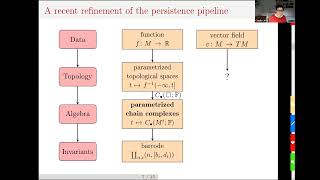
Barcodes for the Topological Analysis of Gradient-Like Vector Fields
Explore topological analysis of gradient-like vector fields using barcodes. Learn about chain complexes, parametrization, and applications in smooth and discrete settings, with insights on stability and approximation.
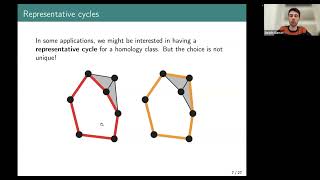
Harmonic Persistent Homology for Disentangling Multiway Interaction in Data
Explore Harmonic Persistent Homology for analyzing multi-omics data, uncovering hidden patterns in complex diseases, and identifying biomarkers associated with latent biological pathways.

Teaching Neural Networks a Sense of Geometry
Explore Topological Data Analysis (TDA) and its intersection with machine learning to enhance neural networks' geometric reasoning abilities across various applications.
Detecting Non-Trivial Cycles of Point Clouds and Time Series Data on Manifolds
Explore techniques for identifying complex cycles in point clouds and time series data on manifolds, with applications in machine learning and dynamical systems.
Topological Node2vec: Improving Graph Embeddings with Persistent Homology
Exploring persistent homology to enhance graph embeddings, combining topology with machine learning for improved data analysis and representation in complex networks.
Persistent Homology for Infinite Complexes - Extending Theory to Infinite CW Complexes
Explore the extension of persistent homology to infinite CW complexes, including key theorems and applications in topological data analysis.
Introduction to Perverse Sheaves
Dive into the fundamental concepts and theoretical foundations of perverse sheaves with expert mathematician Mark Goresky, exploring advanced mathematical structures and their applications.
Quantitative Almost-Existence in Dimension Four
Delve into advanced symplectic geometry concepts, exploring Hofer-Zehnder's theorem and the existence of closed characteristics in four-dimensional space through rigorous mathematical analysis.
Sheaves on Graphs, the Hanna Neumann Conjecture, and Algebraic Geometry Applications
Explore advanced graph theory concepts through sheaf theory and the Hanna Neumann conjecture, featuring innovative problem-solving approaches and applications in discrete mathematics.