Pathwise Conditioning and Non-Euclidean Gaussian Processes
Explore advanced Gaussian process techniques for efficient Bayesian optimization, including pathwise conditioning and models on graphs and manifolds, enhancing decision-making in complex settings.
Non-reciprocal Quantum Matter: Quantum Geometry and Kramers Degeneracy
Explore non-reciprocal quantum matter, focusing on quantum geometry and Kramers degeneracy. Delve into field-free paradigms, linear and nonlinear phenomena, and extreme nonlinearities in layered materials.
Entangleability of Cones
Explore tensor products of finite-dimensional proper cones, solving Barker's conjecture using convex geometry and algebraic topology, with applications to entanglement in non-classical systems.

How Can Large Language Models Learn From Humans? - Understanding Psycholinguistic Predictions and Sheaf Theory
Explore how combining lexical predictions from LLMs with syntactic structures can improve language understanding, using sheaf theory to better match human reading patterns and comprehension.
Anchored Symplectic Embeddings and Non-Squeezing Phenomena in Four Dimensions
Delve into advanced symplectic geometry, exploring non-squeezing phenomena, Markov numbers, and the relationship between symplectic embeddings and surface anchors in four-dimensional spaces.
Topology of Electronic Materials and Their Linear and Nonlinear Responses - Lecture 1
Delve into quantum physics concepts like Berry curvature and electron wavefunction geometry, exploring topological states and their applications in electronic materials through advanced theoretical frameworks and experimental observations.
Profinite Properties of Artin Groups
Delve into advanced group theory concepts exploring Artin groups, their profinite properties, residual finiteness, and connections to braid groups through mathematical analysis and recent research findings.
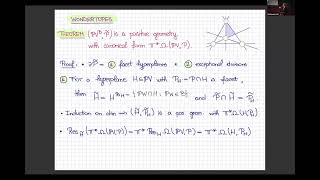
Wondertopes in Combinatorial Physics
Dive into the mathematical concept of Wondertopes and their applications in fundamental physics through an engaging exploration of combinatorial principles and theoretical frameworks.
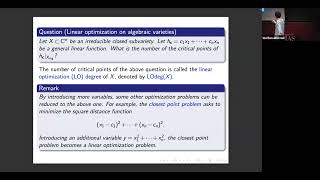
Topological Aspects in Algebraic Optimizations
Explore advanced mathematical concepts connecting topology and algebraic optimization theory through rigorous analysis of fundamental physics principles and combinatorial methods.
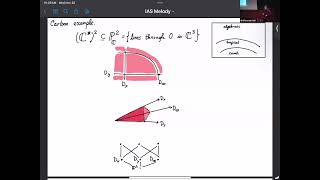
Hopf Algebras in the Cohomology of A_g
Delve into advanced mathematical concepts exploring Hopf algebras and their role in cohomology of A_g, examining fundamental relationships in algebraic geometry and combinatorial physics.
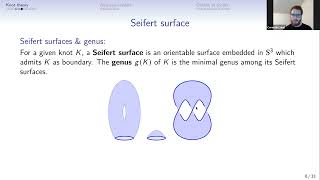
Hopf Arborescent Links, Minor Theory, and Decidability of the Genus Defect
Delve into advanced topological concepts exploring Hopf arborescent links, examining their four-dimensional properties and computational aspects of genus defects through minor theory and well-quasi-orders.
Geometry, Arithmetic, and Dynamics of Discrete Groups - Lecture 18
Explore advanced mathematical concepts in discrete groups, focusing on geometric principles, arithmetic relationships, and dynamic behaviors in group theory and related mathematical structures.

Vertex, Edge, Clique - Understanding Graph Theory Fundamentals
Explore fundamental concepts of graph theory, from basic elements like vertices and edges to complex structures like cliques, enhancing your understanding of network analysis and data relationships.
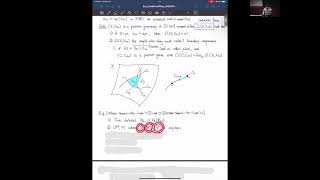
Canonical Forms of Oriented Matroids
Delve into advanced mathematical concepts exploring oriented matroids, their canonical forms, and applications in combinatorial physics through expert analysis and theoretical frameworks.
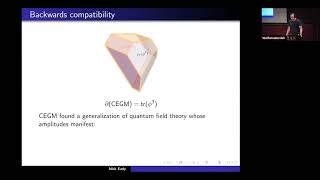
Adventures in Configuration Space
Explore advanced mathematical concepts in configuration space, focusing on combinatorial approaches to fundamental physics problems and their theoretical applications.
Geometry, Arithmetic, and Dynamics of Discrete Groups - Lecture 17
Delve into advanced mathematical concepts exploring discrete groups, focusing on their geometric properties, arithmetic relationships, and dynamic behaviors in mathematical theory.
Probing Moduli Space Cohomology Using Quantum Field Theory
Delve into advanced quantum field theory applications for analyzing moduli space cohomology, exploring mathematical connections between combinatorics and fundamental physics principles.
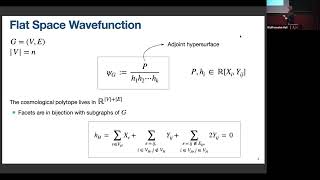
Euler Discriminant of Complements of Hyperplanes
Delve into advanced mathematical concepts exploring the Euler discriminant in hyperplane complements, focusing on combinatorial applications in fundamental physics.
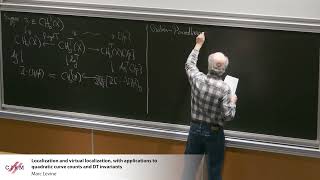
Localization and Virtual Localization - Applications to Quadratic Curve Counts
Delve into cellular A1-homology theory for smooth algebraic varieties, exploring its computational aspects and connections to Poincaré duality, with focus on smooth projective rational surfaces.
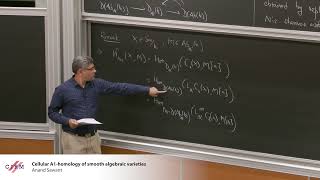
Cellular A1-Homology of Smooth Algebraic Varieties
Delve into cellular A1-homology theory for smooth algebraic varieties, exploring its computability, motivic analogues of Poincaré duality, and applications to smooth projective rational surfaces.
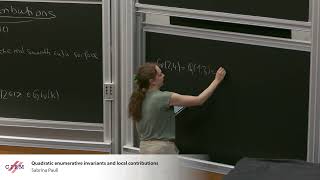
Quadratic Enumerative Invariants and Local Contributions in Algebraic Geometry
Delve into quadratic enumerative geometry, exploring enriched counting methods for geometric objects using quadratic forms, with applications to lines on cubic surfaces and hypersurfaces.