Gromov's Reconstruction Theorem and Measured Gromov-Hausdorff Convergence in Lorentzian Spaces
Explore Lorentzian space convergence, Gromov reconstruction theorem, and measured Lorentz-Gromov-Hausdorff convergence in nonsmooth general relativity. Gain insights into isomorphy of measured Lorentzian spaces.
Properties of the Null Distance on a Spacetime
Explore the null distance concept in spacetime, its definition, examples, and relationship to metric space structures.
A Wilsonian Effective Action for (1+3+6)-Dimensional Emergent Universes in the IKKT Model
Explore the IKKT model's potential for describing Type IIB superstring theory and its emergent universe solutions, focusing on the natural emergence of Lorentz invariant mass terms.
Constraints on Kahler Moduli Space of 6D N=1 Supergravity
Explore constraints on Kahler moduli space in 6D N=1 supergravity, delving into advanced theoretical physics concepts and their implications.
Supergroup Chern-Simons Theory
Explore supergroup Chern-Simons theory with Volker Schomerus in this advanced physics lecture from the "Exactly Solvable Models" workshop.

Topological Origins of Yielding in Soft Glassy Materials
Explore topological failure points in soft glassy materials during yielding, using network science tools to predict and understand plastic events in colloidal gels.

Extensions of 1-Cocycles of the Mapping Class Group to the Ptolemy Groupoid
Explore extensions of 1-cocycles from mapping class groups to Ptolemy groupoids, delving into algebraic topology and Grothendieck-Teichmüller theory.
Universal and Exact Aspects of Ideal Flatbands
Explore geometric and analytic aspects of the Quantum Hall effect, focusing on universal and exact features of ideal flatbands.
Uniqueness of Landau Levels and Their Analogs with Higher Chern Numbers
Explore geometric and analytic aspects of the Quantum Hall effect, focusing on Landau levels and their analogs with higher Chern numbers.
Nonlinear Hall Effect Induced by a Quantum Metric Dipole in Antiferromagnetic Heterostructures
Explore nonlinear Hall effect in antiferromagnetic heterostructures, focusing on quantum metric dipole's role and its implications for electron correlations in quantum materials.
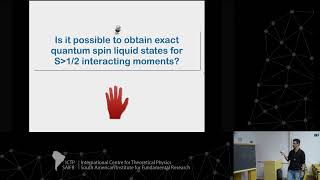
Multipolar Spin Liquid in an Exactly Solvable Model for J = 3/2 Moments
Explore multipolar spin liquids in an exactly solvable model for J = 3/2 moments, focusing on strong electron correlations in quantum materials.
Geometry, Topology and Discrete Symmetries Revealed by Deep Neural Networks
Explore deep neural networks' ability to reveal geometry, topology, and discrete symmetries in manifolds. Learn about universal approximators and their applications in inverse problems and group actions.
From Thom's Gradient Cell Decomposition to the Curvature of Milnor Fibers
Explore Thom's gradient cell decomposition and its impact on understanding complex hypersurface singularities, polar curves, and Milnor fibers through algebraic, topological, and Lipschitz-geometric perspectives.
Perception of Visual Art and Topological Data Analysis
Explore topological data analysis applications in visual art perception, comparing eye movements for abstract paintings vs. AI-generated images using algebraic topology methods.
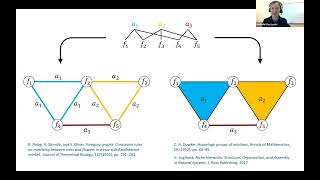
Persistent Homology of Plant-Pollinator Interactions - The Importance of Flowering Plant Surveys
Explore persistent homology in plant-pollinator interactions, analyzing topological features and the impact of flowering plant surveys on understanding community structures.
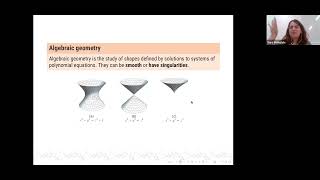
Machine Learning Detects Terminal Singularities in Q-Fano Varieties
Explore machine learning applications in algebraic geometry, focusing on Q-Fano varieties and terminal singularities detection. Gain insights into new combinatorial criteria and high-dimensional Q-Fano landscapes.
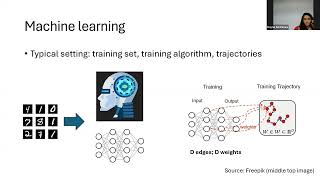
Metric Space Magnitude and Generalization in Neural Networks
Exploring metric space magnitude in neural networks: new topological complexity measures for assessing generalization capabilities, with applications to transformers and deep graph networks.
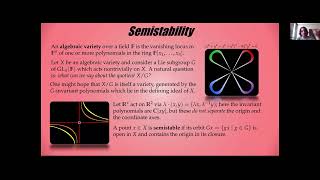
Harder-Narasimhan Filtrations of Persistence Modules
Explore Harder-Narasimhan types in quiver representations, examining their applications and limitations in persistence modules across various contexts in algebraic topology.

Computing Generalized Ranks of Persistence Modules via Unfolding to Zigzag Modules
Efficient algorithm for computing generalized ranks of persistence modules using unfolding to zigzag modules, with applications in algebraic topology and data analysis.
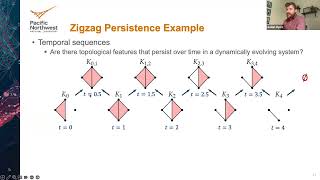
Understanding Temporal Hypergraph Dynamics with Zigzag Persistence
Explore temporal hypergraphs and zigzag persistence to analyze complex systems' topological evolution, applied to cybersecurity and social networks for understanding underlying dynamics.
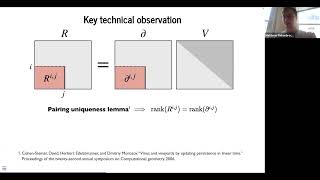
Spectral Relaxations of the Persistent Rank Invariant - Applied Algebraic Topology Network
Spectral relaxations of persistent rank invariant: A framework for continuous relaxations, offering stability and differentiability while preserving key properties and enabling efficient GPU-parallelized computation.