Sketches of a Mathematical Theory of Qualia
Exploración matemática de los qualia: definición, estructura y relación con la teoría cuántica. Propone un modelo de conciencia basado en principios abstractos del comportamiento de dispositivos que detectan qualia.
Introduction to Geometric Control Theory - Lecture 4
Explore geometric control theory's advanced concepts, focusing on mathematical foundations and practical applications in dynamic systems and optimization.
Introduction to Geometric Control Theory - Lecture 3
Explore advanced concepts in geometric control theory, focusing on mathematical principles and applications in dynamic systems and optimization.
Introduction to Geometric Control Theory - Part II
Explore advanced concepts in geometric control theory, focusing on mathematical principles and applications in dynamic systems and optimization.
Introduction to Geometric Control Theory - Lecture 1
Explore geometric control theory fundamentals with expert Andrei Agrachev, covering key concepts and applications in this comprehensive lecture from ICTP Mathematics.
Perverse Sheaves and Resurgence in Borel Summation
Explore the connection between resurgence theory and perverse sheaves, focusing on Borel summation, Stokes phenomena, and alien derivatives in algebraic structures.
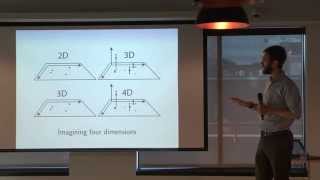
Topological Data Analysis - New Perspectives on Machine Learning - by Jesse Johnson
Explore geometric patterns in data and how abstract geometry concepts enhance machine learning algorithms. Gain insights into data structure through higher-dimensional perspectives.
From Hyperbolic Geometry to Data Clustering
Explore how hyperbolic geometry and knot theory inspire innovative data clustering algorithms, bridging abstract mathematics with practical data science applications.
Stabilizing the Unstable Output of Persistent Homology Computations
Explore stabilizing techniques for persistent homology computations, focusing on generating cycles and their applications in topological data analysis.
Sampling Smooth Manifolds Using Ellipsoids
Explore sampling smooth manifolds using ellipsoids, a novel approach requiring lower sample density than traditional ball-based methods, with potential applications in data science and topology.

Detecting Bifurcations in Dynamical Systems with Zigzag Persistent Homology
Explore zigzag persistent homology for efficient detection of bifurcations in dynamical systems, reducing computational costs and capturing topological changes in a single persistence diagram.
Alexander Wagner - Nonembeddability of Persistence Diagrams into Hilbert Spaces
Explore nonembeddability of persistence diagrams in Hilbert spaces, examining stability, metrics, and implications for machine learning applications in topological data analysis.
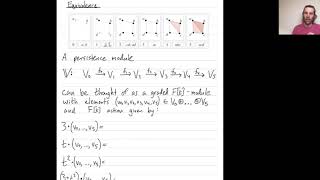
Computing Persistent Homology - Introduction
Explore the fundamentals of persistent homology computation, covering key concepts, intuition, and practical applications in topological data analysis.
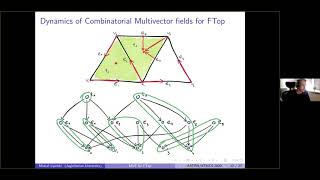
Conley-Morse-Forman Theory for Generalized Combinatorial Multivector Fields
Generalized combinatorial multivector fields on finite topological spaces: extending Conley-Morse-Forman theory for data science applications, including isolated invariant sets, Conley index, and Morse decompositions.
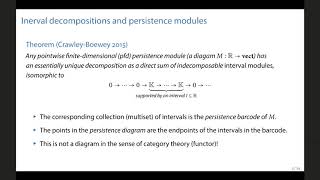
Ulrich Bauer - Persistence Diagrams as Diagrams
Explore persistence diagrams as categorical functors, examining their structure, stability, and relationships to matchings. Learn about new constructions and theorems in this advanced algebraic topology lecture.
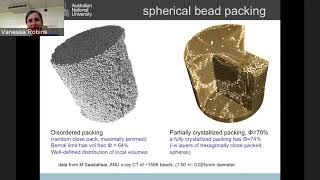
Vanessa Robins - Persistence Diagrams of Bead Packings
Exploring grain-scale mechanisms in granular crystallization using X-ray tomography and persistent homology, revealing key formation processes of tetrahedral and octahedral pores in spherical bead packings.
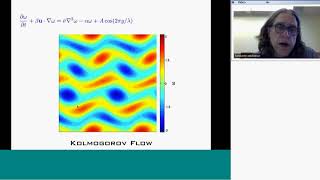
Nonlinear Dynamics, High Dimensional Data, and Persistent Homology
Explore nonlinear dynamics, high-dimensional data analysis, and persistent homology with Konstantin Mischaikow. Learn about algebraic topology applications, persistence diagrams, and recent advancements in data science.
Gunnar Carlsson - Local to Global Principles in Persistent Homology
Explore persistent homology's local-to-global principles, computational methods, and applications in topology and data analysis with expert Gunnar Carlsson.
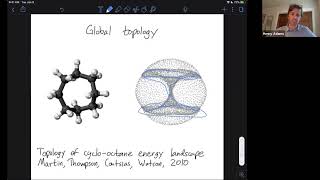
From Persistent Homology to Machine Learning
Overview of persistent homology's applications in machine learning, exploring its use in analyzing global topology and local geometry of datasets, with examples from various fields and discussions on stability and interpretability.
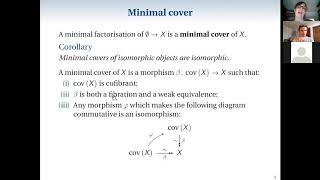
Invariants for Tame Parametrised Chain Complexes
Explore invariants for tame parametrised chain complexes in applied algebraic topology, focusing on explicit constructions, comprehensive frameworks, and discriminative power in topological data analysis.
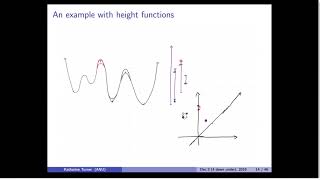
Why Should Q=P in the Wasserstein Distance Between Persistence Diagrams?
Explore Wasserstein distance in persistence diagrams, focusing on q=p choice. Covers geometric implications, stability results, algebraic versions, and computational advantages for central tendencies.