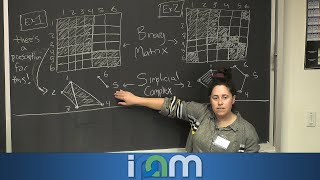
The ABCs of Topological Data Analysis for Matrix Analysis
Explore topological data analysis for matrix structure, focusing on persistent homology and Betti curves. Learn applications in neuroscience, including analysis of neural correlation matrices.
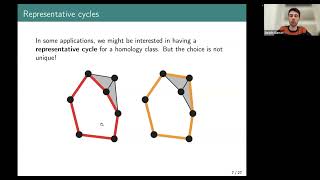
Harmonic Persistent Homology for Disentangling Multiway Interaction in Data
Explore Harmonic Persistent Homology for analyzing multi-omics data, uncovering hidden patterns in complex diseases, and identifying biomarkers associated with latent biological pathways.
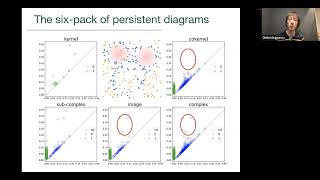
TDA for Chromatic Point Clouds
Generalizace persistentní homologie pro barevné bodové mraky. Detekce prostorových interakcí mezi různými typy bodů s aplikacemi v biologii a medicíně.
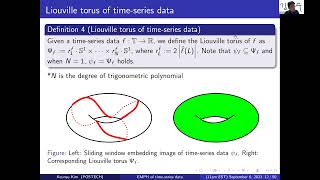
Exact Multi-Parameter Persistent Homology of Time-Series Data
Explore multi-parameter persistent homology for time-series data analysis, featuring an exact formula for one-dimensional reduction and efficient computational methods using Fourier decomposition and Liouville torus.

Teaching Neural Networks a Sense of Geometry
Explore Topological Data Analysis (TDA) and its intersection with machine learning to enhance neural networks' geometric reasoning abilities across various applications.
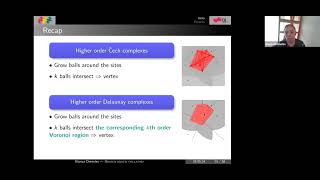
Collapsing Higher Order Čech to Higher Order Delaunay Complexes - Current Results and Open Questions
Explore higher order Čech and Delaunay complexes in TDA, examining their relationship through simplicial collapses and t-Voronoi regions. Discover current findings and open questions in this evolving field.

Topological Node2vec: Improving Graph Embeddings with Persistent Homology
Exploring persistent homology to enhance graph embeddings, combining topology with machine learning for improved data analysis and representation in complex networks.
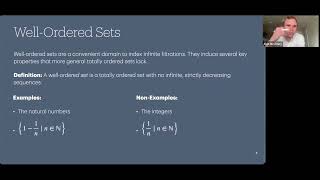
Persistent Homology for Infinite Complexes - Extending Theory to Infinite CW Complexes
Explore the extension of persistent homology to infinite CW complexes, including key theorems and applications in topological data analysis.
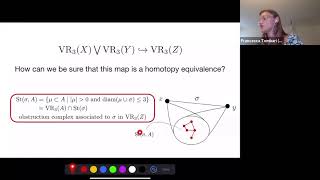
Decomposing Simplicial Complexes - Without Losing Pieces
Explore simplicial complex decomposition, its impact on homotopy type, and applications in Vietoris-Rips complexes. Learn about obstruction complexes and their role in understanding topological changes.
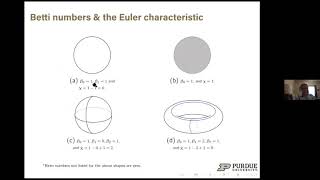
Andrew Thomas - Functional Limit Theorems for Euler Characteristic Processes
Explore functional limit theorems for Euler characteristic processes in Vietoris-Rips complexes, covering strong law of large numbers and central limit theorem in the thermodynamic regime.
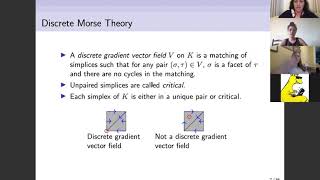
Morse-Based Fibering of the Rank Invariant
Explore multi-parameter persistence in data analysis using discrete Morse theory to compute rank invariants, partition parameter space, and deduce persistence diagrams for equivalent classes of lines.
Sheaves as Computable and Stable Topological Invariants for Datasets
Explores sheaf theory in topological data analysis, connecting level-sets persistence with derived sheaves. Presents functorial equivalences, stability theorems, and barcode decompositions for continuous data analysis.
The Gromov-Hausdorff Distance Between Spheres
Explore the Gromov-Hausdorff distance between spheres, its applications in geometry and topology, and methods for calculating precise values between specific sphere pairs.
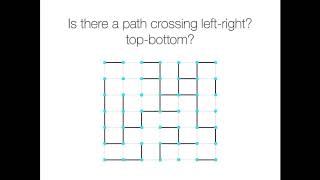
Homological Percolation: The Formation of Giant Cycles
Explore homological percolation, analyzing giant cycles in random structures and their phase transitions. Learn to differentiate signal from noise in persistence diagrams and discover connections to Euler characteristic curves.
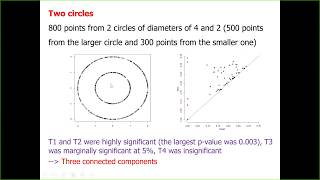
Modeling and Replicating Persistence Diagrams
Explore modeling and replicating persistence diagrams for statistical inference in topological data analysis. Learn about RST approach, parametric modeling, and improvements for clustered data.
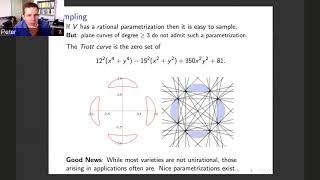
Bernd Sturmfels - Learning Algebraic Varieties from Samples
Explore algebraic varieties through sampling, focusing on topology and geometry. Learn algorithms for determining dimensions and polynomials, with practical applications in Julia.
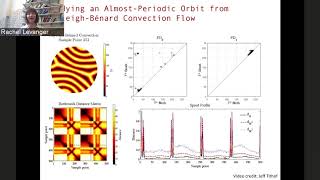
Rachel Levanger - A Comparison Framework for Interleaved Persistence Modules
Explore rigorous tracking of noise in persistent homology, comparing approximation techniques and addressing non-uniform sub-level set filtrations in topological data analysis.
An Approximate Nerve Theorem
Explore the Nerve Theorem's application in topological data analysis, focusing on epsilon-acyclic covers and their impact on persistent homology approximations in space filtrations.
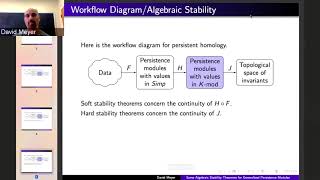
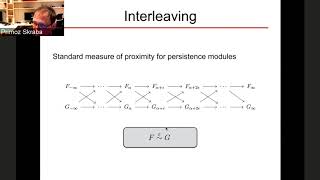
David Meyer - Some Algebraic Stability Theorems for Generalized Persistence Modules
Algebraic stability theorems for generalized persistence modules, exploring interleaving metrics, bottleneck metrics, and isometry theorems in the context of poset algebras and quiver representations.

Pawel Dlotko - A Few Simple Stories on Topology in Action
Explore practical applications of computational topology in material science, dynamical systems, and brain research. Learn how theory and algorithms work together to solve real-world problems.
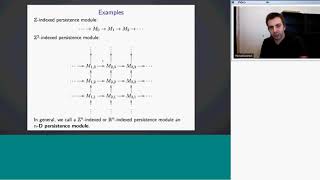
Michael Lesnick - Algebraic Stability of Zigzag Persistence Modules
Explore algebraic stability in zigzag persistence modules, covering key concepts, theorems, and applications in topological data analysis and computational topology.