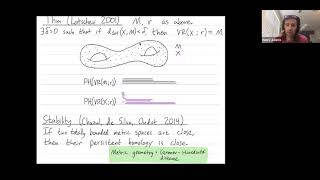
Vietoris-Rips Thickenings - Problems for Birds and Frogs
Explore open problems in Vietoris-Rips complexes, connecting diverse mathematical areas. Suitable for both broad theorists and problem-solving specialists in applied algebraic topology.

Introduction to Cubical Complexes and Persistence - 2020
Explore cubical complexes and cubical homology for efficient analysis of digital images using persistent homology, with applications in topological data analysis.
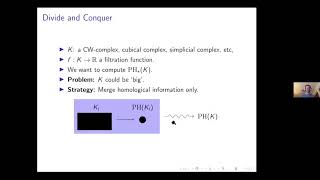
The Persistence Mayer-Vietoris Spectral Sequence
Explore the persistent Mayer-Vietoris spectral sequence, its applications in parallelizing persistent homology computations, and its ability to provide locality-enriched persistence barcodes.
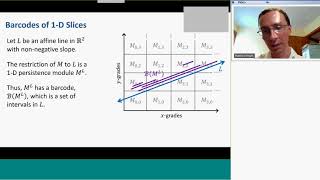
Visualizing 2 Dimensional Persistent Homology
Explore techniques for visualizing 2D persistent homology, a powerful tool in topological data analysis, to gain insights into complex datasets and their underlying structures.
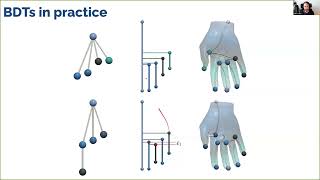
Julien Tierny - Principal Geodesic Analysis of Merge Trees and Persistence Diagrams
Computational framework for Principal Geodesic Analysis of merge trees, adapting PCA to Wasserstein metric space. Efficient algorithm for data reduction and dimensionality reduction in topological data analysis.
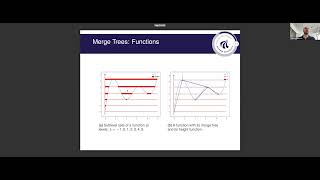
Data Analysis with Merge Trees
Explore merge trees as topological summaries in data analysis, including their advantages over persistence diagrams, computational challenges, and applications in functional data and medical imaging.
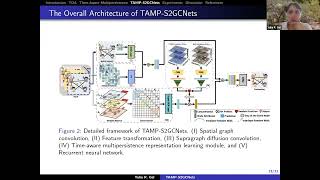
Coupling Time-Aware Multipersistence with Graph CNNs for Time Series Forecasting
Explore innovative time series forecasting using Graph Neural Networks and multipersistence, applied to traffic flow, cryptocurrency prices, and COVID-19 hospitalizations.

Algebraic Perspectives of Persistence
Explore algebraic approaches to persistent homology, focusing on the stability of persistence diagrams and their relation to input data changes in topological data analysis.

Novel Computational Perspectives of Persistence
Explore innovative computational approaches to persistence in algebraic topology, focusing on advanced techniques and their applications in data analysis and topological research.
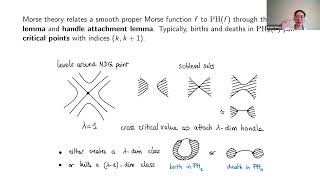
Generalized Morse Theory of Distance Functions to Surfaces for Persistent Homology
Unifying distance fields, persistent homology, and Morse theory to quantify complex shape textures, with applications in characterizing vascular structures in leukemia samples.

Topological Data Analysis on Dynamic Brain Networks
Explore topological data analysis for dynamic brain networks, learning to cluster networks into states and analyze temporal changes using Wasserstein distance. Gain insights into state space estimation and heritability of network changes.
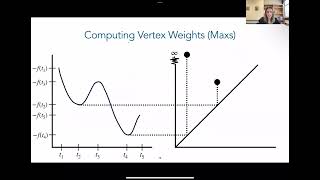
Time Series and Biological Network Analysis via Directed Graphs
Explore robust techniques for analyzing biological time series data using directed acyclic graphs, focusing on extremal events and applications in genomic research and network analysis.
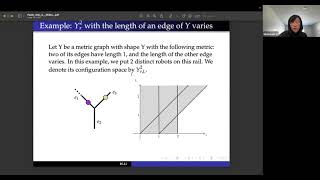
Two-Parameter Persistent Homology of Second Configuration Spaces in Star Graphs
Explore configuration spaces in robot motion planning, focusing on 2-parameter persistent homology of second configuration spaces of star graphs with restraint parameters.
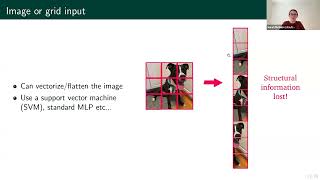
Classification of Euler Characteristic Transforms Using CNNs - 5/9/24
Explore how Euler Characteristic Transforms and CNNs can be used for shape classification, with a focus on leaf datasets. Learn about ECT-CNN pipeline, rotation equivariance, and practical applications.
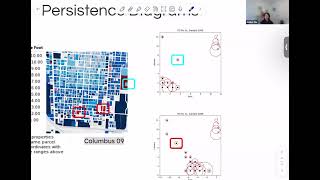
Topological Data Analysis in Economic Context - Property Tax Maps
Exploring property tax patterns using topological data analysis to classify housing structures and regional demographics, offering new insights into community organization and economic indicators.
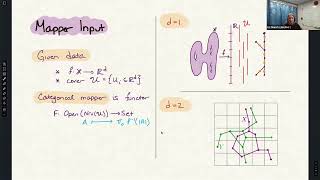
Bounding the Interleaving Distance for Mapper Graphs with a Loss Function
Exploring interleaving distance for Mapper graphs, introducing a loss function to measure assignment quality and enable polynomial-time computation for data comparison and clustering.
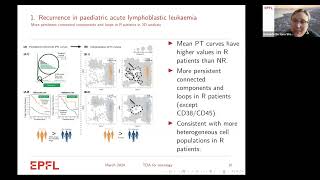
Applications of Topology to Oncology Data
Exploring Persistent Homology in oncology: predicting leukaemia relapse risk and analyzing tumor microenvironments using topological data analysis and machine learning techniques.
Data Analysis Using Zigzag Persistence for Temporal Hypergraphs
Explore temporal hypergraphs and zigzag persistence in Topological Data Analysis to understand complex systems' evolution, with applications in cybersecurity and social networks.

Informational and Topological Signatures of Individuality in Network Neuroscience
Exploring brain function through topological data analysis, demonstrating improved individual and age discrimination using algebraic-topological features extracted from resting fMRI data compared to traditional methods.
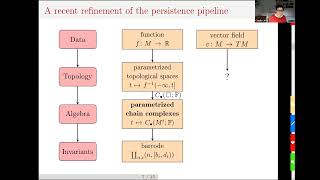
Barcodes for the Topological Analysis of Gradient-Like Vector Fields
Explore topological analysis of gradient-like vector fields using barcodes. Learn about chain complexes, parametrization, and applications in smooth and discrete settings, with insights on stability and approximation.

Discrete Morse Graph Skeletonization and Application to Local Structures of scRNA-seq Data
Explores topological data analysis for extracting graph skeletons from high-dimensional data, with applications in analyzing local structures of scRNA-seq datasets across brain regions.