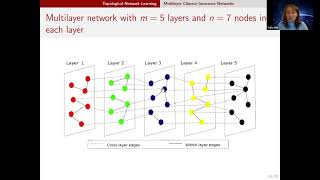
Yulia Gel - Topological Clustering of Multilayer Networks
Explore topological clustering of multilayer networks, focusing on higher-order interactions and local neighborhood shapes. Learn applications in climate-insurance and COVID-19 data analysis.

Detecting Bifurcations in Dynamical Systems with Zigzag Persistent Homology
Explore zigzag persistent homology for efficient detection of bifurcations in dynamical systems, reducing computational costs and capturing topological changes in a single persistence diagram.
Alexander Wagner - Nonembeddability of Persistence Diagrams into Hilbert Spaces
Explore nonembeddability of persistence diagrams in Hilbert spaces, examining stability, metrics, and implications for machine learning applications in topological data analysis.
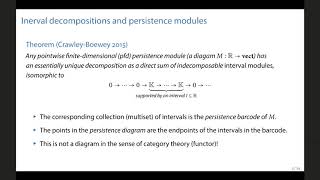
Ulrich Bauer - Persistence Diagrams as Diagrams
Explore persistence diagrams as categorical functors, examining their structure, stability, and relationships to matchings. Learn about new constructions and theorems in this advanced algebraic topology lecture.
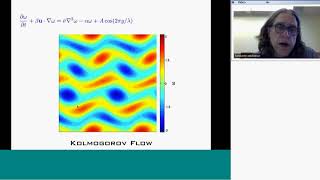
Nonlinear Dynamics, High Dimensional Data, and Persistent Homology
Explore nonlinear dynamics, high-dimensional data analysis, and persistent homology with Konstantin Mischaikow. Learn about algebraic topology applications, persistence diagrams, and recent advancements in data science.
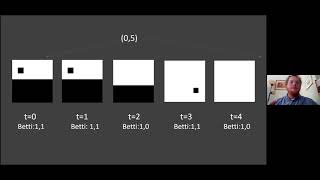
A Canonical Framework for Summarizing Persistence Diagrams
Explore a canonical framework for summarizing persistence diagrams in topological data analysis, including theoretical foundations, applications, and future developments.
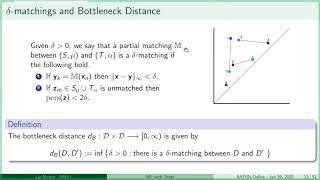
Liz Munch - Featurization of Persistence Diagrams Using Template Functions for ML Tasks
Explore topological data analysis and persistence diagrams for machine learning, focusing on featurization techniques using template functions to map complex data into Euclidean space.
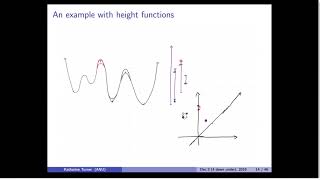
Why Should Q=P in the Wasserstein Distance Between Persistence Diagrams?
Explore Wasserstein distance in persistence diagrams, focusing on q=p choice. Covers geometric implications, stability results, algebraic versions, and computational advantages for central tendencies.
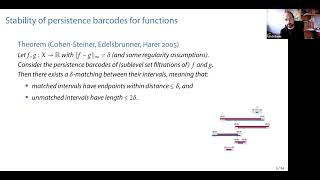
Persistence in Functional Topology
Explore functional topology's evolution, connecting persistent homology to critical point theory and calculus of variations. Gain insights into Morse's theory and its application to minimal surfaces.
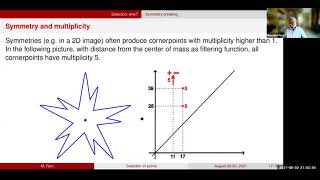
Massimo Ferri - Selection of Points in Persistence Diagrams
Explore point selection in persistence diagrams, including Kurlin's criterion and the Ziqqurat method, for noise reduction and improved data analysis in topological data analysis.
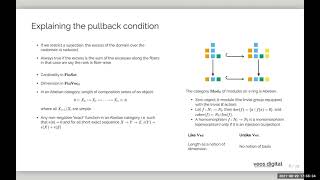
Comparing Neural Networks via Generalized Persistence
Exploring generalized persistence to compare neural network architectures, analyzing data representations at each layer and providing insights into network behavior and performance.

The Generalized Persistence Diagram Encodes the Bigraded Betti Numbers
Explore how generalized persistence diagrams encode bigraded Betti numbers in 2-parameter persistence modules, with implications for RIVET software and interval decomposable modules.
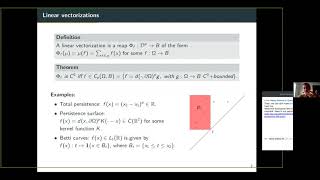
Studying the Space of Persistence Diagrams Using Optimal Partial Transport II
Exploring persistence diagrams through optimal transport theory, bridging topological data analysis with measure spaces to characterize convergence and prove new results in random settings.
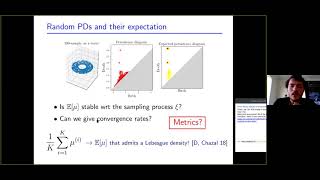
Studying the Space of Persistence Diagrams Using Optimal Partial Transport - Part I
Exploring persistence diagrams through optimal partial transport, bridging topological data analysis with measure theory. Novel approach enables new insights into convergence, continuity, and random settings in TDA.
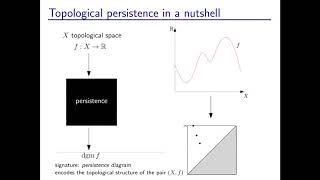
On the Metric Distortion of Embedding Persistence Diagrams into RKHS
Explores embedding Persistence Diagrams into Reproducing Kernel Hilbert Spaces, analyzing metric properties and stability guarantees for machine learning applications in Topological Data Analysis.
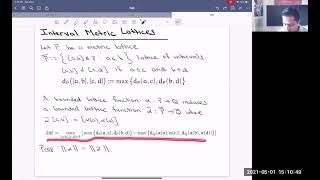
Edit Distance and Persistence Diagrams Over Lattices
Functorial pipeline for persistent homology: from filtered simplicial complexes to persistence diagrams. Addresses multiparameter persistent homology and functoriality of persistence diagrams.
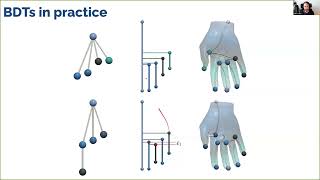
Julien Tierny - Principal Geodesic Analysis of Merge Trees and Persistence Diagrams
Computational framework for Principal Geodesic Analysis of merge trees, adapting PCA to Wasserstein metric space. Efficient algorithm for data reduction and dimensionality reduction in topological data analysis.
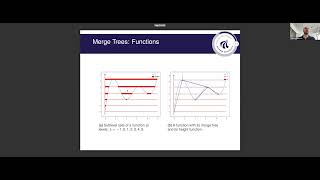
Data Analysis with Merge Trees
Explore merge trees as topological summaries in data analysis, including their advantages over persistence diagrams, computational challenges, and applications in functional data and medical imaging.

Algebraic Perspectives of Persistence
Explore algebraic approaches to persistent homology, focusing on the stability of persistence diagrams and their relation to input data changes in topological data analysis.
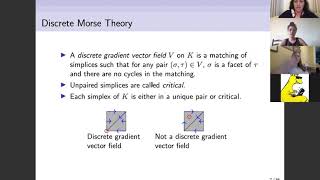
Morse-Based Fibering of the Rank Invariant
Explore multi-parameter persistence in data analysis using discrete Morse theory to compute rank invariants, partition parameter space, and deduce persistence diagrams for equivalent classes of lines.
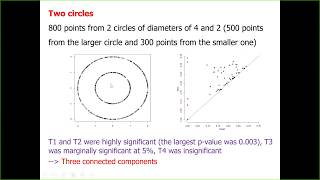
Modeling and Replicating Persistence Diagrams
Explore modeling and replicating persistence diagrams for statistical inference in topological data analysis. Learn about RST approach, parametric modeling, and improvements for clustered data.