An Intrinsic Persistent Homology Transform
Explores an intrinsic persistent homology transform for metric spaces, focusing on metric graphs. Discusses injectivity results and compares to related constructs in topological data analysis.

Topological Data Analysis of Collective Motion
Explore topological data analysis for collective motion in nature, examining bird flocks, fish schools, and insect swarms through innovative mathematical models and simulations.
The Vietoris Rips Complex of the Circle
Explore the Vietoris-Rips complex of the circle, its homotopy types at different thresholds, and implications for persistent homology in topological data analysis.
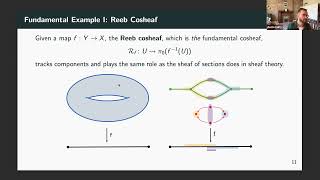
Exemplars of Sheaf Theory in TDA
Exploring sheaf theory applications in topological data analysis through four case studies, covering level set persistence, merge trees, and innovative approaches to persistent homology.
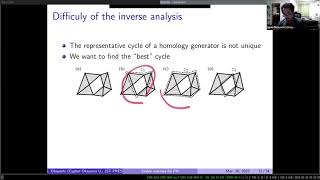
Ippei Obayashi - Stable Volumes for Persistent Homology
Explore stable volumes in persistent homology: a novel method to identify robust topological structures in data, overcoming instability issues and revealing minimal building blocks.
Stability of 2-Parameter Persistent Homology
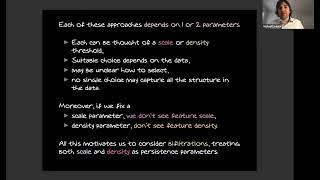
Explores stability results for 2-parameter persistent homology, covering multicover bifiltration, subdivision bifiltrations, and degree bifiltrations. Discusses computational aspects and implications for practical applications.
Don Sheehy - Persistent Homology of Lipschitz Extensions
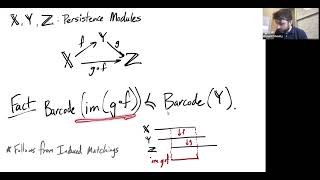
Explore persistent homology of Lipschitz functions, analyzing sublevel set filtrations and barcodes from sample data. Learn about sub-barcodes and their theoretical guarantees in topological data analysis.
Multi-Parameter Persistent Homology is Practical
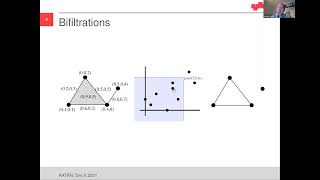
Explore practical applications of multi-parameter persistent homology in topological data analysis, focusing on efficient algorithms for large datasets and recent computational advancements.
Statistics, Topology and Data Analysis
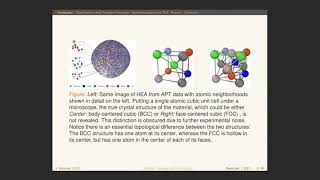
Explore the synergy between statistics and topological data analysis for solving real-world problems, with a focus on supervised learning and applications in materials science.
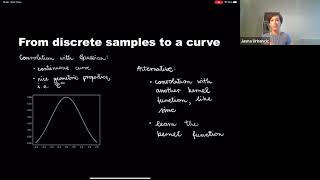
Optimizing Embedding Using Persistence
Explore optimizing Takens-type embeddings of time series using persistent (co)homology. Learn practical approaches for finding good embeddings and discuss the space of embeddings and open questions.
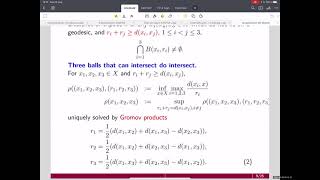
Geometry and Topology of Data
Explore geometric and topological properties of data sets, including curvature concepts and their relation to hyperconvexity, offering new insights into Topological Data Analysis.
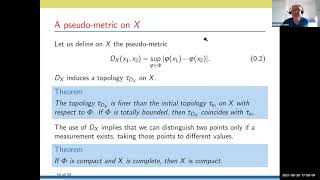
On the Role of Group Equivariant Non-Expansive Operators in TDA
Explore group equivariant non-expansive operators as tools for approximating data observers in Topological Data Analysis, focusing on their mathematical properties and applications.
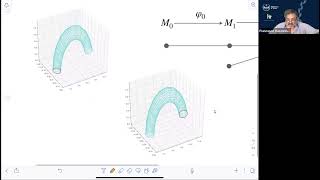
Parallel Decomposition of Persistence Modules Through Interval Bases
Explore parallel decomposition of persistence modules using interval bases, enhancing Topological Data Analysis with distributed computation and Hodge decomposition techniques.

Topological Data Analysis Based Machine Learning Models for Drug Design
Explores TDA-based models for effective molecular representation in drug design, combining persistent homology, spectral models, and Ricci curvature with machine learning for improved performance.
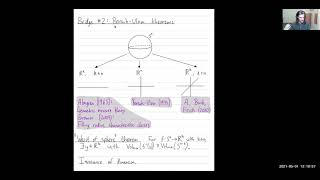
Bridging Applied and Quantitative Topology
Survey of emerging connections between applied and quantitative topology, focusing on Vietoris-Rips complexes and their applications in computational topology, geometric group theory, and dataset shape approximation.
Practical Clustering and Topological Data Analysis
Explore clustering algorithms and topological data analysis from a data science perspective, covering techniques from k-means to DBSCAN and dimensionality reduction methods like UMAP.
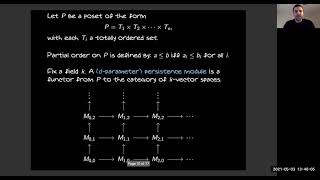
L-P Metrics on Multiparameter Persistence Modules
Explores generalizations of p-Wasserstein distance for multi-parameter persistence modules, introducing d_I^p and d_M^p metrics. Examines their properties and applications in topological data analysis.
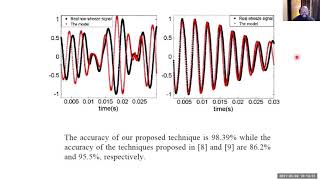
Quasiperiodicity and Persistent Kunneth Theorems
Explore quasiperiodicity in signals, persistent homology, and Kunneth theorems. Learn applications in time series analysis and computational chemistry through topological data analysis.
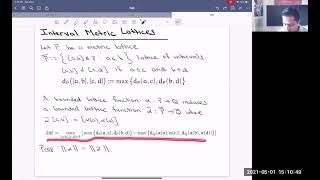
Edit Distance and Persistence Diagrams Over Lattices
Functorial pipeline for persistent homology: from filtered simplicial complexes to persistence diagrams. Addresses multiparameter persistent homology and functoriality of persistence diagrams.
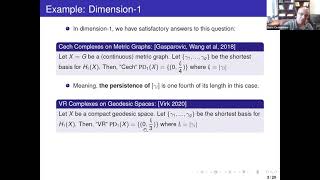
Geometric Approaches on Persistent Homology
Explore geometric interpretations of persistence diagrams, focusing on quantitative descriptions of homology class size and persistence, with analysis of power filtration on unweighted graphs.
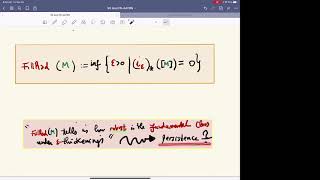
Vietoris-Rips Persistent Homology, Injective Metric Spaces, and The Filling Radius
Explore geometric persistent homology, its isomorphism with Vietoris-Rips filtration, and applications in characterizing persistence barcodes, bounding intervals, and connecting to filling radius.