Entropy - Part 2 - Lecture 72
Explore advanced concepts of entropy, building on foundational knowledge to deepen understanding of thermodynamic principles and their applications.
Invasion Percolation - Part II
Explore advanced concepts of invasion percolation, building on fundamental principles to deepen understanding of fluid flow in porous media.
Percolation Theory
Explore percolation theory, its applications, and fundamental concepts in complex systems and network analysis.

Invasion Percolation - Part I
Explore invasion percolation concepts and applications in porous media flow modeling, focusing on fundamental principles and computational techniques.
Non-equilibrium Fermi Polarons in Driven-Dissipative Systems
Explore non-equilibrium Fermi polarons in driven-dissipative systems, focusing on kinetic equations, relaxation, and non-equilibrium distributions in two-dimensional materials and ultracold atomic gases.
Unusual Representations of Blackbody Radiation
Explore unusual representations of blackbody radiation, including thermofields and classical-like approaches, for a deeper understanding of thermal fields beyond conventional mixed-state models.
Cell Shape Variability and Its Implications in Epithelial Monolayers
Explore cell shape variability in epithelial monolayers, its universal distribution, origins, and implications for tissue dynamics and biological functions.
Direct Confocal Imaging of Fracture Precursors in Casein Gel
Explore direct confocal imaging of fracture precursors in casein gel under shear stress, using advanced microscopy techniques to observe microstructural changes before failure.
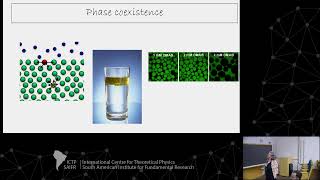
Phase Coexistence, Interface Tension and Convexity of Thermodynamic Potentials
Explore phase coexistence, interface tension, and thermodynamic potential convexity in condensed matter theory with expert insights from IFUSP.
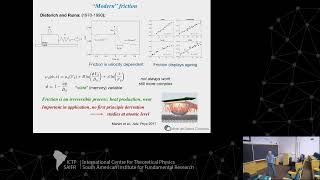
Markov Dynamics and Entropy Production in a Prandtl-Tomlinson Model for Friction
Explore Markov dynamics and entropy production in friction models, focusing on the Prandtl-Tomlinson approach for advanced condensed matter theory insights.
Tutorial Session on Emergent Phenomena in Non-Equilibrium Quantum Many-Body Systems
Explore emergent phenomena in non-equilibrium quantum many-body systems through an expert-led tutorial session.
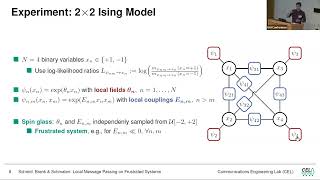
Local Message Passing on Frustrated Systems - UAI Oral Session 6
Explore an alternative message passing algorithm for cyclic graphs, challenging SPA's extrinsic principle and optimizing factor node updates for improved performance on complex networks.
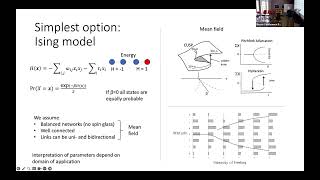
Modeling Psychological Systems with Ternary Spin Models
Explore how ternary spin models enhance psychological research by extending binary network models to include neutral states, offering richer dynamics for analyzing depression, intelligence, and attitude changes.
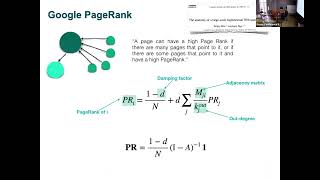
From Centrality Measures to Nanowire Networks - Disordered Systems Methods to the Rescue
Explore advanced network analysis techniques, from centrality measures to nanowire networks, using disordered systems methods to understand complex network dynamics and neuromorphic computing applications.
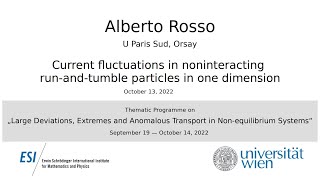
Current Fluctuations in Noninteracting Run-and-Tumble Particles in One Dimension
Explore current fluctuations in noninteracting run-and-tumble particles, focusing on flux distribution through origin and anomalous large-deviation form in active particles.
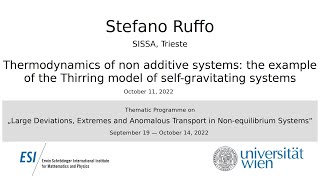
Thermodynamics of Non-Additive Systems: The Example of the Thirring Model
Explore thermodynamics of non-additive systems through the Thirring model, examining ensemble inequivalence and equilibrium states in long-range interacting systems.
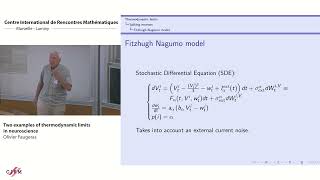
Two Examples of Thermodynamic Limits in Neuroscience
Explore thermodynamic limits in neuroscience through two examples, gaining insights into stochastic analysis and numerical probability in mathematical biology.
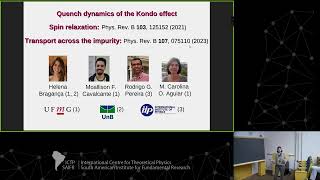
Quench Dynamics of the Kondo Effect
Explore quench dynamics of the Kondo effect in quantum materials, focusing on inhomogeneities, frustration, and topology in strongly correlated electron systems.

Understanding the KPZ Problem - A New Perspective on Random Geometry and Universal Statistics
Delve into the universal properties of random geometries and geodesics in the KPZ framework, exploring statistical mechanics, probability theory, and mathematical physics applications.
1D Statistical Mechanics and Resurgence
Explore advanced concepts in one-dimensional statistical mechanics and resurgence theory through mathematical physics principles and analytical techniques.
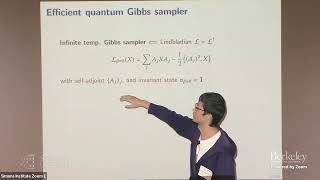
Quantum Gibbs Samplers: Simulation and Convergence Analysis
Delve into quantum Gibbs sampling through Lindblad dynamics, exploring efficient sampling methods and convergence properties in open quantum systems.