
The Startling Reason Entropy and Time Only Go One Way
Explore the fascinating connection between entropy, probability, and the unidirectional flow of time. Discover why natural phenomena tend towards lower energy states and how this relates to the universe's increasing disorder.
SYK III: Entanglement, Non-equilibrium Dynamics and Thermalization - Lecture 3
Explore entanglement, non-equilibrium dynamics, and thermalization in quantum systems. Delve into advanced concepts of quantum information theory and their applications in many-body physics.
Quantum Information Processing and Simulation with Rydberg Atom Arrays - Class 1
Explore quantum information processing and simulation using Rydberg atom arrays in this advanced physics lecture, part of a series on non-equilibrium quantum systems.
Artificial Chemical Intelligence: AI for Chemistry and Chemistry for AI
Explore the integration of AI with chemistry, focusing on trustworthy frameworks for molecular discovery. Learn about innovative approaches to predict mechanisms and overcome challenges in computational chemistry.
Machine Learning and the Real Space Renormalization Group
Explore the intersection of machine learning and renormalization group theory, focusing on real-space applications and information theory perspectives in physics.
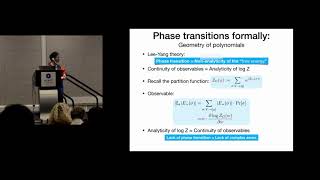
A Deterministic Algorithm for Counting Colorings with 2Δ Colors
Explore a deterministic algorithm for counting colorings, delving into phase transitions, partition functions, and entropy conditions in graph theory.
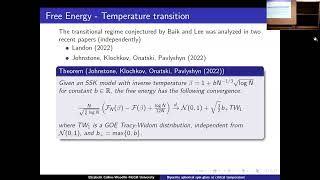
Bipartite Spherical Spin Glass at Critical Temperature - With a Random Matrix Detour
Explore the intricacies of bipartite spherical spin glass at critical temperature, including insights from random matrix theory in this advanced probability seminar.
Table Partitioning 101
Learn table partitioning in SQL Server: advantages, disadvantages, implementation, and best practices for improved database management and performance optimization.
Statistical Mechanics of Consciousness - Maximization of Information Content of Neuronal Networks Is Associated With Conscious Awareness
Explore statistical mechanics approach to consciousness, examining brain network complexity and information processing optimization in conscious vs. unconscious states.
Temperature Dependence of Fermi Level
Explore the temperature-dependent behavior of the Fermi level in semiconductors, understanding its impact on electronic properties and device performance.

Phonon Heat Capacity and Its Contribution to Solids' Thermal Properties - Lecture 53
Explore thermal properties of phonons and their contribution to heat capacity in solids. Gain insights into fundamental concepts of solid-state physics.
Nonequilibrium Atom-Field Interactions at Finite Temperature
Explore nonequilibrium interactions between atoms and material-modified thermal vacuum, examining deviations from blackbody radiation near surfaces and discussing emergence of blackbody-radiation-induced effects.
Efficient Learning of Ground and Thermal States Within Phases of Matter
Delve into advanced quantum computing concepts, focusing on efficient methods for learning ground and thermal states in matter phases, with emphasis on sample complexity and algorithmic improvements.
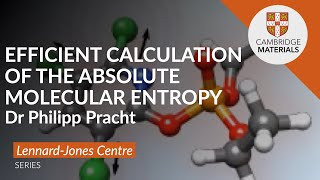
Efficient Calculation of the Absolute Molecular Entropy
Learn efficient methods for calculating absolute molecular entropy, combining DFT and semi-empirical approaches to achieve chemical accuracy in free energy computations for realistic chemical reaction modeling.
A Weak Convergence Viewpoint on Invertible Coarse-Graining
Explore weak convergence in invertible coarse-graining, combining force-matching with neural networks to recover fine-grained free energy surfaces in biomolecular systems.
A Quantum Computing Algorithm to Speed Up Metropolis Sampling
Explore a quantum algorithm for accelerating Metropolis sampling in multidimensional systems, leveraging wave function collapses for non-local configuration space moves.
On the Limit Theory of Mean Field Optimal Stopping with Common Noise
Explore mean field optimal stopping with common noise, focusing on limit theory. Gain insights into mathematical finance concepts presented at the Eastern Conference.
Extensive Entropy Functionals and Non-Ergodic Random Walks
Explore extensive entropy functionals and non-ergodic random walks in statistical physics and complex systems.
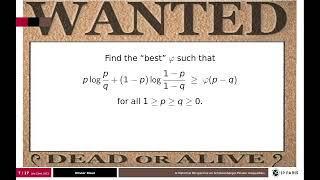
A Historical Perspective on Schützenberger-Pinsker Inequalities
Explore the historical development and significance of Schützenberger-Pinsker inequalities in information theory and probability theory.
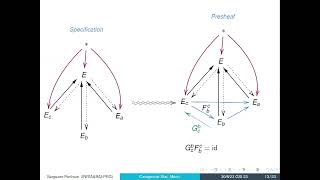
A Categorical Approach to Statistical Mechanics
Explore statistical mechanics through a categorical lens, gaining insights into complex systems and thermodynamic principles.
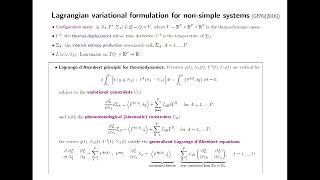
Hamiltonian Variational Formulation for Non-Simple Thermodynamic Systems
Explore Hamiltonian variational formulation for complex thermodynamic systems, gaining insights into advanced mathematical approaches in physics and engineering.