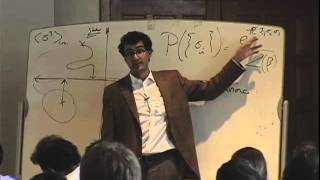
Coarse-Graining, Renormalization and Universality - Lecture 1
Explore coarse-graining, renormalization, and universality in complex systems. Learn key concepts and applications in mathematical, biological, cognitive, and social sciences.
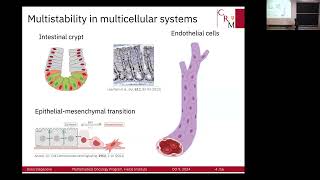
A Method to Coarse-Grain Multi-Agent Stochastic Systems with Regions of Multistability
Dive into a mathematical oncology seminar exploring coarse-graining techniques for multi-agent stochastic systems, focusing on regions of multistability in cancer modeling.
Black Hole Coarse Graining, Connes-Cocycle Flow, and Its Bulk Dual - Raphael Bousso
Explore black hole coarse graining, Connes-Cocycle flow, and its bulk dual in this advanced physics lecture, delving into entanglement wedge complementarity and ensemble interpretation.
Random Matrix Theory and Its Applications - Lecture 5
Explore advanced random matrix theory concepts, including Gaussian ensembles, coarse-graining techniques, and the Wigner semi-circular law in this comprehensive lecture.
Learning Uncertainty-Aware Models of Defect Kinetics at Scale - IPAM at UCLA
Explore advanced techniques for modeling metal properties, including energy landscape exploration, coarse-graining with uncertainty quantification, and descriptor-based approaches for capturing diverse material characteristics.
Slow Time-Scale Behavior of Fast Microscopic Dynamics - IPAM at UCLA
Explores computational methods for understanding slow time-scale behavior of rapid microscopic dynamics, with applications in materials modeling and plasticity. Presents theory and examples for coarse-graining complex systems.
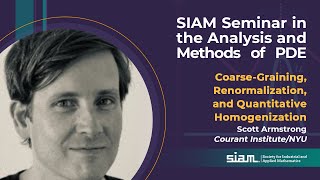
Coarse-graining, Renormalization, and Quantitative Homogenization in PDE Analysis
Explore quantitative homogenization in elliptic and parabolic equations, focusing on coarse-graining and renormalization techniques. Discuss applications to degenerate equations and mathematical physics models.
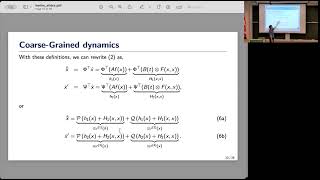
Learning Coarse-Grained Dynamics on Graphs
Explore coarse-grained dynamics on graphs with John Harlim, delving into advanced machine learning techniques for dynamical systems analysis and modeling.
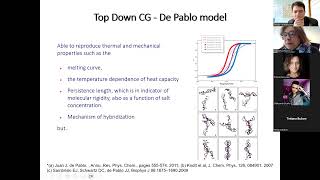
Coarse Graining and Multiscale Modeling of DNA - Part 2
Delve into advanced DNA modeling techniques, exploring coarse graining and multiscale approaches for understanding complex molecular structures and interactions at different computational levels.
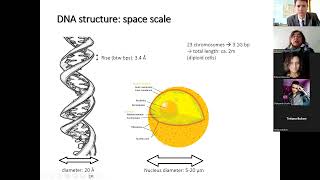
Coarse Graining and Multiscale Modeling of DNA - Part 1
Explore advanced computational techniques for DNA modeling, focusing on coarse-graining methods and multiscale approaches to understand DNA structure and dynamics at different resolutions.
Chemically Transferable Generative Backmapping of Coarse-Grained Proteins
Explore innovative machine learning techniques for generative backmapping of coarse-grained proteins, focusing on transferability, reliability, and efficiency in molecular simulations.
Machine Learning Gradients in Molecular Simulations
Explore ML gradients in molecular simulations, including surrogate functions, active learning, and differentiable programming for enhanced scientific modeling and optimization.
A Weak Convergence Viewpoint on Invertible Coarse-Graining
Explore weak convergence in invertible coarse-graining, combining force-matching with neural networks to recover fine-grained free energy surfaces in biomolecular systems.
Continuous Upscaling in Multiscale Modeling
Explore continuous upscaling methods for multi-scale modeling. Learn about gradual smoothing transformations, upscaling rules for various physical quantities, and applications to steady-state diffusion problems.