Running Plain Kubernetes Pods on SLURM - April 17, 2024
Explore innovative techniques for running Kubernetes pods on SLURM, bridging cloud-native and HPC environments for enhanced computational workflows and resource management.
Machine Learning Meets Data Assimilation - Physics-Based Data-Driven Digital Twins
Explore the intersection of machine learning and data assimilation for creating physics-based, data-driven digital twins in weather and climate modeling.
Deep Learning and Numerical Methods Intersections for Improving Molecular and Fluid Dynamics
Explore intersections of deep learning and numerical methods to enhance molecular and fluid dynamics simulations, improving accuracy and efficiency in scientific computations.
Pods Everywhere - InterLink: Virtual Kubelet Abstraction for HPC Resource Exploitation
Explore InterLink, an open-source Virtual-Kubelet extension enabling seamless access to external hardware-accelerated machines through Kubernetes APIs, revolutionizing scientific computing workflows.
A Scalable Platform for Training and Inference Using Kubeflow at CERN
Explore CERN's Kubeflow-based machine learning platform for data preparation, analysis, training, and inference in physics research, with insights from the ATLAS experiment.
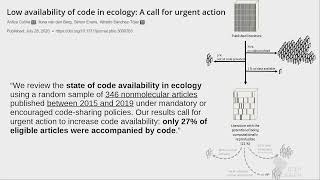
Quantitative Foundations of Ecological and Evolutionary Research - Class 11
Explore quantitative foundations of ecology and evolution, covering code publishing, best practices, GitHub usage, and scientific publishing processes.
Tackling the Challenges of High-Performance Graph Analytics at Compiler Level
Explore COMET, a DSL and compiler framework for efficient tensor algebra code generation, focusing on optimizations for high-performance graph analytics on heterogeneous systems.
Abstract Interpretation for Automatic Differentiation
Explore abstract interpretation for automatic differentiation, analyzing its application in machine learning, scientific computing, and graphics.
Axom: Building Blocks for High Performance Scientific Computing Applications - Tutorial 2024
Explore Axom's robust software components for building high-performance scientific computing applications, fostering collaboration and shared infrastructure across projects.
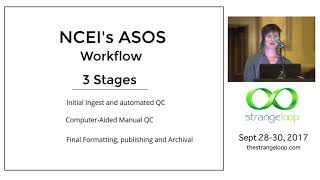
Onyx-Native, Information Flow Models and Scientific Computing
Explore Onyx-Native library for modernizing legacy scientific computing systems, focusing on information flow models and their application to complex, long-lived codebases like NOAA's ASOS Ingest System.
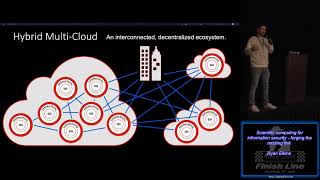
Scientific Computing for Information Security - Forging the Missing Link
Explore scientific computing's role in information security, focusing on data analytics, automation, and practical examples to enhance effectiveness and solve industry challenges.
The Language of Programming
Exploring programming through linguistics, examining code as language and collaboration. Insights from grammar theory, language acquisition, and sociolinguistics to enhance programming practices and perspectives.
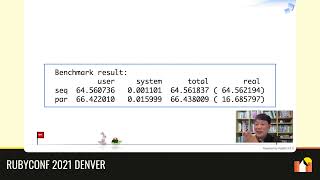
Keynote - Beyond Ruby 3.0
Explore Ruby's future beyond 3.0 with creator Yukihiro Matsumoto. Discover advancements in static typing, concurrency, syntax, performance, and tools shaping the language's evolution.

A Taste of Julia
Explore Julia's Lisp-inspired features and modern optimization techniques for scientific computing, highlighting its high-level syntax and high-performance capabilities.

A Tour of Julia
Explore Julia's high-performance capabilities, JIT compilation, and unique features like meta-programming and multiple dispatch. Learn how it combines Python-like productivity with C/C++-level performance.
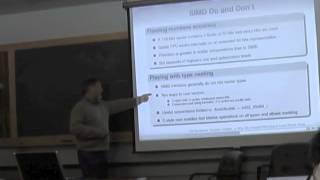
The Numerical Template Toolbox for High Performance Computing
Explore the Numerical Template Toolbox for high-performance computing in C++, focusing on efficient array operations, architectural optimization, and intuitive API design using Boost components.
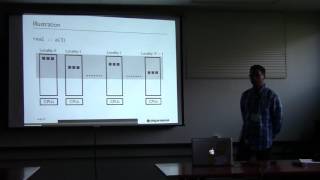
Extending C++ with Co-Array Semantics
Extending C++ with co-array semantics for efficient distributed computing in HPX, enabling SPMD schemes and simplified data transfer between localities in scientific applications.
The Julia Language and C++ - The Perfect Marriage
Explore Julia's integration with C++, showcasing its high performance, dynamic dispatch, and seamless interfacing capabilities through Cxx.jl and CxxWrap.jl, with interactive examples and benchmarks.
Docker and Python - Making Them Play Nicely and Securely for Data Science and ML
Docker best practices for data science and machine learning: optimizing image builds, ensuring security, and implementing efficient deployment workflows for data-intensive applications.
Diving into Scientific Python
Explore scientific Python with Python(x,y), a comprehensive distribution for data analysis, visualization, and numerical computing.
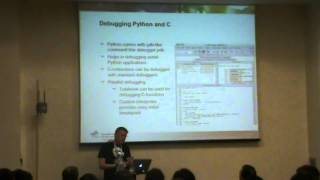
Python for High Performance and Scientific Computing
Explore Python's capabilities for high-performance and scientific computing, enhancing your skills in numerical simulations and data analysis for research and industry applications.