Open-Source Initiatives and Benchmarking Efforts in Machine Learning for Drug Discovery - Day 5
Explore open-source initiatives and benchmarking efforts in machine learning for drug discovery with Karmen Condic-Jurkic from Valence Labs.
Supporting NASA Science with OpenStack - Infrastructure and Applications in Space Research
Discover how NASA leverages OpenStack cloud infrastructure to support space telescopes and scientific missions, exploring architecture, networking, storage solutions, and real-world applications.

NumPy Tutorial for Physicists, Engineers, and Mathematicians - 2022
Comprehensive NumPy tutorial for STEM professionals, covering array operations, calculus, statistics, linear algebra, and practical examples tailored to physics, engineering, and mathematics.
Bouncy Balls Simulation in 3D - Episode 6
Explore 3D bouncy ball simulations using VPython. Learn about collisions, pressure, temperature, and the Ideal Gas Law through interactive coding and experimentation.
Octave Tutorial for Machine Learning
Comprehensive Octave tutorial covering basic to advanced concepts, including data types, math operations, vectors, matrices, and linear algebra for machine learning applications.

Python NumPy for Your Grandma
Learn NumPy's array operations, indexing, math functions, and advanced techniques through easy-to-understand explanations and practical challenges. Perfect for beginners and experienced programmers alike.
PLSE Seminar Series - Eva Darulova - Programming with Numerical Uncertainties
Explore automated techniques for verifying and improving numerical software accuracy, addressing challenges in finite-precision arithmetic and error estimation for scientific computing applications.
Java Applications - Java Programming - Java Tutorial
Explore Java's versatile applications in web, mobile, embedded systems, AI/ML, and more. Learn how Java's platform independence enables diverse software development across industries.
Under a Microscope - Exploring Fast and Safe Rust for Biology
Explore how Rust's safety and performance revolutionize computational biology, enabling breakthroughs in protein and virus research. Learn about the field's challenges and opportunities for Rustaceans.
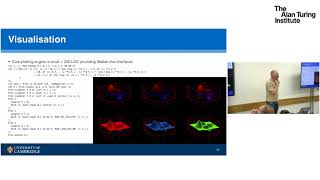
The Design of Functional Numerical Software - Dr. Richard Mortier, University of Cambridge
Explore functional numerical software with Owl, an OCaml library for scientific computing. Learn about its architecture, features, and applications in CPU, GPU, and browser environments.
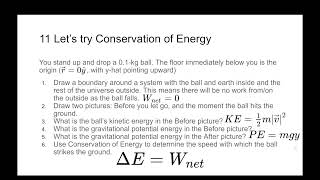
Graphing Energy Using VPython for Physics 1
Learn to visualize energy concepts through VPython coding, enhancing your understanding of physics principles and computational skills.
Modeling Data in Jupyter Notebook
Harness Python's power in Jupyter to analyze lab data, create models, and visualize results. Learn essential data manipulation techniques for physics research and experimentation.
Python Tutorial 2 - Arrays for Computational Physics Beginners
Learn to use arrays in Python for computational physics, covering essential concepts for undergraduate-level assignments in a beginner-friendly tutorial.
Rewriting Scientific Computing Tools in Rust - Challenges and Lessons Learned
Exploring Rust's potential in scientific computing by rewriting linear algebra, complex functions, and FFT from Octave. Discusses challenges, benefits, and lessons learned in improving scientific tools.

Sort in NumPy - Python Programming
Learn to efficiently sort arrays in NumPy using the sort() function, exploring its parameters and applications in Python data analysis and manipulation.
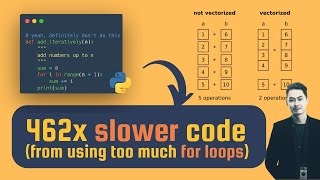
Use Less For-Loops, Use More Vectorization - Improving Code Efficiency
Optimize Python code by replacing for-loops with vectorization techniques, improving efficiency and speed while maintaining readability and functionality.

Java Language Features Q&A with Brian Goetz
Brian Goetz discusses Java language features, including Projects Amber and Valhalla, addressing topics like expressions, named arguments, union types, and future developments in AI, science, and gaming applications.

LANL's Journey Toward Computational Storage - Exploring Data Reduction Techniques for Petabyte-Scale Simulations
Explore LANL's innovative approaches to handling massive simulation data through computational storage techniques, focusing on efficient data reduction and analytics optimization for petabyte-scale operations.
Lessons Learned in Ceph Operations for Science at CERN - From 3PB to 100PB
Discover how CERN scaled Ceph from 3PB to 100PB across data centers, exploring operational challenges, performance improvements, and essential lessons for large-scale storage implementation.
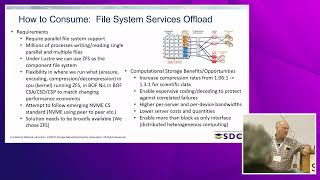
HPC Scientific Simulation and Computational Storage for Large-Scale Data Management
Explore how Los Alamos revolutionizes scientific data management using NVME Computational Storage, featuring proof-of-concept applications and industry partnerships for large-scale data solutions.
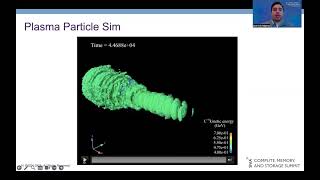
Streamlining Scientific Workflows - Computational Storage Strategies for HPC
Discover how computational storage strategies enhance scientific workflows in HPC environments, optimizing data processing for large-scale simulations and improving efficiency across I/O layers.