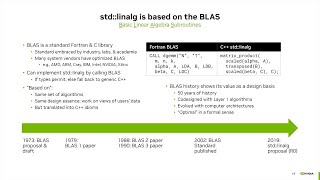
Linear Algebra Coming to Standard C++ - std::linalg
Explore std::linalg, a new C++ library for efficient linear algebra computations using modern C++ idioms. Learn its benefits, implementation, and potential impact on C++ development.

Model-Constrained Deep Learning Approaches for Scientific Machine Learning
Explore model-aware machine learning methods combining scientific computing and data-driven models. Learn about ROM-ML and Autoencoder-based Inversion approaches for PDE-constrained inverse problems.
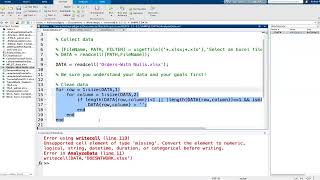
Data Cleaning with MATLAB - nanoHUB Tech Talk
Learn essential techniques for data cleaning in MATLAB, including handling missing values, removing outliers, and formatting data for analysis. Enhance your research and data processing skills.
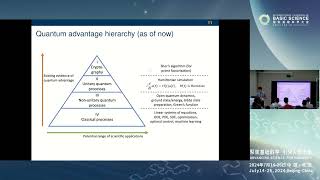
Quantum Advantage in Scientific Computation - ICBS 2024
Explore quantum computing's potential in scientific challenges, focusing on open quantum system dynamics and criteria for quantum advantages.
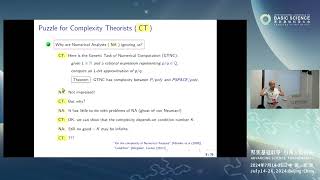
An Effective and Adequate Theory of Real Computation with Applications
Explore an effective theory of real computation, addressing inadequacies in current approaches and discussing applications in scientific and engineering disciplines.
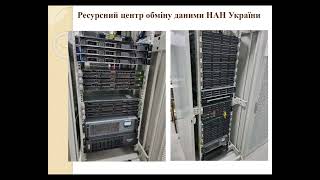
Ресурсний центр для грід- та хмарних технологій
Дізнайтеся про сучасні грід- та хмарні технології, їх застосування в науковій роботі та особливості функціонування ресурсного центру обміну даними в ІТФ НАН України.
Bayesian Tools for the Information Frontier at the LHC
Explore Bayesian machine learning tools and their applications in LHC particle physics research, focusing on information frontier analysis and scientific discovery methods.
Exon - A Built for Purpose Bioinformatics Database
Discover how purpose-built bioinformatics databases work through Exon's architecture, design principles, and practical applications in genomic data management and analysis.
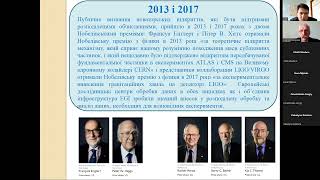
Принципи роботи HPC на прикладі комп'ютерного кластеру
Дізнайтеся про принципи роботи високопродуктивних обчислень (HPC) на реальному прикладі комп'ютерного кластера, його архітектуру та практичне застосування.

How C++23 Changes the Way We Write Code
Explore key C++23 features like std::expected, std::mdspan, deducing 'this', and std::print. Learn how these additions improve error handling, scientific computing, and simplify common idioms.
Floating Point Computations Today and in the Future
Explore floating-point computations, IEEE 754 standard, data compression techniques, POSIT arithmetic, and C++ libraries. Gain insights into deep learning and alternative FP formats.
Updates for the Wolfram Compiler, System Modeler and External Language Integration in Wolfram 14.1
Explore performance updates for Wolfram Compiler, new features in System Modeler, and advancements in external language integration in Wolfram Language and Mathematica version 14.1.
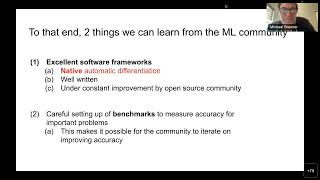
Scientific Uses of Automatic Differentiation - DDPS
Explore automatic differentiation's scientific applications beyond machine learning. Discover innovative approaches in PDEs, self-assembly, fluid dynamics, and protein modeling using large-scale optimization.
RADIUSS and HPCIC: Outreach Through Open-Source Software in the Exascale Era
Explore LLNL's open-source HPC software portfolio and learn about collaboration opportunities in the exascale era. Gain insights into innovative tools addressing emerging challenges in high-performance computing.
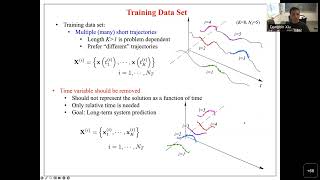
Data-Driven Modeling of Unknown Systems with Deep Neural Networks
Explore data-driven modeling of unknown systems using deep neural networks. Learn to discover and approximate evolution operators for predictive analysis across various problem domains.
Caliper, Hatchet, and Thicket: Open-Source Tools for HPC Performance Analysis
Explore open-source tools for integrating performance profiling, analyzing hierarchical data, and optimizing application performance on supercomputers. Learn to leverage Caliper, Hatchet, and Thicket for HPC environments.
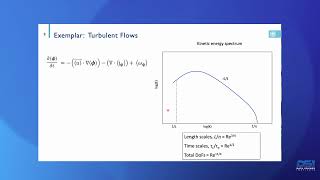
Higher-Order Multi-Variate Statistics for Scientific Data Analysis
Explore advanced multi-variate statistical techniques for scientific data analysis, focusing on higher-order methods like coskewness and cokurtosis for rare event detection and dimensionality reduction in complex systems.
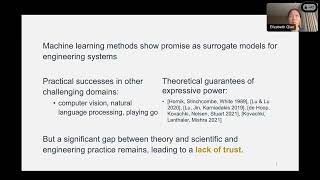
Multi-fidelity Linear Regression for Scientific Machine Learning from Scarce Data
Explore multi-fidelity linear regression for scientific machine learning, addressing data scarcity challenges in complex engineering systems through innovative training approaches.
WEAVE: Building Complex HPC Workflows - Tutorials 2024
Explore WEAVE's integrated tools for building complex HPC workflows, enhancing productivity and scientific quality through common infrastructure and tool integration.

The Mathematical Foundations of Deep Learning: From Rating Impossibility to Practical Existence Theorems
Explorez les fondements mathématiques de l'apprentissage profond, de l'impossibilité de notation aux théorèmes d'existence pratique. Découvrez les défis et les avancées dans ce domaine en pleine expansion.
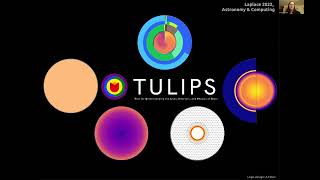
Visualizing MESA Models with TULIPS - How to Python
Learn to visualize MESA stellar evolution models using TULIPS Python package. Create plots and animations showing changes in stars over time. Enhance understanding of stellar structure and evolution.