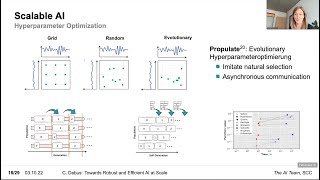
Towards Robust and Efficient AI at Scale
Explore robust, efficient AI for scientific time series forecasting. Learn scalable transformer architectures, energy optimization, and balancing performance with sustainability in large-scale AI applications.
Processing Very Large Image Volumes with the Adaptive Particle Representation
Explore advanced techniques for processing massive image datasets using adaptive particle representation, enabling efficient visualization and analysis of terabyte-scale biomedical data.
Bridging Domain Science and HPC with Julia
Explore Julia's potential in HPC, combining scientific ecosystem with high performance. Gain insights on its strengths, limitations, and notable international projects from an experienced user.

Kirk Lecture: A Recent Technology for Scientific Computing - The Virtual Element Method
Explore the Virtual Element Method, a generalization of FEM for solving PDEs using polygonal/polyhedral meshes, offering improved accuracy, efficiency, and flexibility in scientific computing.
ITensorNetworks.jl - Introduction to Tensor Network Algorithms in Julia
Explore tensor network algorithms and their implementation in Julia using ITensorNetworks.jl for efficient quantum many-body simulations.
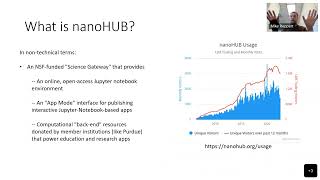
Hands-on Teaching with Jupyter Notebooks on nanoHUB
Explore hands-on teaching using Jupyter Notebooks on nanoHUB for chemistry courses. Learn to create interactive simulations, visualizations, and programming projects for enhanced student engagement and learning.
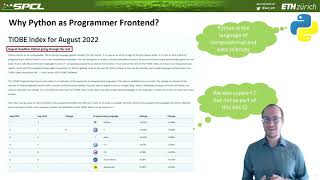
Portable High-Performance Python on CPUs, GPUs, and FPGAs
Optimize Python for high performance on CPUs, GPUs, and FPGAs. Learn HPC-oriented extensions, automatic optimizations, and portable performance techniques across architectures.
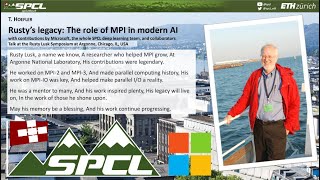
The Role of MPI in Modern AI - Rusty Lusk's Legacy
Explore MPI's crucial role in modern AI and its impact on parallel computing, honoring Rusty Lusk's contributions to the field.
Computational Physics in the Classroom
Explore three approaches to integrating computational physics in education, using modeling techniques to illustrate key principles and functions.
ARCHER2 Training Service: A Three-Year Retrospective and Future Outlook
Explore ARCHER2's comprehensive HPC training program, covering diverse disciplines and user needs. Learn about course design, delivery methods, and tailored training pathways.
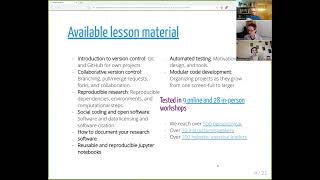
CodeRefinery: Training the Next Generation of Research Software Engineers
Explore CodeRefinery's approach to training researchers in FAIR software practices, from small workshops to large online events, and learn about future opportunities.
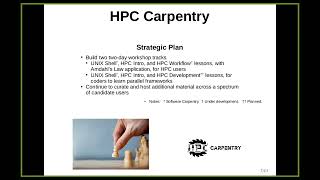
HPC Carpentry: Bridging the Gap in High-Performance Computing Education
Learn essential skills for using high-performance computing resources effectively, bridging the gap for novice users and researchers in domains with newly available HPC access.

ME3255 - Rocket Science Solutions with Python
Explore rocket science solutions using Python, covering advanced concepts and practical applications in aerospace engineering.

State of Julia 2024 - Keynote at JuliaCon 2024
Explore Julia's latest advancements in language, package ecosystem, and community. Discover exciting developments and celebrate the progress of this dynamic programming language in 2024.
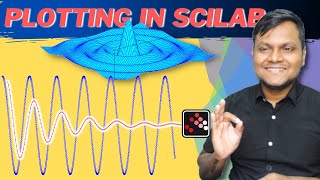
Plotting 2D and 3D Graphs in SCILAB - How to Plot Functions
Learn to create 2D, 3D, polar plots, and animations in Scilab. Master various visualization techniques for numerical computational tasks, enhancing your data representation skills.
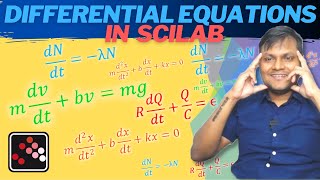
Solving Differential Equations in Scilab - First and Second Order ODEs
Learn to solve first and second order differential equations in Scilab using the ODE command, with practical examples from physics like radioactive decay, capacitor charging, and harmonic oscillators.
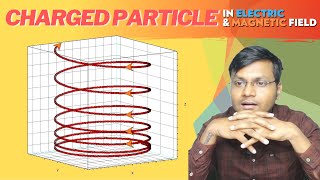
Simulating Charged Particle Motion in Electric and Magnetic Fields Using SCILAB
Explore charged particle motion in electric and magnetic fields through SCILAB simulations, covering physics concepts and programming techniques for various trajectories.
Introduction to Scilab for Beginners - Arrays, Conditional Statements, Loops, and Functions
Learn Scilab basics: mathematical operations, arrays, matrices, conditional statements, loops, and functions. Ideal for physics, math, and engineering students seeking numerical computation skills.
NeuroMANCER - Differentiable Programming Library for Data-driven Modeling and Control
Explore NeuroMANCER: an open-source library for integrating machine learning with scientific computing, focusing on parametric optimization, system identification, and optimal control.

How C++23 Changes the Way We Write Code
Explore key C++23 features like std::expected, std::mdspan, deducing 'this', and std::print. Learn how these additions improve error handling, scientific computing, and simplify common idioms.
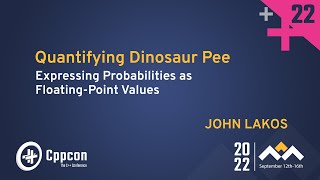
Quantifying Dinosaur Pee - Expressing Probabilities as Floating-Point Values in C++ - Lecture
Explore floating-point precision in C++ through probability calculations, from birthday paradoxes to dinosaur urine, with insights on numerical pitfalls and expected value concepts.