
Neil Turok Public Lecture - The Astonishing Simplicity of Everything
Explore the universe's simplicity at largest and tiniest scales, uncovering new physics avenues and potential technological breakthroughs with renowned physicist Neil Turok.
Einstein's Lost Key - How We Overlooked the Best Idea of the 20th Century
Explore Einstein's initial variable speed of light theory in general relativity, its historical context, and its potential as a Machian interpretation of gravity.
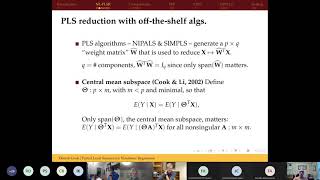
Partial Least Squares for Nonlinear Regression
Explore dimension reduction in PLS regression for nonlinear relationships, challenging traditional views and proposing new insights into PLS-like methods for predictive modeling.
Survival Analysis with TCGA Data in R - Create Kaplan-Meier Curves
Learn survival analysis using TCGA data in R, including Kaplan-Meier curves. Covers key concepts, data preparation, and practical implementation using survival and survminer packages.
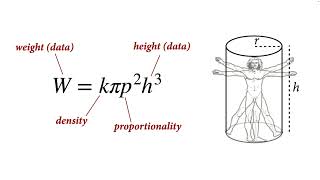
Statistical Rethinking 2023 - Generalized Linear Madness
Explore advanced statistical concepts including allometry, state space models, and ordinary differential equations through practical examples and applications in various fields.

Statistical Rethinking 2022 - Generalized Linear Madness
Explore advanced statistical concepts like geometric models, state-based analysis, and population dynamics through innovative examples and practical applications.

Perceptual Organization From a Bayesian Point of View
Explore Bayesian approach to perceptual organization, examining how the visual system groups images into distinct units through inverse inference and mixture estimation techniques.
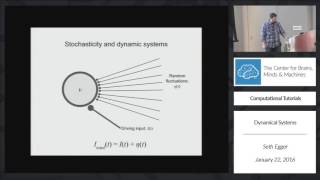
Dynamical Systems in Neuroscience
Explore cluster computing and OpenMind for brain and cognitive sciences, covering dynamical systems, models, and observation techniques in neuroscience research.
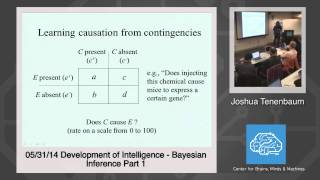
Development of Intelligence - Josh Tenenbaum: Bayesian Inference
Explore Bayesian inference and cognitive neuroscience with Josh Tenenbaum, delving into AI challenges, scene understanding, and advanced mathematical concepts for intelligence development.
Bayesian Inference in Generative Models
Explore approximate Bayesian inference methods, including sampling-based techniques and variational inference, with hands-on exercises in implementing algorithms and using probabilistic programming languages.
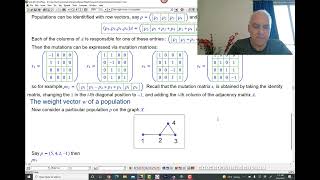
The Pentagon and Numbers Games - A Dualization of the Mutation Game
Explore the duality between the Pentagon Game and Numbers Game, examining their connections to graph dynamics and mathematical structures like ADE graphs and weight lattices.

Curt Jaimungal Interview and Theories of Everything - Sociology and Pure Maths
Exploring diverse topics from physics and mathematics to consciousness and UFOs, this wide-ranging interview delves into theories of everything, sociological aspects of science, and the intersection of academic disciplines.
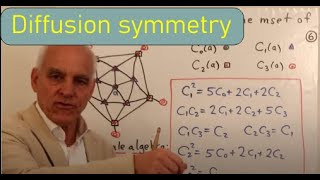
A New Paradigm for Mathematics and Physics - Diffusion Symmetry
Exploring diffusion symmetry as a new paradigm for understanding symmetry in mathematics and physics, offering insights into group theory, character tables, and fusion rule algebras.
Dot Products, Pythagoras' Theorem, and Generalizations - Wild Linear Algebra A - NJ Wildberger
Algebraic approach to metrical geometry using dot products and quadrance. Introduces symmetric bilinear forms for understanding relativistic geometry, with applications to linear algebra and physics.
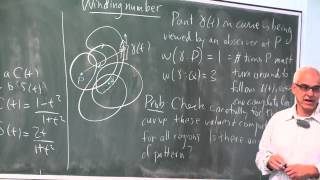
Curvature, Turning Numbers and Winding Numbers - Differential Geometry
Explores advanced concepts in planar curvature, including turning numbers, winding numbers, and parametric curves. Connects to complex analysis and circular motion, offering insights into differential geometry.
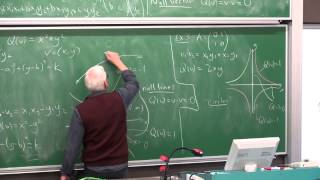
Metrical Structure and Curvature of a Parabola - Differential Geometry
Explore metrical structures and curvature in differential geometry, focusing on parabolas. Learn about symmetric bilinear forms, relativistic geometries, and their applications in physics.
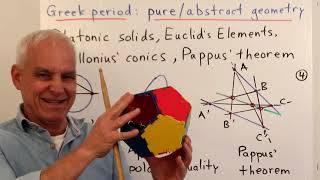
A Brief History of Geometry - Sociology and Pure Mathematics
Explore geometry's evolution from ancient times to 1400 AD, covering key theorems, Platonic solids, and applications in astronomy, surveying, and construction. Highlights include Islamic contributions to spherical geometry.
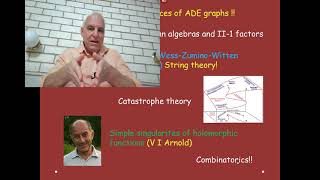
Exceptional Structures in Mathematics and Physics From Dynamics on Graphs
Explore exceptional structures in math and physics through graph dynamics, connecting to Coxeter diagrams, root systems, and Lie algebras. Discover new combinatorial structures and their role in representation theory and modern physics.
The Geometry of the Dihedrons and Quaternions - Famous Math Problems
Explore the geometry of Dihedrons and Quaternions, comparing their properties and connections to relativity, linear algebra, and complex numbers. Gain insights into fundamental mathematical structures.
How to Construct the True Complex Numbers I - Famous Math Problems
Exploring the construction of true complex numbers using field theory and linear algebra, challenging traditional approaches and introducing novel concepts for a modern understanding.
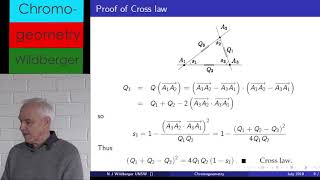
How Chromogeometry Transcends Klein's Erlangen Program for Planar Geometries - N J Wildberger
Discover chromogeometry's three-fold symmetry in planar geometry, unifying Euclidean and relativistic geometries. Explore rational trigonometry, colored Pythagoras theorems, Euler lines, and novel perspectives on conic sections.