ADE Graphs and Lattices, Weights and Quarks
Explore ADE graphs, lattices, and their connections to mathematics and particle physics. Discover the Numbers game, weights, and the fascinating link between A2 diagrams and quark theory.
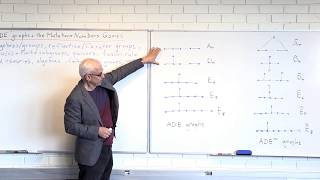
The Ubiquity of ADE Graphs, and the Mutation and Numbers Games - Math Seminars
Explore ADE graphs' mathematical significance, mutation games, and connections to advanced fields like Lie algebra, root systems, and physics in this insightful seminar on combinatorial structures.
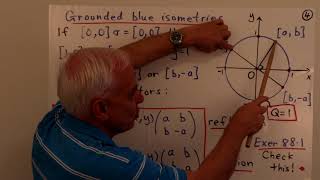
Isometry Groups in Planar Geometry - WildTrig: Intro to Rational Trigonometry - N J Wildberger
Explore isometry groups in Euclidean and relativistic geometries, focusing on grounded isometries, reflections, and rotations using an algebraic approach without infinite operations.
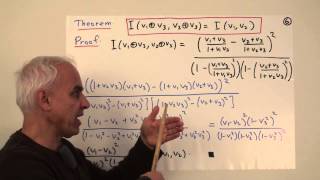
Relativistic Velocity, Core Circles and Paul Miller's Protractor - Rational Geometry
Explore core circles in rational geometry, connecting projective and Euclidean concepts. Learn about relativistic velocity addition and its implications for Einstein's special theory of relativity.
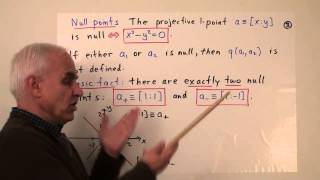
Isometry Groups of the Projective Line III - Rational Geometry Math Foundations
Exploring relativistic geometry in one dimension, extending projective geometry to incorporate Einstein's special theory of relativity and its impact on physics and mathematics.
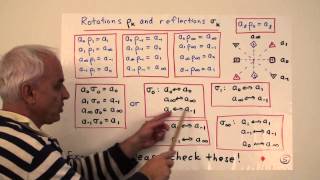
Isometry Groups of the Projective Line - Rational Geometry Math Foundations
Exploring finite field geometry: isometries, rotations, and reflections on the projective line, revealing connections to relativistic geometry and offering a new perspective on Euclidean concepts.
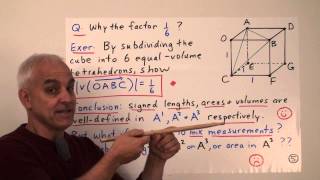
Higher Dimensions and the Roles of Length, Area, and Volume - Rational Geometry Math Foundations
Explore higher dimensions and the fundamental role of squared measurements in geometry. Discover how quadrance, quadrea, and quadrume offer more general and invariant alternatives to traditional length, area, and volume.
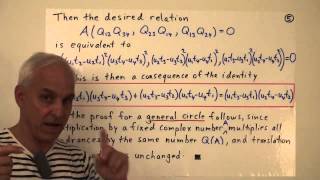
Ptolemy's Theorem and Generalizations - Rational Geometry Math Foundations
Explores Ptolemy's theorem in rational geometry, extending it to finite fields and relativistic planar geometry. Demonstrates how classical results can yield broader insights when formulated without infinite processes.
Astronomy and Trigonometry in India - Math History
Explore ancient Indian contributions to astronomy and trigonometry, including Brahma Gupta's work and the development of sign tables, in this insightful mathematical history lecture.
Applications of 3x3 Matrices - Wild Linear Algebra A
Explore 3x3 matrices and their applications in 3D space, covering dilations, reflections, rotations, and projections. Learn key concepts and formulas for linear transformations in three dimensions.
Center of Mass and Barycentric Coordinates - Wild Linear Algebra A
Explore vectors, forces, and motion through engaging games. Learn about center of mass, Archimedes' principle, and barycentric coordinates in this comprehensive linear algebra lecture.

Self-Study Computational Neuroscience - Coding, Textbooks, Math
Comprehensive guide to starting computational neuroscience: programming languages, coding practice, textbooks, math resources, project ideas, and datasets for self-study and skill development.
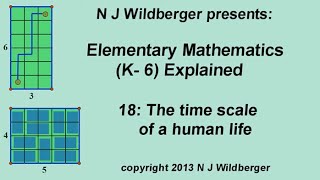
The Time Scale of a Human Life - Elementary Mathematics Explained
Explore the measurement of time through human life stages, astronomical cycles, and life spans. Learn to visualize a century-long timeline and understand key milestones in human development.
An Introduction to Homology - Algebraic Topology
Explore higher-dimensional topology through homology groups, cycles, and spanning trees. Learn to compute and characterize independent cycles in graphs using algebraic techniques.
Perpendicularity, Polarity and Duality on a Sphere - Universal Hyperbolic Geometry
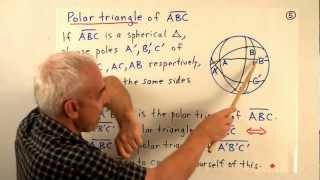
Explore perpendicularity, polarity, and duality on a sphere, including polar triangles and point-plane duality. Gain insights into elliptic geometry and the relationships between geometric elements.
Spherical and Elliptic Geometries - Universal Hyperbolic Geometry
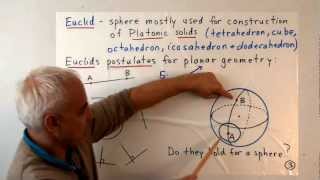
Explore spherical and elliptic geometries, from ancient Greek astronomy to modern concepts. Learn about longitude, latitude, measurement techniques, and key theorems in non-Euclidean spaces.
First Steps in Hyperbolic Geometry - Universal Hyperbolic Geometry
Explore fundamental concepts of universal hyperbolic geometry, including perpendicularity, quadrance, spread, and key theorems, with a focus on projective study of circles and relativistic geometry.
Infinity in Greek Mathematics - Math History - NJ Wildberger
Explore ancient Greek mathematics, focusing on Eudoxus and Archimedes' groundbreaking work in calculus, geometry, and mechanics. Discover their ingenious formulas and principles that laid the foundation for modern mathematics.

Solving PDEs with the Laplace Transform - The Wave Equation
Explore solving the wave equation using Laplace transforms, covering problem setup, PDE to ODE conversion, and solution methods including the Heaviside function and method of characteristics.

The Divergence of a Vector Field: Sources and Sinks
Explore the divergence operator in vector calculus, understanding its role in quantifying local expansion or contraction of vector fields, with examples and applications in fluid dynamics.
Canonical Linear PDEs- Wave Equation, Heat Equation, and Laplace's Equation
Explore fundamental linear PDEs: wave, heat, and Laplace's equations. Gain insights into their properties, applications, and mathematical foundations in engineering and physics.