
New Signed Bijections Pertaining to Alternating Sign Matrices and Gelfand-Tsetlin Patterns
Delve into advanced mathematical concepts exploring signed bijections, alternating sign matrices, and Gelfand-Tsetlin patterns through rigorous theoretical analysis and problem-solving approaches.
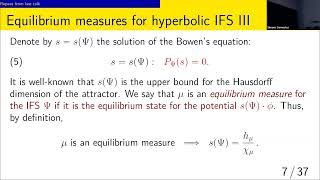
One-Parameter Families of Hyperbolic Iterated Function Systems on the Line - Lecture 3
Delve into hyperbolic iterated function systems and their dimensional properties, exploring transversality methods for analyzing one-parameter families and their applications in measure theory and dynamics.
Infinitesimal Structure of BunG and Jet Spaces - Talk 11
Delve into advanced mathematical concepts exploring jet spaces, principal G-bundles, and conformal blocks for Kac-Moody algebras through an in-depth analysis of BunG's infinitesimal structure.
Symmetries and Quantum Mechanics: Class Functions and Number of Irreducible Representations - Lecture 7
Explore the fundamental concepts of group representation theory in quantum mechanics, focusing on class functions and irreducible representation enumeration.
Symmetries and Quantum Mechanics: Irreducible Representations, Characters, and Schur's Lemma
Delve into advanced quantum mechanics concepts, exploring group representation theory, irreducible representations, characters, and Schur's lemma in theoretical physics applications.
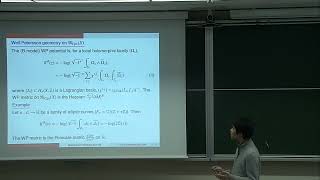
Moduli of Calabi-Yau Manifolds and Mirror Symmetry
Delve into advanced mathematical concepts exploring Calabi-Yau manifolds and mirror symmetry theory through expert insights from Kyoto University's mathematics department.
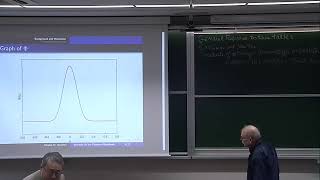
Riemann Hypothesis and the DeBruijn-Newman Constant
Delve into advanced mathematical concepts exploring the Riemann Hypothesis and DeBruijn-Newman constant through expert analysis of their properties, relationships, and significance in number theory.
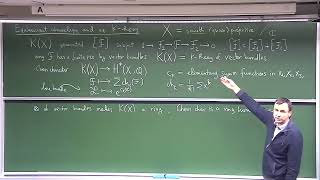
Curve Counting, Geometric Representation Theory, and Quantum Integrable Systems - Lecture 2
Delve into advanced mathematical concepts exploring curve counting, geometric representation theory, and quantum integrable systems with Professor Andrei Okounkov's expert analysis and insights.
The Spaces Up and Vp and Global Solutions to Dispersive Equations
Delve into advanced mathematical concepts of Up and Vp spaces and their applications in solving dispersive equations, featuring insights from Professor Herbert Koch of Universität Bonn.
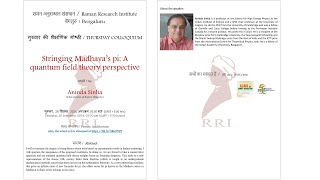
Stringing Madhava's Pi - A Quantum Field Theory Perspective
Delve into quantum field theory's connection to Madhava's historical calculation of pi, exploring mathematical principles and their modern theoretical physics applications.
Survival Analysis
Learn key concepts and techniques in survival analysis, including censoring, truncation, life tables, and Kaplan-Meier curves, with practical examples and applications.
Everything About the Degrees of Freedom of a Robot - Fundamentals of Robotics
Comprehensive exploration of robot degrees of freedom, covering rigid body motion, joint types, and Grübler's formula for various mechanisms including Stewart platforms and Delta robots.

Demystifying Spin 1/2 - Math of Quantum Mechanics
Explore the mathematics behind spin 1/2 particles, debunking common misconceptions and providing a clear, visual explanation using the Bloch sphere representation of quantum states.

From Causal Inference to Autoencoders, Memorization & Gene Regulation - Caroline Uhler, MIT
Exploring causal inference, autoencoders, and gene regulation through genomics and 3D genome organization. Integrates data modalities, analyzes overparameterized autoencoders, and links memorization to real-valued data retrieval.
Sequential Design Based on Mutual Information for Computer Experiments - Joakim Beck, KAUST
Explore uncertainty quantification using Gaussian Process emulators for complex systems. Learn about sequential design methods, mutual information criteria, and applications in climate, tsunami, and earthquake modeling.
Known Boundary Emulation of Complex Computer Models - Ian Vernon, Cambridge
Explore efficient methods for emulating complex computer models using Known Boundary Emulation, focusing on uncertainty quantification and applications in climate, tsunami, and earthquake problems.
Pragmatically Ambitious Multiscale Global Temperature Reconstruction - Finn Lindgren, Edinburgh
Explore pragmatic approaches to global temperature reconstruction using multiscale models, data sources, and statistical techniques for uncertainty quantification and bias correction.
The Search for a Theory of Everything – with Yang-Hui He
Explore the quest for a unified theory of everything, tracing its history from ancient astronomers to modern string theory and the interplay between physics, mathematics, and data.

The Million Dollar Equations - With Tom Crawford
Explore four of the seven unsolved million-dollar math problems, including the Riemann hypothesis and P vs NP, with Oxford mathematician Tom Crawford in this engaging lecture on complex mathematical concepts.
Can We Trust Maths? - With Kit Yates
Explore the impact of mathematics on real-world issues, from medical diagnoses to crime rates, and learn to critically evaluate its use in various contexts for more informed decision-making.

A Solution to the Stable Marriage Problem - Emily Riehl Public Lecture
Explore the mathematics behind the stable marriage problem, its sexist implications, and real-world applications in this engaging lecture by mathematician Emily Riehl.