Scalable Molecular Simulation of Electrolyte Solutions with Quantum Chemical Accuracy
Explore advanced molecular simulation techniques for electrolyte solutions using neural network potentials and DFT, achieving quantum chemical accuracy and revealing novel insights in solution behavior.
Q-Chem 6 Generation: Features and Developments in Quantum Chemistry Software
Explore cutting-edge features in Q-Chem 6, including spectroscopy modeling, energy decomposition analysis, DFT improvements, quantum mechanochemistry, and nuclear-electronic orbital methods.
Full-Stack Quantum Resource Estimation for Materials Science and Quantum Chemistry
Explore quantum resource estimation for materials science applications, from corrosion studies to protein binding, examining computational requirements and challenges in achieving utility-scale quantum computing.
Recent Advances in Quantum Simulation
Explore recent advancements in quantum simulation, focusing on dynamical simulation, unitary access, and applications in quantum chemistry and physics.
Advancing Molecular Simulation with Deep Learning - IPAM at UCLA
Explore cutting-edge applications of deep learning in molecular simulation, covering quantum chemistry, force fields, and Markov State Models for advanced scientific research.
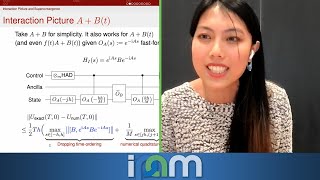
Time-Dependent Hamiltonian Simulation of Highly Oscillatory Dynamics - IPAM at UCLA
Explore highly oscillatory dynamics in quantum systems, focusing on efficient simulation algorithms for time-dependent Hamiltonians with applications in various scientific fields.
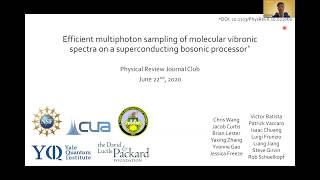
Physical Review Journal Club - Quantum Research with the Authors
Explore efficient quantum simulation for molecular spectroscopy using superconducting bosonic processors, with insights on implementation, photon detection, and algorithmic approaches.
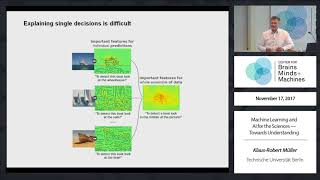
Machine Learning and AI for the Sciences - Towards Understanding
Explore ML and AI applications in sciences, focusing on neuroscience, medicine, and physics. Learn about extracting insights from ML models to enhance understanding in fields like quantum chemistry.
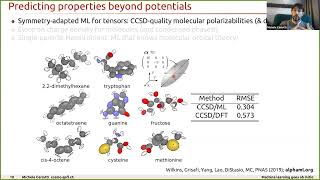
Machine Learning in Condensed Matter and Materials Physics
Explore how machine learning enhances simulations of matter, from electronic to molecular structures, boosting computational methods and potentially leading to new physical insights and exotic materials.
Fast Multipole Method on a Quantum Computer - IPAM at UCLA
Explore quantum adaptation of fast multipole method for efficient particle interaction approximation, potentially revolutionizing quantum chemistry algorithms with O(n) gate complexity.

Generating Approximate Ground States of Molecules Using Quantum Machine Learning
Explore quantum machine learning for generating molecular ground states, focusing on potential energy surfaces and efficient state preparation using variational quantum circuits and neural networks.
Introduction to Quantum Information Science - Part II
Explore advanced quantum information science concepts with UCLA expert Wes Campbell in this comprehensive lecture, part of IPAM's Winter School on Quantum Information Science for Chemistry.
Synergy Between Quantum Circuits and Tensor Networks - IPAM at UCLA
Explore synergies between parametrized quantum circuits and tensor networks, addressing optimization challenges and enhancing performance in quantum computing applications.
Diffusion Models for Sampling Rare Events in Chemistry
Explore advanced diffusion models for generating transition state structures in chemical reactions, accelerating reaction mechanism discovery and network exploration.
Advances in Machine Learned Potentials for Molecular Dynamics Simulation
Explore machine learning advancements in molecular dynamics simulations, covering symmetries, training methods, and applications in hydrocarbon reactions and IR spectra analysis.
Solving Hard Problems with Quantum & High-Performance Computing in The Cloud
Explore quantum computing's integration with high-performance computing in the cloud, its applications in chemistry, logistics, and finance, and learn about Kvantify's approach to solving complex industry problems.
Hello, Multiverse! - Quantum Computing and You
Explore quantum computing fundamentals, applications, and potential without prior physics knowledge. Learn about superposition, entanglement, and write quantum code in this accessible introduction.
Quantum Computing Concepts
Explore quantum computing fundamentals, applications, and challenges. Learn to write quantum code and understand its potential in various fields, guided by a Microsoft Quantum Computing expert.
Doubling the Order of Approximation via the Randomized Product Formula in Quantum Computing
Discover how randomized corrections in Hamiltonian simulation can double error order accuracy from 2k to 4k+1, with practical applications in quantum chemistry using Pauli strings.
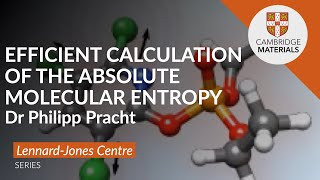
Efficient Calculation of the Absolute Molecular Entropy
Learn efficient methods for calculating absolute molecular entropy, combining DFT and semi-empirical approaches to achieve chemical accuracy in free energy computations for realistic chemical reaction modeling.
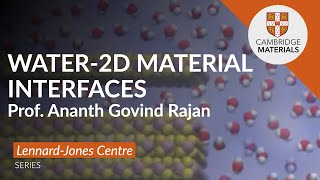
Probing Water-2D Material Interfaces: Quantum and Classical Simulations on Defective and Rough Surfaces
Explore quantum and classical simulations of water-2D material interfaces, focusing on defects and roughness in hexagonal boron nitride. Gain insights into wettability, slip length, and interfacial properties for desalination and sensing applications.