A Mathematical Look at Electronic Structure Theory - JuliaCon 2021 Workshop
Explore density-functional theory and numerical techniques for solving it using Julia. Learn about discretization, solution algorithms, and practical implementation with hands-on coding exercises.
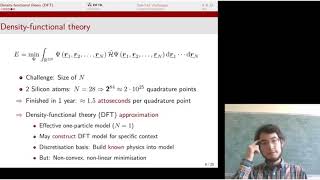
DFTK - A Julian Approach for Simulating Electrons in Solids
Introducing DFTK: A Julia package for density-functional theory simulations, offering flexibility for practical calculations and mathematical development in electronic structure research.
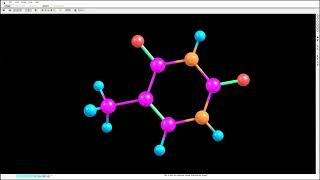
Detailed Introduction to Input Options in Quantum Chemistry
Explore input options in quantum chemistry with Prof. Choi. Gain insights into fundamental concepts and advanced techniques for both beginners and experienced practitioners.
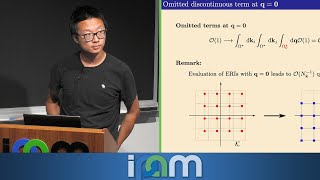
Finite-Size Error and Its Correction in Energy Calculations for Periodic Systems
Explore finite-size errors in periodic systems, focusing on Hartree-Fock and MP2 theories. Learn about convergence rates, Madelung-constant correction, and the staggered mesh method for improved calculations.
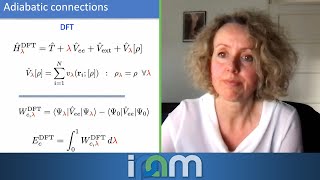
Large-Coupling Strength Expansion in DFT and Hartree-Fock Adiabatic Connections
Explore large-coupling strength expansions in DFT and Hartree-Fock adiabatic connections, examining their applications in quantum chemistry and electronic structure theory.
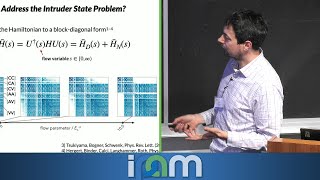
Many-Electron Effective Hamiltonians from Similarity Renormalization Group
Explore many-electron effective Hamiltonians using similarity renormalization group, focusing on bond-breaking reactions, spin states, and excited states of molecules with near-degenerate electronic structures.
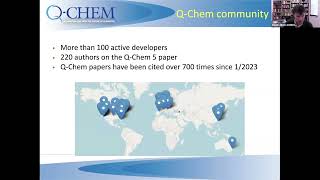
Q-Chem: An Engine for Innovation - 2024 Virtual Winter School in Computational Chemistry
Explore recent developments and new features in Q-Chem code with Martin Head-Gordon from UC Berkeley, highlighting advancements in computational chemistry software.
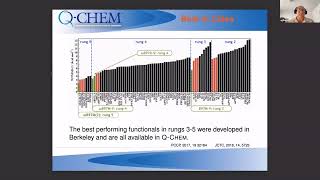
New Features in Q-Chem 6 - 2023 Virtual Winter School in Computational Chemistry
Explore the latest advancements in computational chemistry software with insights on Q-Chem 6.0 and upcoming features in version 6.1, enhancing your research capabilities.

Introduction to Coupled Cluster EOM Exercises - 2023 Virtual Winter School in Computational Chemistry
Introduction to coupled cluster exercises, guiding participants through practical applications of concepts from the previous lecture on coupled cluster calculations.
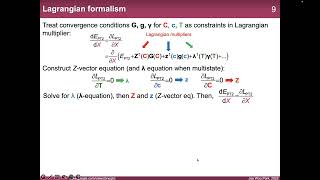
Multireference Quantum Chemistry for Exploring Potential Energy Surfaces
Explore potential energy surfaces using advanced multireference quantum chemistry techniques. Gain insights into complex molecular systems and their behavior.
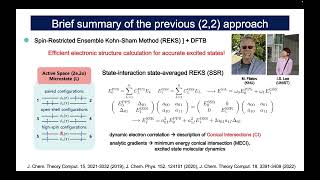
Calculation of Exciton Couplings Based on Density-Functional Tight-Binding Approach with Spin-Restricted Ensemble-Referenced Kohn-Sham Method
Explore density-functional tight-binding and spin-restricted ensemble-referenced Kohn-Sham methods for calculating exciton couplings in quantum chemistry.
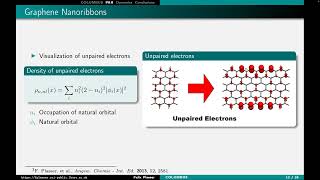
High-Level Multireference Computations Using COLUMBUS - Going Open-Source
Explore advanced multireference computational techniques using COLUMBUS, now open-source. Learn from expert Felix Plasser about cutting-edge quantum chemistry methods.
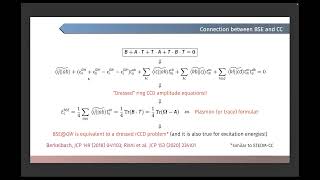
Many-Body Green's Function and State-Specific CI Methods for Excited States
Explore advanced computational methods for excited states, including many-body Green's function and state-specific CI techniques, with expert Pierre-Francois Loos.
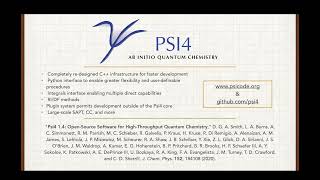
Reduced-Scaling CC Theory in the Frequency and Time Domains
Explore reduced-scaling coupled cluster theory applications in frequency and time domains with expert T. Daniel Crawford's insights.
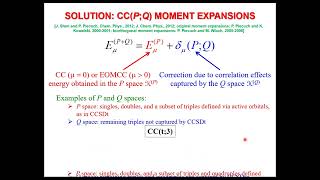
Approaching Exact Quantum Chemistry by Semi-Stochastic and Selected-CI-Driven CC Computation
Explore advanced quantum chemistry techniques, including semi-stochastic methods and selected-CI-driven CC computation, for achieving near-exact results.
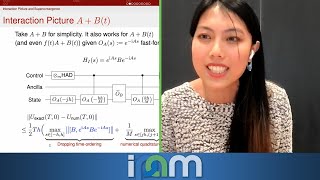
Time-Dependent Hamiltonian Simulation of Highly Oscillatory Dynamics - IPAM at UCLA
Explore highly oscillatory dynamics in quantum systems, focusing on efficient simulation algorithms for time-dependent Hamiltonians with applications in various scientific fields.
Solvated Electron: First Principles and Machine Learning Approaches
Explore advanced modeling of solvated electrons using machine learning, overcoming challenges in accuracy and efficiency to study structure, dynamics, and properties across temperatures.
New Correlation-Consistent Effective Core Potentials
Explore new correlation-consistent effective core potentials for quantum chemistry calculations, enhancing accuracy and efficiency in molecular simulations.
Orbital Optimization - QMCPACK Workshop 2023
Explore advanced techniques in quantum mechanics with a focus on orbital optimization methods and their applications in computational physics.
Relativistic Effects for Exchange Interactions and Spin-Dynamics Simulation
Explore relativistic effects on exchange interactions and spin-dynamics simulation, bridging electronic structure theory with atomistic magnetization dynamics. Gain insights into skyrmion formation and multiscale methods.