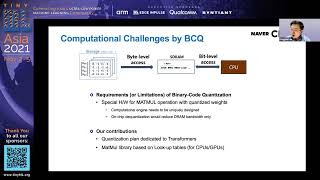
Extremely Low-Bit Quantization for Transformers - tinyML Asia 2021
Explore extremely low-bit quantization techniques for Transformers, focusing on mixed precision strategies to optimize deployment on resource-limited devices without compromising accuracy.
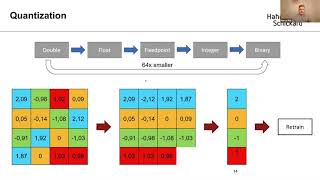
Introduction to Optimization Algorithms to Compress Neural Networks
Explore optimization techniques for compressing neural networks, including pruning and quantization, to enable deployment on resource-constrained devices like smartphones.
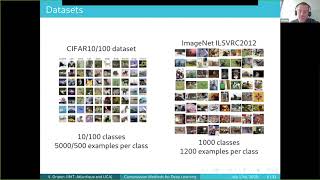
A Review of Compression Methods for Deep Convolutional Neural Networks
Explore compression techniques for Convolutional Neural Networks, including pruning, distillation, and quantization, to optimize deployment on tinyML devices without compromising accuracy.
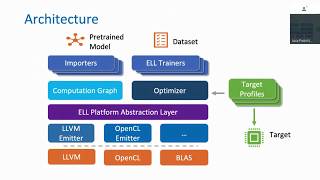
ELL: The Microsoft Embedded Learning Library - Principles and Applications
Explore Microsoft's Embedded Learning Library for efficient AI on resource-constrained devices. Learn about quantization, acceleration techniques, and architecture search for optimized machine learning deployment.
tinyMLPerf: Benchmarking Ultra-low Power Machine Learning Systems
Explore benchmarking for ultra-low power ML systems, focusing on tinyMLPerf's methodology, tasks, and ecosystem impact. Learn about quantization and community-driven efforts in this emerging field.
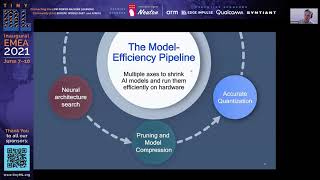
The Model Efficiency Pipeline: Enabling Deep Learning Inference at the Edge
Explore optimizing deep learning for edge devices through model efficiency techniques, including neural architecture search, pruning, quantization, and conditional processing.
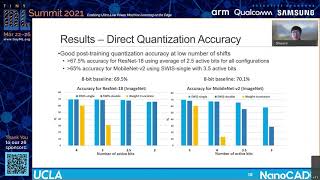
SWIS: Shared Weight Bit Sparsity for Efficient Neural Network Acceleration
Explore SWIS, a quantization framework for efficient neural network inference acceleration, offering improved performance and storage compression through weight decomposition and scheduling algorithms.
hls4ml: An Open-Source Co-Design Workflow for Scientific Low-Power Machine Learning Devices
Explore hls4ml, an open-source workflow for implementing machine learning algorithms on FPGAs and ASICs, enabling real-time processing for scientific applications and accelerating discoveries.
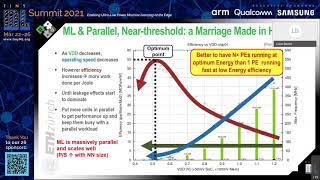
Many Shades of Acceleration - An Open TinyML Platform Perspective
Explore extreme edge AI, energy efficiency, and acceleration techniques for TinyML applications with insights from the PULP platform and RISC-V processors.
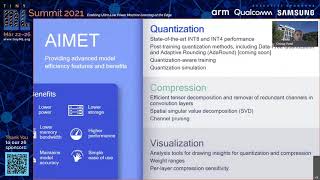
Advanced Network Quantization and Compression Using AIMET - tinyML Summit 2021
Explore advanced network quantization and compression techniques using AIMET to optimize AI models for efficient deployment on end devices, addressing memory, compute, and energy constraints.

Build Industrial-Grade TinyML Applications with Edge Impulse - Tutorial
Learn to build industrial-grade tinyML applications using Edge Impulse. Covers dataset collection, model design, training, optimization, and integration into embedded systems running on MCUs.
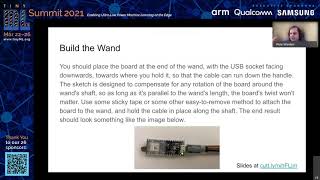
Building a Magic Wand with TensorFlow Lite Micro - Tutorial
Learn to build an IMU-based gesture recognition model for Arduino, covering data gathering, training, and deployment using TensorFlow Lite Micro and CMSIS-NN library.
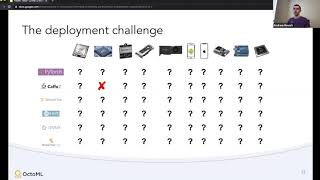
MicroTVM: A Tensor Compiler for Bare Metal
Explore microTVM, a tensor compiler for bare metal devices, its functionality, and future directions. Learn about deployment challenges and see a demonstration of the technology.
AI at the Edge - Enabling Vision for Low-Power Devices
Explore AI's shift to edge devices, focusing on building efficient computer vision algorithms for battery-powered devices. Learn about data collection, continuous learning, and optimization techniques.
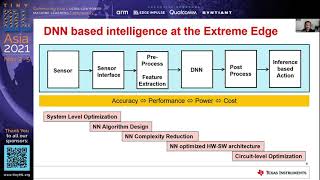
Machine Learning at the Extreme Edge of Always-on Intelligent Sensor Networks
Explore ML optimization techniques for resource-constrained IoT sensor nodes, focusing on system, algorithm, architecture, and circuit levels to achieve significant area-power improvements.

Trends in Deep Learning Hardware
Explore deep learning hardware advancements, including GPU efficiency improvements and data representation innovations, with NVIDIA's chief scientist Bill Dally.
Leveraging Open-Source LLMs for Production
Explore open-source LLMs, comparing them to proprietary options. Learn about hosting costs, performance evaluation, and practical applications. Gain insights into fine-tuning techniques and emerging trends in AI development.
PyTorch 2.1 - New Features and Accelerating Generative AI Models
Explore PyTorch 2.1's new features for AI model acceleration, including compile, distributed, inference, and edge technologies, with insights on optimizing generative AI models for enhanced performance.

GPT-Fast - Blazingly Fast Inference with PyTorch
Explore techniques for accelerating AI inference using PyTorch, including compile, quantization, speculative decoding, and tensor parallelism, with expert insights from Horace He.

Testing Microsoft's New VLM - Phi-3 Vision Model
Explore Microsoft's Phi-3 Vision model capabilities through hands-on demonstrations, including image analysis and 4-bit quantization, with insights from the model's documentation and research paper.

Scalable MatMul-free Language Modeling - Paper Explained
Explore innovative MatMul-free language modeling techniques using quantization and recurrence, achieving comparable performance to traditional models while significantly reducing computational costs and memory usage.