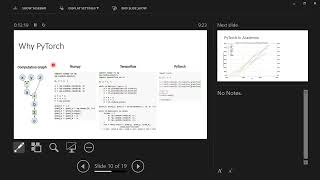
PyTorch Tutorial: Deep Learning Framework Fundamentals - Fall 2022
Master PyTorch fundamentals and deep learning concepts, from tensor operations to GPU acceleration, autograd, and data loading - all through hands-on coding examples and practical implementations.
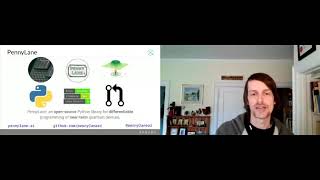
Software for Quantum Machine Learning
Explore quantum machine learning algorithms, adapting deep learning concepts to train quantum computers using familiar tools like TensorFlow and PyTorch.
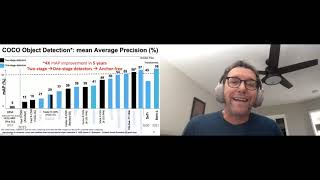
State-of-the-Art Deep Learning-Based Object Detection in 2D
Explore state-of-the-art object detection systems, including two-stage, one-stage, and transformer-based approaches. Learn to upgrade detection pipelines and tackle key challenges in 2D and 3D object detection.
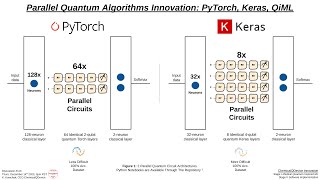
Parallel Quantum Algorithms Innovation: PyTorch, Keras, and QiML
Explore parallel quantum algorithms for machine learning using PyTorch and Keras. Enhance model accuracy and efficiency by incorporating quantum layers in neural networks.
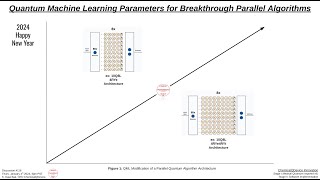
Quantum Machine Learning Parameters for Breakthrough Parallel Algorithms
Explore breakthrough parallel quantum algorithms for machine learning, improving performance and efficiency. Learn key benefits and optimal parameter settings for quantum-classical hybrid models.
Forecasting the Future with EarthPT
Explore EarthPT, an open-source Earth Observation pretrained transformer. Learn about its capabilities in predicting surface reflectances, vegetation indices, and potential applications in land use classification and crop yield forecasting.
Take Large Scale AI from Research to Production with Google Cloud's AI Hypercomputer
Discover Google Cloud's AI Hypercomputer: a supercomputing architecture optimizing hardware, software, and consumption models for efficient AI deployment at scale. Gain insights from Kakao Brain and Nuro's experiences.
Systems Engineering in Machine Learning - Navigating Low-Level Challenges
Explore systems engineering in ML with Andrew Dye, discussing low-level work, blending disciplines, and ML infrastructure challenges. Gain insights on distributed training, managing scale, and bridging gaps between firmware and MLOps.
AWS Trainium and Inferentia - Enhancing AI Performance and Cost Efficiency
Explore AWS Trainium and Inferentia's AI accelerators for enhanced performance, cost savings, and seamless integration with popular frameworks. Learn about their benefits and implementation in ML workflows.
Uber's Michelangelo: Strategic AI Overhaul and Impact - MLOps Podcast
Explore Uber's Michelangelo platform evolution, from basic ML predictions to advanced deep learning and generative AI, addressing challenges and introducing innovative features for streamlined AI operations.
MLOps MLflow: Deep Learning Frameworks - PyTorch and TensorFlow Integration
Explore integrating deep learning frameworks Pytorch and Tensorflow with MLflow for enhanced model management and tracking.
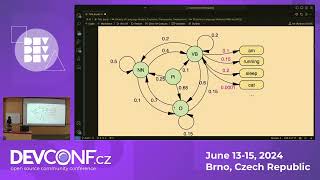
History of Language Models: Evolution, Frameworks, and Deployment
Explore language models' evolution from early systems to neural networks, transformers, and large-scale pretraining. Gain insights on key frameworks and real-world deployment strategies.
Deep Learning in Audio for Absolute Beginners: From No Experience to a Deployed Model
Jumpstart deep learning in audio: from basics to deploying models. Learn myths, dataset creation, PyTorch training, and real-time plugin deployment for Virtual Analog modeling of audio effects.
Deep Learning in Audio for Absolute Beginners: From No Experience to a Deployed Model
Jumpstart deep learning in audio: from basics to deploying models. Learn myths, fast techniques, dataset creation, PyTorch training, and real-time plugin deployment for Virtual Analog modeling.
Inference Engines and Audio - Machine Learning in Audio Applications
Explore inference pipelines in machine learning for audio applications, including common engines, their functionality, and creating custom solutions for platforms like Cmajor.
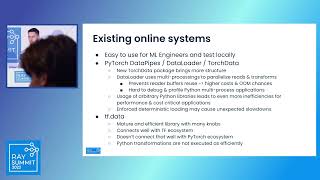
Cruise.data - A New Dataset Processing Pipeline for Cruise ML
Explore Cruise.data, a novel ML data pre-processing framework combining tf.data, PyTorch, and large-scale processing capabilities for efficient and scalable dataset handling in autonomous vehicle development.
Ray Train: A Production-Ready Library for Distributed Deep Learning
Explore Ray Train's architecture for efficient, cost-effective distributed deep learning. Learn about resource scheduling, API simplicity, and exclusive features for LLM training, including Distributed Checkpointing.
Fast and Scalable Model Training with PyTorch and Ray
Learn distributed model training with PyTorch and Ray. Migrate code, scale AI workflows, and optimize performance for large-scale training and fine-tuning on Anyscale.
Unlocking LLM Performance with eBPF - Optimizing Training and Inference Pipelines
通过eBPF实现LLM训练和推理过程的可观察性,优化性能。介绍内存、网络和GPU分析方法,分享在PyTorch和llm.c项目中的实践经验,提高GPU利用率。

Informer: Training and Inference
Explore time series prediction using Informer, a transformer-based model. Learn to train and make predictions through hands-on coding, enhancing your skills in advanced forecasting techniques.
Build an Intelligent Python App Without Infrastructure Hassles - Azure Container Apps
Explore building intelligent Python apps using Azure Container Apps. Learn to deploy serverless containers, integrate Azure OpenAI, and leverage GPU compute for ML frameworks like PyTorch.