
The Psychology, Biology and Politics of Food - Lecture 1
Explore the complex interplay between psychology, biology, and politics in shaping our food choices and systems.

The Psychology, Biology and Politics of Food - Lecture 5
Explore the intricate connections between psychology, biology, and politics in relation to food systems and consumption patterns.

The Psychology, Biology and Politics of Food - Lecture 9
Explore the intricate connections between psychology, biology, and politics in relation to food systems and consumption patterns.

Editing Embryos - Private Choices and Public Goods - Jonathan Anomaly, Hayek Lecture Series
Explore ethical implications of genetic editing technologies, coordination challenges, and potential government interventions in shaping future generations' traits and cognitive diversity.

The Secret to Satisfaction - Is Everything We've Been Told About Happiness Wrong?
Explore the complexities of happiness, mental health, and societal pressures in this thought-provoking panel discussion challenging conventional wisdom on wellbeing and satisfaction.

Yin and Yang of Determination in Science - Overcoming Challenges
Explore the challenges and triumphs of women in science with Professor Kate Smith-Miles, focusing on determination, success, and navigating male-dominated fields.
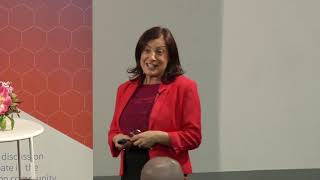
Wellbeing Education as a TREAT - Designing Engaging School-Based Programs
Innovative approach to school-based wellbeing education using the TREAT framework: Tangible, Relevant, Evidence-based, Alluring, and Transformational. Aims to inspire and empower youth in proactively shaping their mental health.
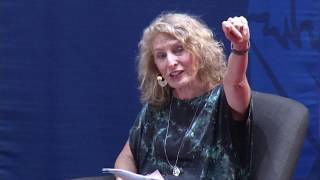
What You Need to Know About Eating Disorders - Expert Panel Discussion
Explore the complexities of eating disorders, their evolving manifestations, and strategies for prevention and support with expert insights from researchers and advocates.
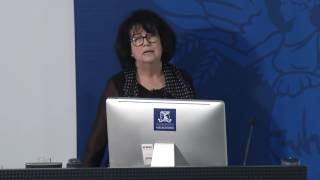
Learning about Human Learning: How We Grow Individually and Collectively
Explore human learning's uniqueness, societal impact, and evolution through generations. Gain insights into research history and future directions in understanding this complex phenomenon.
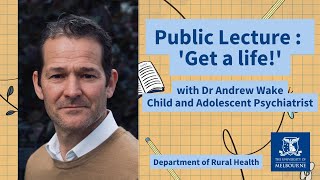
How to Re-engage Your Kids Post-COVID - Motivation and Parenting Strategies
Expert insights on re-engaging children post-COVID: Learn motivation strategies, parenting techniques, and developmental understanding to create positive change and support your child's growth.
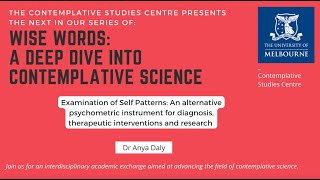
Examination of Self Patterns: An Alternative Phenomenological Interview for Mental Health
Explore pattern theory of self to enhance understanding of mental disorders and self-awareness. Dr Daly discusses innovative approaches to psychiatry and contemplative practices.
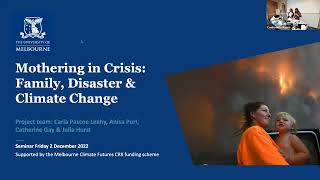
Mothering in Crisis - Family, Disaster and Climate Change
Explore mothers' experiences of climate-fueled disasters, examining historical perspectives and contemporary challenges to understand family impacts and support needs in an era of environmental change.
The Neuronal Basis of Consciousness
Explore the neural foundations of consciousness, from basic neuroscience to complex cognitive processes, through lectures on perception, attention, memory, and brain architecture.
Introduction to Basic Cognitive Processes
The approach adopted in this course will look at human behavior at large as made up of many component mental processes such as sensation, perception, attention, memory, language, imagery, decision making, problem solving, emotion and others.
Game Theory and Economics
The course would introduce to the fundamental tools of game theory, a few equilibrium concepts, apart from numerous exercises and applications.
Jonas Dalege on the Physics of Attitudes & Beliefs
Exploring statistical mechanics to understand belief formation and attitude dynamics. Insights into cognitive dissonance, ambivalence, and social interactions through physics-inspired models of opinion networks.
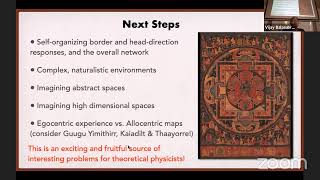
Imagining Space
Explore the neuroscience of spatial perception, from neurons to grid patterns, and discover how the brain constructs our sense of place and navigation.
Emergence of Life in the Brain
Explore the potential emergence of a new form of life within the brain, examining neural matter, replicators, and the intersection of evolution and learning.
Helena Miton on Cultural Evolution in Music and Writing Systems
Explore cultural evolution in music and writing systems, examining how material constraints and cognitive factors shape the development of rhythms and letter forms across societies and time.
The Art & Science of Resilience in the Wake of Trauma with Laurence Gonzales
Explore resilience after trauma through psychology and neuroscience. Learn strategies for coping, finding wisdom, and living fully despite hardship. Gain insights on the body-mind connection and personal growth.
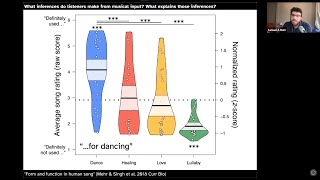
Principles of Music Perception
Explore the universal aspects of music perception, including tonal and metrical systems, and their impact on human psychology across cultures and developmental stages.