C++ Class Template Argument Deduction - History, Uses, and Enabling it for Classes - Lecture
Explore C++17's Class Template Argument Deduction (CTAD) feature, its history, usage, and implementation in custom classes. Learn about deduction guides, enhancements, and future directions.
Reflection in C++ - Past, Present, and Hopeful Future
Explore C++ reflection's evolution, potential applications, and future prospects. Gain insights into advanced programming concepts and language design for enhanced code flexibility and reuse.
Name Lookup and Overload Resolution in C++ - Back to Basics - Lecture
Explore name lookup and overload resolution in C++. Learn language rules, processes, pitfalls, and best practices for efficient coding. Suitable for all skill levels with basic C++ familiarity.
C++ Package Managers - Simplifying Dependency Management
Explore package managers for C++ dependencies, comparing system, build system, and language-specific solutions. Learn to streamline workflows and efficiently manage libraries across platforms.
Smarter C++ Atomic Smart Pointers - Efficient Concurrent Memory Management
Explore efficient concurrent memory management techniques, combining atomic smart pointers and deferred reclamation for scalable C++ code. Learn to write high-performance, memory-safe concurrent programs.
The Observer Design Pattern in C++
Explore the Observer design pattern in C++, learning implementation techniques, real-world applications, and trade-offs for more maintainable and flexible event handling systems.
How to Use C++ Dependency Injection to Write Maintainable Software - CppCon 2022
Explore dependency injection techniques in C++ to create decoupled, easily refactored, and testable components. Learn to manage data and behavior dependencies for more maintainable software.
Reproducible Developer Environments in C++ - CppCon 2022
Explore modern solutions for creating reproducible C++ developer environments, focusing on GitHub Codespaces and Microsoft Dev Box to streamline project setup and enhance productivity.
Simulating Low-Level Hardware Devices in C++
Explore C++ techniques for simulating hardware devices and registers, enhancing embedded development efficiency and error testing capabilities.

Putting the R in R&D: Research in Software Development
Explore real-world examples of how research shapes software projects, with code demonstrations in Go, Ruby, JavaScript, and Bash. Gain insights into the integral role of research in software careers.
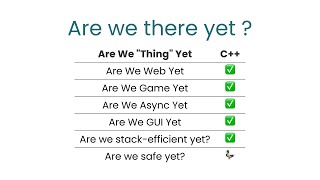
Better CMake: A World Tour of Build Systems - Better C++ Builds
Explore advanced build systems for C++, comparing CMake with newer alternatives. Learn best practices for software supply chain security, reproducibility, and remote builds.
Coping With Other People's C++ Code - Strategies for Collaborative Development
Explore strategies for navigating complex C++ codebases, addressing conflicting design patterns, and maintaining productivity amid challenging code. Learn practical tools and insights from behavior science.
Writing Python Bindings for C++ Libraries - Easy-to-use Performance
Learn to create Python bindings for C++ libraries, focusing on API design, memory management, data conversion, and performance optimization for seamless integration between C++ and Python.
Building Effective Embedded Systems in C++ - Architectural Best Practices
Enhance embedded development effectiveness with insights on robustness, speed, and maintainability. Gain practical advice for overcoming challenges and achieving successful outcomes in embedded systems projects.
Abstraction Patterns for Cross Platform Development Using C++ - CppCon 2023
Explore abstraction patterns for cross-platform C++ development, from basic to advanced techniques. Gain insights on complexity, maintainability, and performance across various platforms.
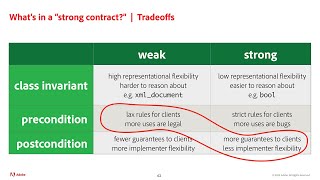
Better Code: Contracts in C++ - Lecture
Explore techniques for writing correct, maintainable C++ code using contracts. Learn to strengthen code quality, improve reviews, and build a more robust software future.
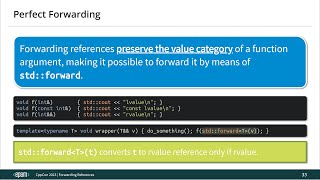
Back to Basics: Forwarding References - How to Forward Parameters in Modern C++ - 2023
Explore forwarding references in Modern C++, understanding their importance, usage with std::forward, identification in code, and potential pitfalls. Gain insights into improving overload sets.
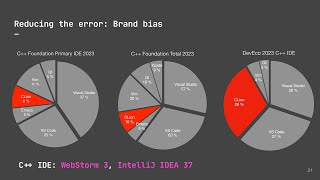
Tips on Surveying the C++ Community
Explore insights on conducting effective C++ community surveys, including methodology, bias removal, and data interpretation. Learn to leverage research findings for informed decision-making.
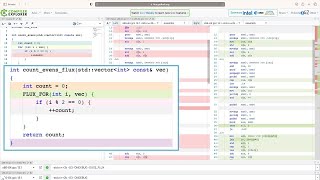
Iteration Revisited: A Safer Iteration Model for C++ - CppCon 2023
Explore a safer iteration model for C++ with Flux, a C++20 library offering improved safety, performance, and compatibility with existing code.
Safety and Security for C++ - Panel Discussion - Lecture 1
Explore safety and security in C++ with industry experts. Gain insights on recent developments, standards, and best practices for robust software development across critical domains.
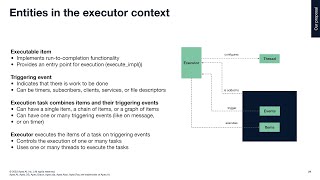
Building Bridges: Leveraging C++ and ROS for Simulators, Sensor Data and Algorithms
Explore C++ and ROS integration for robust robotics simulation, focusing on communication bridges, deterministic execution, and cross-simulator compatibility. Enhance autonomous driving applications with scalable testing frameworks.