Negative Indicators of Consciousness in Artificial Systems
Explore the concept of negative consciousness indicators in AI systems, examining factors that decrease the likelihood of machine consciousness and their implications for artificial intelligence research.
T-Test Numerical Problems in Applied Statistics and Hypothesis Testing
Master the step-by-step procedure for solving t-test problems in statistics, focusing on practical applications and hypothesis testing methods for engineering and business analysis.

ME3255 - Analyzing NYSE Monte Carlo Model
Analyze NYSE stock data using Monte Carlo simulations. Learn to model market behavior and predict future trends with statistical methods.
Hypothesis Testing for Difference of Standard Deviations in Applied Statistics
Master statistical hypothesis testing techniques for analyzing differences in standard deviations, with practical applications in probability and advanced mathematics.
Difference of Mean - Hypothesis Testing in Applied Statistics
Master statistical hypothesis testing through practical numerical problems focused on difference of means, enhancing your applied mathematics and analytical skills.
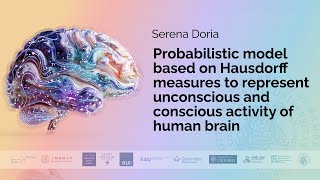
Probabilistic Model Based on Hausdorff Measures to Represent Unconscious and Conscious Activity of Human Brain
Explore how Hausdorff measures and probabilistic models explain human consciousness, cognitive biases, and selective attention through mathematical frameworks and real-world examples.

Chi Square Test for Independence of Attributes in Applied Statistics - Numerical Hypothesis Testing
Master statistical analysis through Chi-Square testing, focusing on attribute independence and hypothesis testing with practical numerical examples and applications.
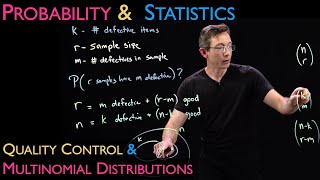
Quality Control and Non-Destructive Inspection Using the Multinomial Distribution
Explore quality control principles through multinomial distribution, learning to assess batch reliability using non-destructive inspection methods and statistical sampling techniques.

Introduction to Subfactorials and Derangements in Combinatorics
Explore the fascinating concept of subfactorials and derangements through an engaging mathematical journey, using real-world examples of men, hats, and probability calculations.
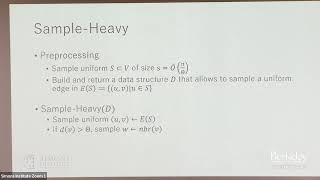
Sampling Multiple Edges Efficiently
Dive into efficient algorithms for sampling multiple edges in graphs, exploring innovative techniques and mathematical frameworks presented by MIT researcher Talya Eden.
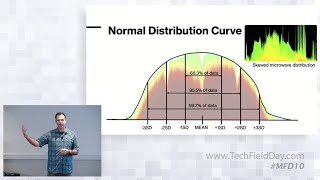
Understanding Wi-Fi Collision Probability and Network Congestion Management
Explore Wi-Fi network collision probabilities through theme park analogies, space-time concepts, and QoS principles to understand efficient network design and transmission management.

Self-Certification for Entropy Generation in Quantum-Based Random Number Generation
Discover a quantum-based approach to generating and certifying true random encryption keys, exploring innovative methods for assessing randomness quality and entropy generation.
Z Test and Hypothesis Significance in Applied Statistics
Master the fundamentals of Z-test statistics through step-by-step procedures and practical numerical examples, enhancing your ability to perform hypothesis testing and statistical analysis.
Test for Single Proportion and Hypothesis in Applied Statistics
Master statistical hypothesis testing through single proportion analysis, covering one-tail and two-tail tests with practical applications and numerical examples.
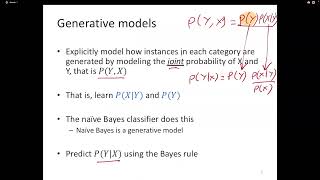
Discriminative and Generative Models in Machine Learning - Lecture 24B
Explore the key distinctions between discriminative and generative models in machine learning, focusing on their unique approaches and practical applications.
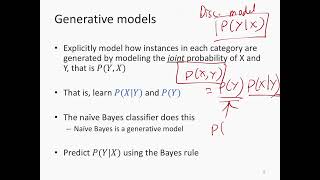
Generative and Discriminative Models in Machine Learning - Lecture 27B
Explore the fundamental differences between generative and discriminative models in machine learning through a concise high-level introduction to these essential modeling approaches.
Electric Flow Sampling and Quantum Walks on Trees
Explore electric flow sampling (elfs) in quantum walks, examining their connection to random walks, hitting times on trees, and applications in quantum algorithms for distribution sampling.
Quantum Theory in Finite Dimension Cannot Explain Every General Process
Explore groundbreaking research demonstrating how certain finite-dimensional processes in quantum theory require explanations beyond classical probability and quantum mechanics frameworks.
Delivering Delivery Time Prediction - Machine Learning Lessons and Model Optimization
Discover practical insights into ML model development, from handling unclear requirements to ensemble classification techniques and determining optimal probability cutoffs for delivery predictions.
A Weak Convergence Viewpoint on Invertible Coarse-Graining
Explore weak convergence in invertible coarse-graining, combining force-matching with neural networks to recover fine-grained free energy surfaces in biomolecular systems.
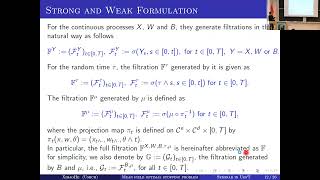
On the Limit Theory of Mean Field Optimal Stopping with Common Noise
Explore mean field optimal stopping with common noise, focusing on limit theory. Gain insights into mathematical finance concepts presented at the Eastern Conference.