Signals and Systems II
Comprehensive exploration of advanced signal processing concepts, including probability theory, random variables, stochastic processes, and spectral analysis for electrical engineering applications.
Boolean Models in Hyperbolic Space
Explore Boolean models in hyperbolic space, examining geometric functionals and asymptotic formulas for expectations, variances, and covariances, with insights into new phenomena compared to Euclidean cases.
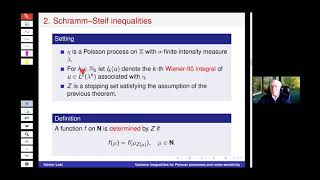
Schramm-Steif Variance Inequalities for Poisson Processes and Noise Sensitivity
Explore Poisson processes, variance inequalities, and noise sensitivity in stochastic geometry. Gain insights into k-percolation and the Poisson Boolean model with bounded grains.
Probability Theory and Applications
Explore advanced probability concepts, stochastic processes, and queueing models. Gain insights into Markov chains, Poisson processes, and reliability theory for practical applications.

Queuing Theory and Poisson Process
Introduction to M/M/1 queue model and Poisson process, covering fundamental concepts of queuing theory. Explores key principles and applications in simple queuing systems.
Geometric Functionals of Polyconvex Excursion Sets of Poisson Shot Noise Processes
Explore geometric functionals of polyconvex excursion sets in Poisson shot noise processes, including asymptotics, variance bounds, and central limit theorems for intrinsic volumes.
Inspection Paradox Approach to Stochastic Resetting
Explore the inspection paradox and its application to stochastic resetting in random processes, from diffusion to animal foraging, using elementary mathematical tools.
M/G/1 Queue - Expected Busy Period, Waiting Time, and PASTA - Lecture 37
Explore M/G/1 queues, analyzing busy periods, waiting times, PASTA principle, and Little's theorem for enhanced understanding of queueing systems.
Causal Set Kinematics: Reconstructing Spacetime Geometry from Random Posets
Explore causal set quantum gravity, reconstructing spacetime geometry from random posets. Learn dimension estimation, topology, and geometric invariants in discrete orders.
Eigenpath Traversal by Poisson-Distributed Phase Randomisation
Explore quantum computation through Poisson-distributed phase randomization, examining how dephasing operations enable eigenspace tracking and optimize quantum algorithms like Grover search.

Combined Stochastic Models for Cancer Patient Trajectories
Integrating diverse clinical data into a unified stochastic model for cancer patient trajectories, combining tumor growth, metastasis, and survival data using Julia for simulation and Bayesian inference.
A Cookbook for Deep Continuous-Time Predictive Models
Explore deep continuous-time predictive models for irregularly-sampled time series, from feedforward approaches to latent-variable stochastic differential equations.