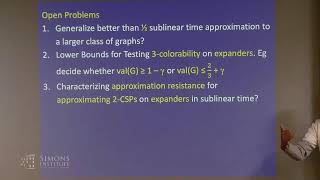
Sublinear Time Algorithms for Max-Cut Approximation on Expander Graphs
Explore random walks on graphs to achieve better-than-1/2 approximation for max-cut on expanding and clusterable graphs, using sublinear time algorithms.
Shaving Logs by Weighing Coins - Extroverted Sublinear Algorithms
Explore innovative sublinear algorithms for efficient data analysis, focusing on log-shaving techniques and coin-weighing problems in computational complexity.
Using Ancient Math to Speed Up Security Assessments of Windows Executables
Discover how to accelerate Windows executable security assessments using Euclidean Distance and Bayes Theorem, enabling rapid triage and efficient risk reduction in regulated environments.

The Metrics Manifesto
Discover predictive analytics for security, including decision science, Bayesian methods, and quantitative risk management. Learn to measure attack surface and present advanced metrics to boards.
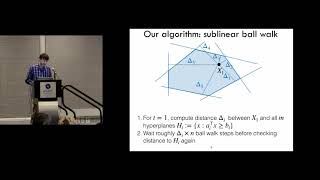
Faster Polytope Rounding, Sampling, and Volume Computation via a Sublinear Ball Walk
Explore advanced algorithms for efficient polytope analysis, including rounding, sampling, and volume computation using innovative Markov chain techniques.
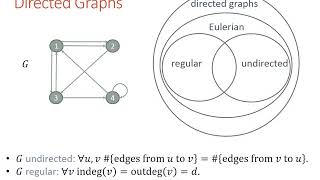
High-Precision Estimation of Random Walks in Small Space
Explore advanced techniques for estimating random walks in limited space, covering pseudorandom generators, graph algorithms, and Laplacian systems for efficient problem-solving.
What's in Your Risk Assessment?
Accelerate your risk assessment approach to meet evolving regulatory demands and stakeholder needs for high-quality decision data in this informative session on effective risk management strategies.
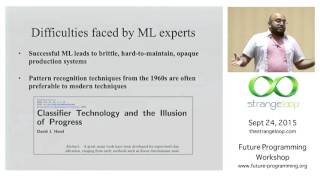
An Overview of Probabilistic Programming
Explore probabilistic programming through BayesDB, Picture, and Venture platforms. Learn about Bayesian databases, 3D scene perception, and general-purpose probabilistic computing for data analysis and AI applications.
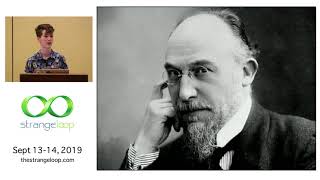
Minimalist Piano Forever
Explore generative music using Erik Satie's minimalist piano works. Learn about Markov chains, MIDI, and browser-based audio to create endless, evolving compositions and dynamic sheet music.
Simple Machine Learning
Explore basic machine learning approaches for classification in PHP, with real-world applications and practical demonstrations.
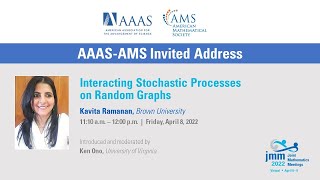
Interacting Stochastic Processes on Random Graphs
Explore interacting stochastic processes on random graphs, covering models like voter and neuronal hox, and examining challenges in sparse regimes and local convergence.
Coverage-based Greybox Fuzzing as Markov Chain
Explore coverage-based greybox fuzzing as a Markov chain process, enhancing software testing efficiency and vulnerability detection in computer security applications.
Pyambic Pentameter - Generating Rhyming and Metered Poems
Explore generating rhyming and metered poems using Python, combining Markov chains and NLTK for creative text generation with style and structure.
A Careful Walk Through Probability Distributions, Using Python
Explore probability distributions using Python, demystifying key concepts like sampling, joint, conditional, and marginal distributions for a solid foundation in Bayesian statistics.
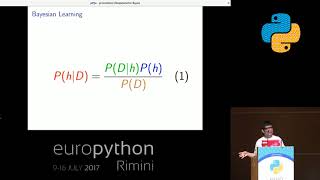
Introduction to Nonparametric Bayesian Models
Explore flexible machine learning with Nonparametric Bayesian Models. Learn about Dirichlet Process, compare parametric vs nonparametric approaches, and discover relevant Python libraries for advanced data analysis.
Adaptive Threat Modeling
Explore adaptive threat modeling to dynamically analyze and respond to evolving security risks. Learn to leverage web traffic data for identifying threat actors and enhancing quantitative risk analysis.
An AI with an Agenda - How Our Cognitive Biases Leak Into Machine Learning
Explores how human cognitive biases can infiltrate AI and machine learning models, offering strategies to mitigate these issues and create more objective, ethical algorithms.

Naive Bayes Classifier - A Friendly Approach
Visual explanation of Bayes' Theorem and Naive Bayes algorithm, applied to spam detection. Accessible approach requiring only basic math skills and a desire to learn.

Universal Hash Functions - Introduction and Applications
Explore universal hash functions, their properties, and applications in computer science. Learn about strongly universal hash functions and practice with example problems.
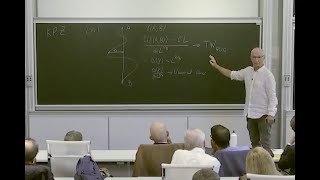
KPZ Universality and Iterates of Random Monotone Maps
Explore KPZ universality and random monotone map iterations with insights from Konstantin Khanin's mathematical research.
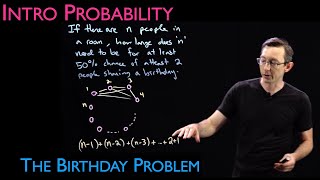
The Birthday Problem in Probability - Computing Probability Through Complements
Explore the fascinating Birthday Problem in probability theory, learning how to calculate shared birthday chances through complementary probability and factorial computations.