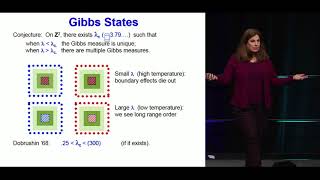
Emergent Phenomena in Random Structures and Algorithms
Explore emergent phenomena in random structures and algorithms, focusing on mathematical insights and applications in complex systems and computational methods.
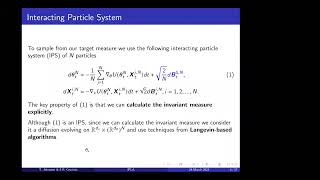
Interacting Particle Systems for Expectation Maximization in Latent Variable Models
Explore a novel interacting particle system for EM optimization in latent variable models, featuring Langevin diffusion analysis and non-asymptotic concentration bounds for maximum likelihood estimation.
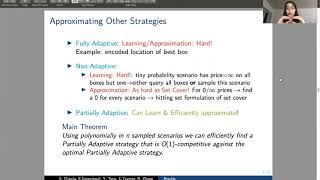
Pandora's Box with Correlations - Learning and Approximation
Explore learning and approximation techniques for correlated Pandora's Box problems, focusing on algorithmic approaches and theoretical insights.
Using Equivalence Classes to Accelerate Solving the Discrete Logarithm Problem in a Short Interval
Explore techniques to accelerate solving the discrete logarithm problem using equivalence classes, including fast inversion, distinguishing points, and random walks.
Learning from Dependent Data - Lecture 1
Explore techniques for learning from dependent data, focusing on probabilistic and optimization methods in data science. Gain insights into handling interconnected information effectively.
Distinguished Seminar in Optimization and Data - Ryan O'Donnell
Explore quantum state tomography, distribution metrics, and independence testing with insights on quantum-inspired improvements to classical problems in optimization and data analysis.
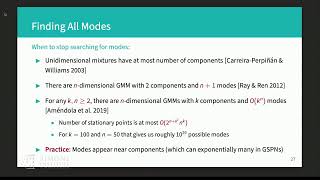
On Finding Modes of Gaussian Sum-Product Networks
Explore challenges and tractability of finding modes in Probabilistic Circuits, focusing on Gaussian Sum-Product Networks for machine learning tasks like structured prediction.
Tracking Significant Changes in Bandit - IFDS 2022
Explores significant changes in bandit algorithms, focusing on adaptive procedures and random replays for tracking environmental shifts in reward and context distributions.
Bandits II - Advanced Algorithms and Applications
Explore advanced bandit algorithms and their applications in decision-making under uncertainty with Kevin Jamieson from the University of Washington.
Bayesian Networks for Causal Reasoning - Lecture 1
Introduction to Bayesian networks for causal reasoning in healthcare, exploring their application in analyzing clinical data and inferring patterns to improve patient outcomes and medical decision-making.

Uncertainty-Tracking Computation Hardware for Processing Data from the Physical World
Explore innovative processor architecture for tracking uncertainty in computations, enhancing accuracy and efficiency in various domains from quantum algorithms to sensor data processing.

ShiffBot and Gemini API Integration with Node.js and p5.js - Coding Train Livestream
Explore ShiffBot, showcase reviews, and create a Node.js and p5.js example for the Gemini API. Learn about AI-powered tools and practical coding applications in this interactive session.
List-Decoding Random Code Ensembles - Advances in Error-Correcting Codes
Explore advanced error-correcting code theory, focusing on list-decoding techniques for random code ensembles. Gain insights into cutting-edge research in coding theory.
Some Problems Regarding Bayesian Networks
Exploration of challenges in Bayesian networks, discussing structural properties, dynamics, and applications in probability theory and network science.
What Is ChatGPT Doing? Understanding Large Language Models - Episode 2
Explore the inner workings of ChatGPT and large language models, understanding their token-by-token generation process and the complexities behind their seemingly intelligent outputs.
GFlowNet Foundations and Applications in Biological Sequence Design
Explore GFlowNet foundations and applications in biological sequence design. Learn about flow conservation, transition probabilities, and practical implementations for molecule generation and peptide design.

Stochastic Interpolants: A Unifying Framework for Flows and Diffusions - Lecture
Explore a unified framework for generative models, bridging flow-based and diffusion-based methods using stochastic interpolants. Learn about probability flow equations, likelihood estimation, and applications in AI for drug discovery.
Lilac: A Modal Separation Logic for Conditional Probability
Explore Lilac, a novel separation logic for probabilistic programs, introducing a modality for conditional probability reasoning and validating its effectiveness through formal verification examples.
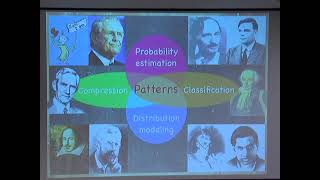
Values and Patterns in Data Learning - 2009
Explore discrete value analysis in data learning through distribution modeling, probability estimation, data compression, and classification. Discover insights from renowned mathematicians and information theorists.

Learning Energy-Based Models of High-Dimensional Data - 2002
Explore energy-based models for high-dimensional data analysis. Learn about deterministic networks, perceptual inference, and efficient learning techniques for large-scale models.
Probabilistic Programming in Python - Conf42 Python 2024
Explore Bayesian statistics, probabilistic modeling, and MCMC in Python. Learn key concepts and practical applications through demonstrations and workflow explanations.