Process of Model Building - Discrete-Time Population
Explore discrete-time population modeling with Vishwesha Guttal. Learn the process of building ecological models and gain insights into population dynamics.

What Darwin Won't Tell You About Evolution - With Jonathan Pettitt
Explores evolutionary complexity beyond natural selection, discussing genetic drift, non-coding DNA, and unique mechanisms in C. elegans, challenging traditional views on how organisms evolve.
Tracking Short-Term Evolution in a Pedigreed Wild Population
Explore short-term evolution in wild populations through pedigree analysis, examining genetic contributions, selection processes, and life-cycle stages to uncover evolutionary dynamics in nature.
Fitness Maps to a Large-Effect Locus in Introduced Stickleback
Explore the role of large-effect loci in stickleback adaptation, focusing on fitness mapping and evolutionary dynamics in introduced populations.
Ancient Genomic History of Dogs, Wolves and Humans
Explore the genomic history of dogs and wolves, uncovering ancient populations, gene flow patterns, and adaptive traits in modern breeds like Huskies.
Drift, Inbreeding, and Ne
Explore genetic drift, inbreeding, and effective population size through probability theory, distributions, and evolutionary concepts. Gain insights into population genetics and its applications in evolutionary biology.
GWAS in Structured Populations by Magnus Nordborg
Explore genome-wide association studies in structured populations, covering linkage mapping, population structure confounding, and fine mapping challenges. Insights on heritability and adaptation across species.
Introduction to the Coalescent Theory - Lecture 3
Explores coalescent theory in population genetics, covering selection models, detecting selection, local adaptation, and challenges in interpreting genetic data for evolutionary insights.
Sexual Selection in Females by Kavita Isvaran
Explores sexual selection in females, challenging traditional male-focused views. Examines evidence from various species, discussing competition, signaling, and aggression in female mating strategies.
Introduction to the Coalescent Theory - Lecture 2
Explore coalescent theory, population genetics, and evolutionary processes. Covers effective population size, migration, recombination, and linkage disequilibrium. Includes examples and simulations to illustrate key concepts.
Introduction to Coalescent Theory - Lecture 1
Explore coalescent theory in population genetics, covering Wright-Fisher models, mutation rates, and applications to human evolution. Gain insights into analyzing genetic data and detecting population changes.
Introduction to Quantitative Genetics - By Maria Orive
Explore quantitative genetics, including multifactorial models of genotype/phenotype relationships and key concepts from Hard & Clark 2007, in this comprehensive introduction to evolutionary biology principles.
Conservation Genomics by Nancy Chen
Explore genomic techniques for species conservation, including demographic modeling, heritability analysis, and genetic rescue strategies, to address biodiversity loss and extinction risks in the Anthropocene.
The Population-Genetic Environment - Lecture 1
Explore population genetics theory, covering genetic drift, mutation rates, and recombination. Gain insights into evolutionary processes and their impact on population dynamics across different organisms.
Introduction to Stochastic Modeling in Evolution - Lecture 1
Explore stochastic modeling in evolution, covering heritability, Mendel's experiments, neutral evolution, random genetic drift, and fixation probability through lectures and experiments.

Lambda-Coalescents Arising in a Population With Dormancy
Explore Lambda-coalescents in populations with dormancy, examining genealogy and multiple ancestral line mergers through a three-season model of spring awakening, summer reproduction, and winter dormancy.
Population Genetics and Evolution - I- The Mechanisms of Evolution
Explore population genetics and evolution mechanisms through key concepts like exponential growth, Galton-Watson processes, selection, and fitness measurement in long-term experiments with E. coli and RNA viruses.
Introduction to Gene Genealogies and Coalescent Processes by John Wakeley
Explore gene genealogies and coalescent processes in population genetics, covering inference of human population history from genome sequences and SNP-difference data analysis.
Understanding Tandem Running Recruitment in Indian Ants
Explores tandem running in Indian ants during colony relocation, examining recruitment strategies, decision-making flexibility, and movement dynamics to understand collective behavior in social insects.
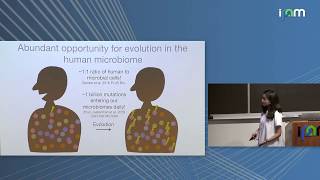
Population Genetics in the Human Microbiome
Explore microbiome evolution, ecological processes, and rapid adaptation in human-associated bacteria. Gain insights into population genetics and emerging research opportunities in this field.
Genomics, CRISPR, and the Future of Gene Sequencing
Explore genomics, CRISPR, and their impact on healthcare and society. Gain insights into genetic discoveries, market access, and future applications of gene sequencing technologies.