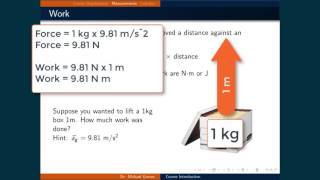
Physical Chemistry - Thermodynamics, Statics, and Kinetics
Comprehensive physical chemistry lectures covering thermodynamics, kinetics, and equilibrium. Explore gas laws, energy concepts, phase diagrams, reaction rates, and advanced topics in chemical systems.
Grade 11 Chemistry - Chemical Equilibrium
Explore chemical equilibrium concepts in-depth, focusing on reaction dynamics, reversibility, and factors affecting equilibrium states in chemical systems.
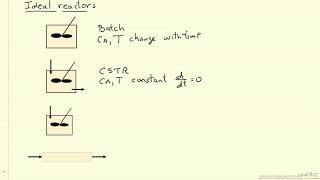
Kinetics Review for Graduate Reaction Engineering Course
Comprehensive review of kinetics and reactor design for graduate-level chemical engineering, covering various reactor types, reaction mechanisms, and design problems through screencasts.

Physical Chemistry
Comprehensive exploration of physical chemistry principles, covering thermodynamics, quantum mechanics, and chemical kinetics. Ideal for students seeking in-depth understanding of chemical systems and their behavior.
Some Basic Concepts of Chemistry Class 11 NEET
In this series, Anoop sir will discuss Matter and its Properties from the chapter Some Basic Concepts of Chemistry, NEET important questions from Some Basic Concepts of Chemistry, and tips and tricks to solve questions, and will help you revise the topic…
Chemistry for JEE
Comprehensive JEE Chemistry preparation covering key topics like chemical equilibrium, kinetics, and organic compounds, with a focus on problem-solving and exam strategies.
Simulating Chemical Kinetics with ReactionMechanismSimulator.jl - JuliaCon 2021
Explore chemical kinetics simulation using ReactionMechanismSimulator.jl. Learn about mechanism analysis, symbolic reduction, and efficient steady-state solution identification in Julia.
NanoHUB Jupyter Notebooks for Research and Education in Chemistry
Explore nanoHUB Jupyter Notebooks for creating chemistry teaching applications. Learn about tools for simulating proteins, analyzing lab data, and studying molecular spectroscopy. Discover how to develop and share scientific software effectively.
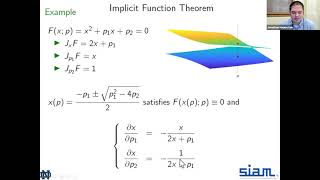
Applications of Homotopy Continuation in Science and Engineering
Explore homotopy continuation in numerical algebraic geometry and its applications in chemistry, mechanical engineering, and biological modeling. Learn about tracking solutions to parameterized nonlinear equations.
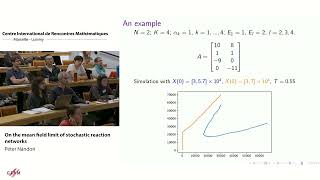
On the Mean Field Limit of Stochastic Reaction Networks
Explore mean field limits in stochastic reaction networks. Gain insights into probabilistic techniques for random and time-dependent dynamical systems from expert mathematician Péter Nándori.
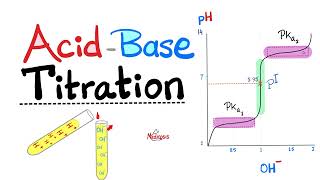
Titration of Acids and Bases - Understanding Strong and Weak Acids, Bases, and Isoelectric Points
Master fundamental acid-base titration concepts, from strong and weak acids/bases to equivalence points and isoelectric points. Explore pH calculations, dissociation constants, and practical applications in chemistry.
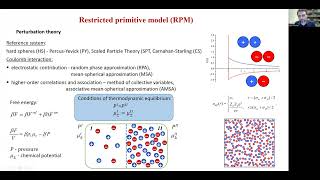
Phase Behavior of Ionic Liquids in Disordered Porous Media
Explore the complex dynamics of ionic liquids within disordered porous media, examining their phase behavior and fundamental physical properties through theoretical physics analysis.
Bosons and Multi-Component Fermions Near Unitarity - Ubirajara van Kolck
Explore bosons and multi-component fermions near unitarity, focusing on few-body physics challenges in atomic and nuclear systems, with insights on universality and organizing principles.
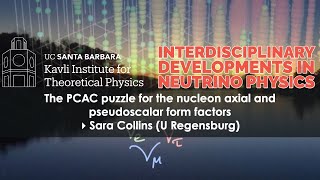
The PCAC Puzzle for the Nucleon Axial and Pseudoscalar Form Factors - Sara Collins
Explores the PCAC puzzle for nucleon axial and pseudoscalar form factors, discussing reliability, isospin limits, excited states, effective field theory, and limitations in lattice QCD calculations.
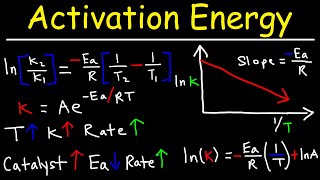
Collision Theory - Arrhenius Equation & Activation Energy - Chemical Kinetics
Explore collision theory, Arrhenius equation, and activation energy in chemical kinetics. Learn to calculate rate constants and understand energy diagrams for chemical reactions.
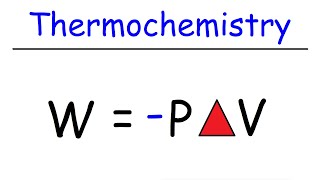
Thermochemistry Equations and Formulas With Practice Problems
Learn essential thermochemistry equations and formulas, and practice solving common problems to strengthen your understanding of this fundamental chemistry topic.
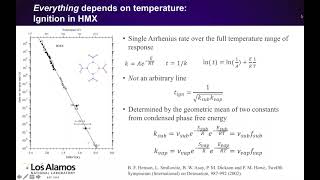
Classical Chemical Kinetics in Shock Physics
Explore chemical kinetics in shock physics, focusing on rate constants, order, and applications in initiation and detonation. Learn about globalized chemistry models for thermal ignition of secondary explosives.
Cargo Transport in Vivo - How Is Transport Regulated? by Steven P. Gross
Explores regulation of intracellular cargo transport, focusing on motor proteins kinesin and dynein. Discusses global and semi-global regulation, adaptation mechanisms, and implications for cellular processes like lipid transfer and nuclear migration.
Chemical Reaction Networks - Lecture 1
Explore stochastic chemical reaction networks, their examples, definitions, and the deficiency zero theorem in this comprehensive lecture on statistical physics of complex systems.
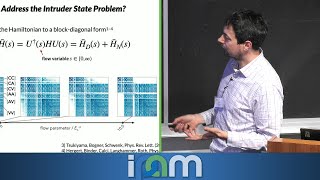
Many-Electron Effective Hamiltonians from Similarity Renormalization Group
Explore many-electron effective Hamiltonians using similarity renormalization group, focusing on bond-breaking reactions, spin states, and excited states of molecules with near-degenerate electronic structures.

Active Associative Memory by Suri Vaikuntanathan - University of Chicago - KITP Chalk Talk
Explore how non-equilibrium dynamics enhance memory and information processing in biological systems, from neuronal circuits to immune responses, challenging traditional equilibrium-based paradigms.