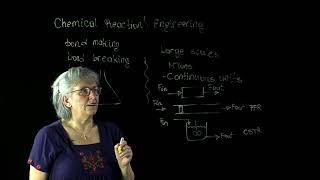
Advanced Chemical Reaction Engineering - Prof. Dr. Deniz Üner
Explore advanced concepts in chemical reaction engineering, including reactor design, energy balances, kinetics, and complex reactions for both ideal and non-ideal systems.
Stanford Chemical Engineering Online Master's Degree Program Webinar
Explore Stanford's online Chemical Engineering MS program: curriculum, career benefits, and enrollment details. Faculty discuss this part-time degree's unique features and answer questions.

Chemical Kinetics - Initial Rates Method
Learn to calculate reaction rates, identify rate law expressions, and determine rate constants in this comprehensive introduction to chemical kinetics, with practical examples and problem-solving techniques.
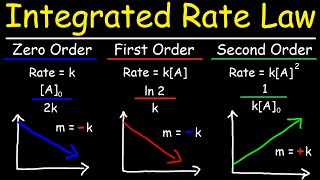
Integrated Rate Laws - Zero, First, and Second Order Reactions - Chemical Kinetics
Comprehensive introduction to chemical kinetics, covering integrated rate laws for zero, first, and second-order reactions. Includes problem-solving techniques for rate constants, concentrations, and half-life calculations.

Chemistry - Rate Processes
Explore reaction rates, complex reactions, and theories in chemistry. Learn about specific reactions, enzyme inhibition, oscillatory reactions, and advanced topics like ultrafast processes and reaction dynamics.
Thermodynamics & Kinetics
Comprehensive exploration of chemical thermodynamics and kinetics, covering laws, equilibrium, electrochemistry, and reaction dynamics. Ideal for deepening understanding of fundamental chemical principles.

Combustion
Comprehensive exploration of combustion principles, from chemical reactions and kinetics to flame dynamics, diffusion processes, and advanced topics like turbulent combustion and detonations.
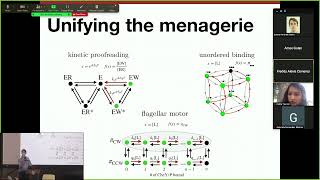
The Laws of Sensitivity for Small Nonequilibrium Systems
Explore laws constraining sensitivity in small, nonequilibrium systems. Uncover mechanisms behind biochemical switches, sensors, and molecular discrimination, with implications for gene regulation models.
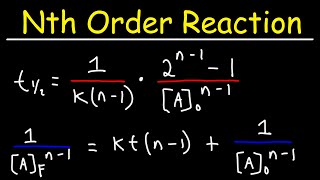
Integrated Rate Laws and Half Life Formula - Nth Order Reaction - Chemical Kinetics
Explore integrated rate laws and half-life formulas for nth order reactions in chemical kinetics, enhancing your understanding of reaction rates and mechanisms.
Chemistry
Explore advanced chemistry topics including quantum theory, computational methods, and nonlinear dynamics with expert lectures on cutting-edge research and applications.
Chemistry for JEE
Comprehensive JEE Chemistry preparation covering key topics like chemical equilibrium, kinetics, and organic compounds, with a focus on problem-solving and exam strategies.
Simulating Chemical Kinetics with ReactionMechanismSimulator.jl - JuliaCon 2021
Explore chemical kinetics simulation using ReactionMechanismSimulator.jl. Learn about mechanism analysis, symbolic reduction, and efficient steady-state solution identification in Julia.
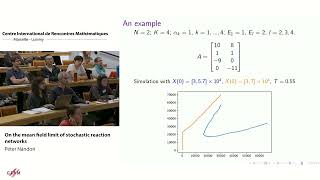
On the Mean Field Limit of Stochastic Reaction Networks
Explore mean field limits in stochastic reaction networks. Gain insights into probabilistic techniques for random and time-dependent dynamical systems from expert mathematician Péter Nándori.
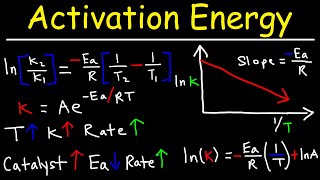
Collision Theory - Arrhenius Equation & Activation Energy - Chemical Kinetics
Explore collision theory, Arrhenius equation, and activation energy in chemical kinetics. Learn to calculate rate constants and understand energy diagrams for chemical reactions.
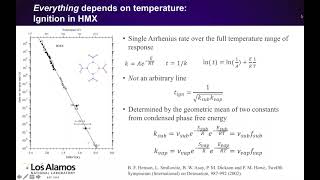
Classical Chemical Kinetics in Shock Physics
Explore chemical kinetics in shock physics, focusing on rate constants, order, and applications in initiation and detonation. Learn about globalized chemistry models for thermal ignition of secondary explosives.
Chemical Reaction Networks - Lecture 1
Explore stochastic chemical reaction networks, their examples, definitions, and the deficiency zero theorem in this comprehensive lecture on statistical physics of complex systems.
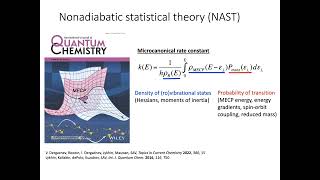
NAST: Nonadiabatic Statistical Theory Package for Predicting Kinetics of Spin-Dependent Processes
Explore nonadiabatic statistical theory for predicting spin-dependent process kinetics, comparing methods and examining real-world applications like ISC and surface reactions.
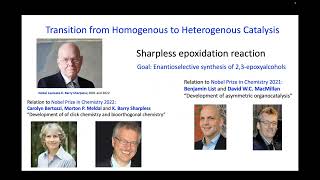
Exploring Potential Energy Surfaces with the Unified Reaction Valley Approach (URVA)
Explore potential energy surfaces using the unified reaction valley approach (URVA) for advanced chemical reaction analysis and understanding.
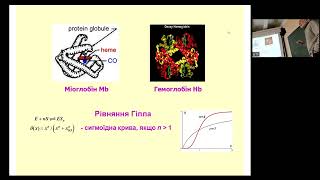
Кінетична кооперативність мономерних ферментів
Дослідіть кінетичну кооперативність мономерних ферментів через поглиблений аналіз їх властивостей та механізмів функціонування у біологічних системах.
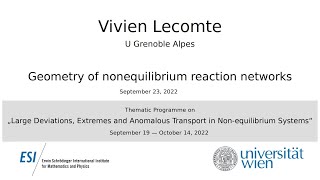
Geometry of Nonequilibrium Reaction Networks
Explore geometric interpretations of nonequilibrium reaction networks, extending Hill-Schnakenberg theory to hypergraphs and analyzing cycles, cocycles, and stochastic models.