Naturally Speaking - Planktic Foraminifera and Climate Change
Explore planktic foraminifera's evolution and global distribution over 23 million years, revealing insights into ancient climates and fossil dating reliability.

The Biggest Things in the Universe - A SciShow Compilation
Explore the universe's largest phenomena, from giant crystals to massive comets, in this captivating compilation of scientific wonders and natural marvels.
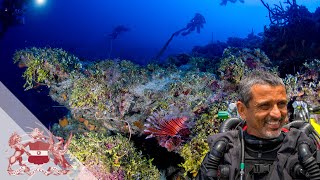
Exploring the Coral Reef's Twilight Zone
Dive into the unexplored depths of coral reefs with expert Luiz Rocha. Discover groundbreaking research, challenges, and spectacular findings in the twilight zone of these diverse ecosystems.
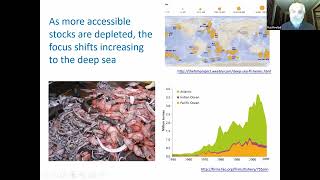
Evolution and Conservation in the Deep Sea
Explore deep sea biodiversity, evolutionary processes, and conservation challenges. Gain insights into unique adaptations and environmental drivers shaping life in this mysterious ecosystem.

Fish Athletes: Energy Use and Environmental Adaptation in Fish
Explore fish swimming efficiency, energy use, and environmental impacts with cutting-edge research techniques. Gain insights into climate change and food supply policy implications.
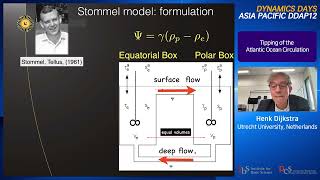
Tipping of the Atlantic Ocean Circulation
Explore the Atlantic Meridional Overturning Circulation's sensitivity to freshwater, its potential collapse, and climate impacts through ocean-climate model analyses.
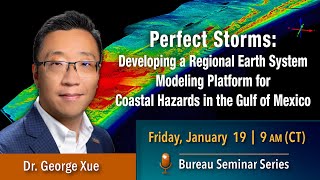
Perfect Storms: A Regional Earth System Modeling Platform for Coastal Hazards in the Gulf of Mexico
Explore a Regional Earth System Model for Gulf of Mexico coastal hazards, integrating atmospheric, oceanic, and river processes to analyze and manage climate-related disasters.
Wind-Forced Seasonal Exchange Between Marginal Seas and the Open Ocean
Explore wind-driven circulation in marginal seas and ocean exchange using numerical models. Analyze interior and shelf dynamics, coastal wave impacts, and deep water exchange through straits.
Mechanisms of Offshore Solid and Liquid Freshwater Flux from the East Greenland Current
Explore mechanisms controlling freshwater export from East Greenland Current using numerical models and scaling theory. Analyze offshore ice flux, liquid freshwater flux, and key parameters influencing these processes.
Dynamics Near a Shear Flow with Coriolis Force
Explore the impact of Coriolis force on large-scale fluid dynamics, focusing on shear flows under beta-plane approximation and their unique spectral properties.
Vortices over Bathymetry - Dynamics of Planetary-scale Fluid Flows
Explore long-lived anticyclones over topographic basins in oceans, examining their coexistence with cyclonic circulation and analyzing variational solutions in two-layer models.
Modeling Density-Driven Flows in the Presence of Chaotic Advection
Explore a hybrid kinematic-dynamic model for density-driven flows, combining traditional Stommel Box and chaotic advection approaches to study oceanic feedback processes.
Dipolar Geophysical Vortices: Coastal Eddies and Mesoscale Ocean Dipoles
Explore coastal eddy modeling and mesoscale dipoles in ocean dynamics. Analyze vortex-wave interactions, energy fluxes, and quasi-geostrophic equations for planetary-scale fluid flows.
Wind-Driven Transport at the Ocean Surface: Beyond the f-Plane
Explore wind-driven ocean transport beyond the f-plane, examining Ekman's theory extensions to β-plane and sphere, and analyzing water column trajectories using advanced mathematical techniques.
The Dynamics of Oceanic Vortices
Explore mesoscale vortices in Earth's oceans, their connections to regional currents and submesoscale structures, using observations and models. Compare with other planetary atmospheres.
Balance, Jets and Coherent Structures in Geophysical Fluid Dynamics - Lecture 4
Explore planetary-scale fluid dynamics, focusing on balance, jets, and coherent structures in geophysical systems.
Balance, Jets and Coherent Structures in Geophysical Fluid Dynamics - Lecture 3
Explore planetary-scale fluid dynamics, focusing on balance, jets, and coherent structures in geophysical systems.
NOAA's Carbon Dioxide Removal Research Strategy - Webinar
Explore NOAA's carbon dioxide removal strategy, including research needs, agency assets, and equity considerations in climate change mitigation efforts.
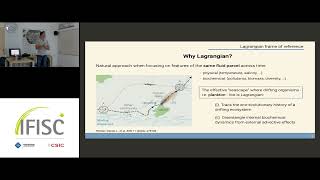
A Lagrangian View on the Seascape: Theory and Applications
Explore Lagrangian seascape theory and its applications in ecological modeling, climate change, and marine connectivity through advanced simulations and network analysis.
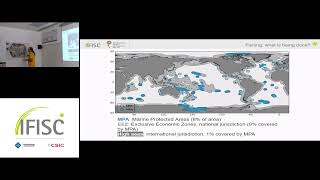
Analysis of Marine Fishing Using Vessel Trajectories: Global Structure and Suspicious Behavior
Explore marine fishing analysis through vessel trajectories, examining global structures and identifying suspicious behaviors in maritime activities.
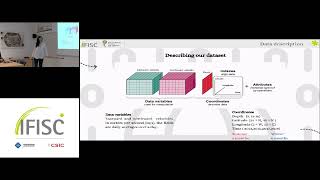
Lagrangian Studies in the Western Mediterranean Sea
Explore Lagrangian dynamics in the Western Mediterranean Sea, analyzing ocean currents and particle trajectories for enhanced understanding of marine ecosystems and climate patterns.