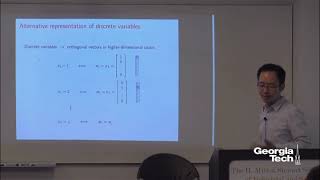
Projected Power Method: An Efficient Algorithm for Joint Discrete Assignment - Lecture 3
Explore an efficient algorithm for joint discrete assignment using projected power method. Learn about low-complexity procedures, optimization techniques, and statistical models for solving discrete assignment problems.
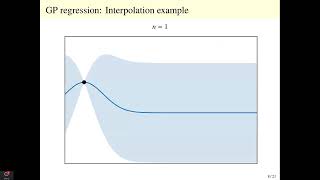
Probabilistic Richardson Extrapolation
Explore probabilistic Richardson extrapolation using Gaussian processes for accelerated convergence in numerical methods, with applications in cardiac modeling and statistical experimental design.
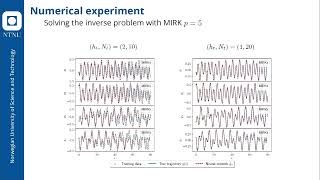
Learning Hamiltonian Systems with Mono-Implicit Runge-Kutta Methods
Explore advanced numerical methods for simulating Hamiltonian systems using Mono Implicit Runge-Kutta techniques, enhancing accuracy and efficiency in scientific computations.
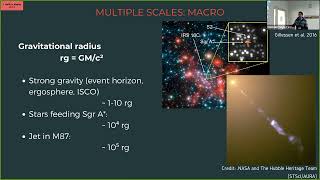
Simulating the Multi-Scale Environment of Supermassive Black Holes
Explore simulation techniques for modeling supermassive black holes, focusing on incorporating large-scale environmental data into event horizon simulations to enhance EHT observations.
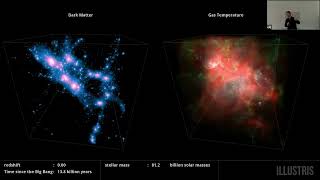
Exploring the Local Group with Constrained Simulations
Explore the Local Group using constrained simulations to study low-mass galaxies, including ultra-diffuse galaxies, and their implications for dark matter and galaxy evolution.

Hamiltonian Mechanics: Mass on a Cone with Gravity
Explore Hamiltonian mechanics through a mass-on-cone problem, using Python to model and analyze the motion in a gravitational field.
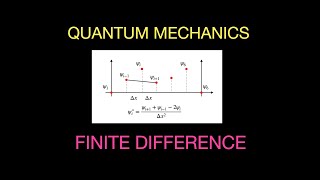
1D Infinite Square Well Solution Using Python and Finite Difference Method
Explore quantum mechanics using Python to solve the 1D infinite square well problem with finite difference method and visualize results through animations and graphs.
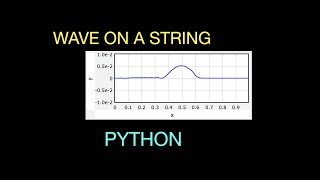
Modeling a Wave on a String - Finite Difference in Python
Model a wave on a string using finite difference calculations and Web VPython. Learn Python coding techniques for physics simulations and data visualization.
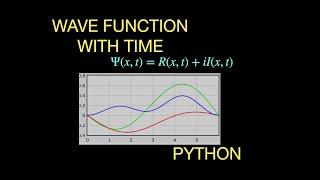
Solving the Time-Dependent Schrödinger Equation with Finite Difference Method in Python
Explore numerical solutions to the time-dependent Schrödinger equation using Python's finite difference method for 1D quantum systems.
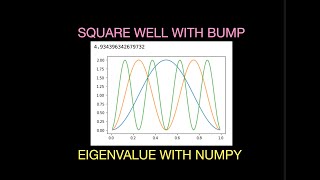
Solving the Square Well with a Bump Using Python and NumPy - Eigenvalue Problem
Solve the infinite square well with a bump potential using Python and NumPy. Learn finite difference method, matrix construction, and eigenvalue problem solving for quantum mechanics.
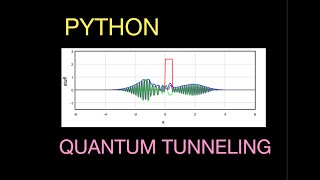
Quantum Tunneling: Modeling with NumPy and Python
Model quantum tunneling using Numpy and finite difference method. Learn theory, create potential, wave functions, and Hamiltonian matrices. Visualize results with Python animations.
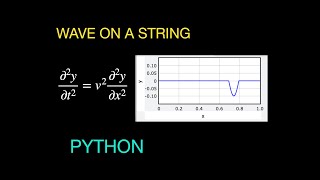
Modeling a Wave Pulse on a String with the Finite Difference Method and Python
Model wave pulses on strings using finite difference method and Python with Web VPython. Gain hands-on experience in computational physics and wave mechanics.
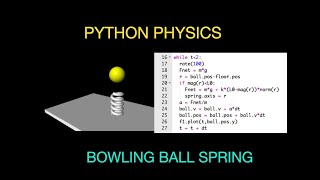
Python Physics: Modeling a Bowling Ball Landing on a Spring
Model a bowling ball's impact on a spring using Python, exploring energy conservation and force-based approaches to calculate compression.
Ocean Modeling: Stochastic Approaches to Numerical Simulations
Explore stochastic approaches in ocean modeling, including Monte-Carlo methods, perturbed initial conditions, and stochastic boundary conditions and dissipation operators for improved numerical simulations.

Recent Numerical Results on D0-Brane Matrix Model
Explore latest numerical simulations of D0-brane matrix model, confirming duality with type IIA superstring theory and uncovering new insights into M-theory and black holes.
Recent Progress in Numerical Studies of the Lorentzian IKKT Model
Explore recent numerical studies of the Lorentzian IKKT matrix model, including the Complex Langevin Method and the effects of adding a Lorentz invariant mass term.
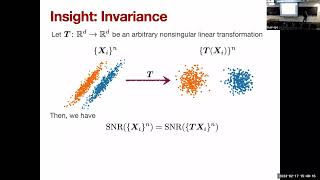
Clustering a Mixture of Gaussians with Unknown Covariance - Lecture
Explore clustering with Gaussian mixtures, focusing on maximum likelihood estimation, Max-Cut solutions, and efficient algorithms. Investigate statistical-computational gaps and challenges in high-dimensional settings.
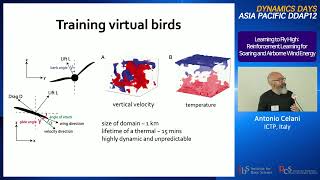
Learning to Fly High: Reinforcement Learning for Soaring and Airborne Wind Energy
Explore reinforcement learning for soaring and airborne wind energy, focusing on optimal control strategies in turbulent atmospheric conditions.

Kirk Lecture: A Recent Technology for Scientific Computing - The Virtual Element Method
Explore the Virtual Element Method, a generalization of FEM for solving PDEs using polygonal/polyhedral meshes, offering improved accuracy, efficiency, and flexibility in scientific computing.
Swarm-Based Gradient Descent Method for Non-Convex Optimization
Explore innovative swarm-based gradient descent techniques for solving non-convex optimization problems, presented by Prof. Eitan Tadmor from the University of Maryland.
Time Integration of Tree Tensor Networks
Explore numerical methods for time-dependent quantum dynamics using tree tensor networks, focusing on efficient algorithms and error analysis for high-dimensional problems.