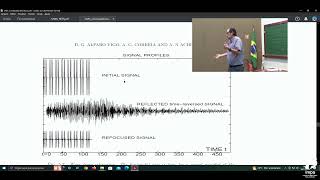
Numerical Methods for PDEs - Class 22
Aprofunde-se em métodos numéricos avançados para equações diferenciais parciais, explorando técnicas e aplicações em nível de doutorado.
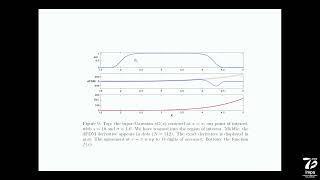
Numerical Methods for PDEs - Class 21
Explore advanced numerical methods for solving partial differential equations in this doctoral-level lecture, focusing on cutting-edge techniques and applications in mathematical modeling.
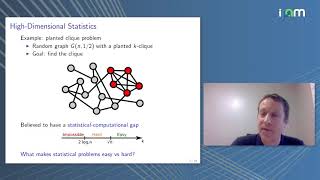
The Kikuchi Hierarchy and Tensor PCA
Explores advanced algorithms for tensor PCA, introducing a new hierarchy inspired by Kikuchi free energy to improve belief propagation performance and match sum-of-squares methods.
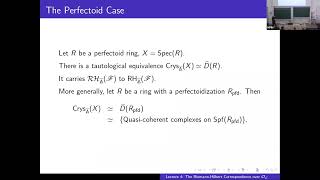
Jacob Lurie: A Riemann-Hilbert Correspondence in P-adic Geometry
Explore p-adic geometry and the Riemann-Hilbert correspondence, covering perfectoid spaces, crystals, and spectral methods in this advanced mathematics lecture.

Graph Alignment: Informational and Computational Limits - Lecture 2
Explore graph alignment challenges, focusing on informational and computational limits. Gain insights into probabilistic and optimization methods for data science applications.
Introduction to Theory and Numerics of Partial Differential Equations - Lecture 5
Explore numerical methods for solving partial differential equations, focusing on techniques essential for gravitational wave astronomy and computational relativity.
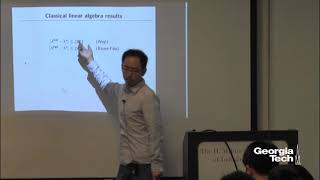
Spectral Methods Meets Asymmetry: Two Recent Stories - Lecture 4
Explore spectral methods for asymmetric data matrices, covering top-K ranking and matrix de-noising. Learn advantages over traditional approaches in data analysis and estimation.
Modern Numerical Methods in Computational Relativity - Lecture 5
Explore advanced numerical techniques in computational relativity, focusing on simulating black hole mergers and other high-energy astrophysical phenomena for gravitational-wave astronomy.
Modern Numerical Methods in Computational Relativity - Lecture 2
Explore advanced numerical techniques for solving Einstein's equations in computational relativity, focusing on applications in gravitational-wave astronomy and astrophysical simulations.
Modern Numerical Methods in Computational Relativity - Lecture 3
Explore advanced numerical techniques for solving Einstein's equations in computational relativity, focusing on modeling gravitational waves from merging black holes and neutron stars.
Modern Numerical Methods in Computational Relativity - Lecture 4
Explore advanced numerical techniques in computational relativity, focusing on solving Einstein's field equations for gravitational-wave astronomy and astrophysical phenomena modeling.
A Spectral Framework for Constraining Anisotropic Eddy Viscosity - Lecture 2
Explores a spectral framework for constraining anisotropic eddy viscosity in geophysical fluid dynamics, focusing on advanced modeling techniques and their applications in understanding complex oceanic and atmospheric processes.
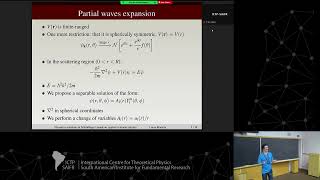
Numerical Solutions of Schrödinger's Equation Applied to Atomic Physics - Class 3
Explore numerical solutions of Schrödinger's equation in atomic physics, focusing on advanced techniques and applications in the field.
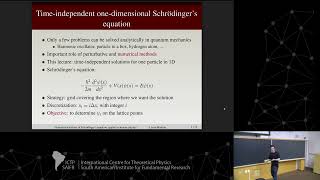
Numerical Solutions of Schrödinger's Equation Applied to Atomic Physics - Class 1
Explore numerical solutions of Schrödinger's equation in atomic physics, focusing on fundamental concepts and computational techniques.
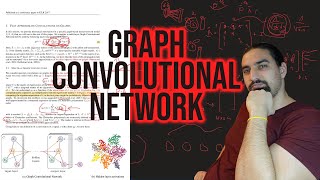
Graph Convolutional Networks - GNN Paper Explained
Comprehensive exploration of Graph Convolutional Networks, covering theory, implementation, and applications. Delves into spectral methods, Weisfeiler-Lehman perspective, and GNN depth, offering insights for both beginners and experts.

Understanding, Interpreting and Designing Neural Network Models Through Tensor Representations
Explore tensor representations for neural networks, enhancing interpretability, expressive power, generalization, and robustness in deep learning models through spectral methods and innovative architecture design.
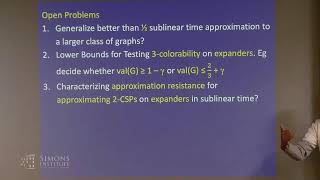
Sublinear Time Algorithms for Max-Cut Approximation on Expander Graphs
Explore random walks on graphs to achieve better-than-1/2 approximation for max-cut on expanding and clusterable graphs, using sublinear time algorithms.
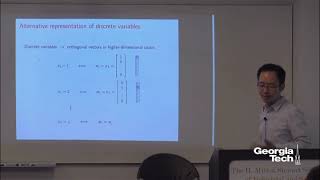
Projected Power Method: An Efficient Algorithm for Joint Discrete Assignment - Lecture 3
Explore an efficient algorithm for joint discrete assignment using projected power method. Learn about low-complexity procedures, optimization techniques, and statistical models for solving discrete assignment problems.
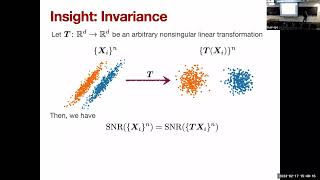
Clustering a Mixture of Gaussians with Unknown Covariance - Lecture
Explore clustering with Gaussian mixtures, focusing on maximum likelihood estimation, Max-Cut solutions, and efficient algorithms. Investigate statistical-computational gaps and challenges in high-dimensional settings.
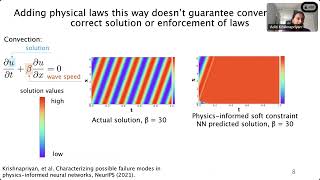
Bridging Numerical Methods and Deep Learning with Physics-Constrained Differentiable Solvers
Explore machine learning strategies for neural PDE solvers, focusing on self-supervised learning and simulation-in-the-loop approaches to enhance spatiotemporal modeling across various systems.